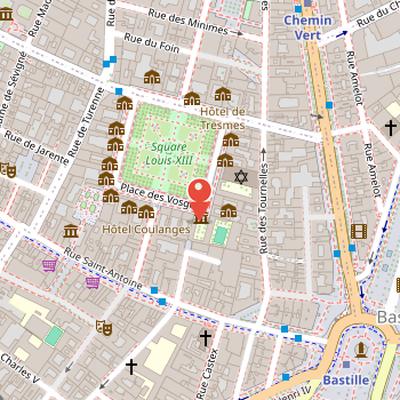
Maison de Victor Hugo is a monographic Paris museum located at 6, place des Vosges. It preserves the former hôtel de Rohan-Guémené, where Victor Hugo rented an apartment on the second floor from 1832 to 1848. During these sixteen years, he experienced his social, political, and family life there, received writers including Lamartine, Alfred de Vigny, Alexandre Dumas, Honoré de Balzac, Prosper Mérimée, and Sainte-Beuve, and witnessed events such as his daughter Léopoldine’s marriage and the Villequier tragedy of 1843. In the study, he wrote works including Lucrèce Borgia, Les Burgraves, Ruy Blas, Marie Tudor, several major poetry collections, much of Les Misérables, and the beginning of La Légende des siècles. The apartment later underwent alterations, and the museum’s collections were assembled from donations, including drawings, photographs, manuscripts, editions, furniture elements, and souvenirs. It is one of the 14 museums of the City of Paris managed by Paris Musées.
Nearby Objects
-
 Place des Vosges 100 m away
 -
 Temple du Marais 160 m away
 -
 Bastille 250 m away
 -
 Place de la Bastille 300 m away
 -
 Le Génie de la Bastille 300 m away
Victor Hugo's Former Paris Apartment
The Maison de Victor Hugo is a monographic Parisian museum located at 6, place des Vosges. It preserves the former hotel de Rohan-Gueguene, where Victor Hugo rented an apartment on the second floor. Hugo lived in this apartment for sixteen years, from 1832 to 1848. The museum is one of the 14 museums of the City of Paris and is managed by the public administrative establishment Paris Musees.
Victor Hugo at the Hotel de Rohan-Guemenee
In 1832, Victor Hugo left rue Jean-Goujon for an apartment on the second floor of the Hotel de Rohan-Guemenee. He rented it from Madame Pean de Saint-Gilles through her son-in-law, notary Bellanger, and lived there for sixteen years of social, political, and family life. The apartment became a major setting in his life and work. Hugo received Lamartine, Alfred de Vigny, Alexandre Dumas, Honoré de Balzac, Prosper Merimee, and Sainte-Beuve there. He also witnessed the marriage of his daughter Leopoldine and the Villequier tragedy of 1843 from this apartment.
The study in the apartment was the site of major literary work. There Hugo wrote Lucrece Borgia, Les Burgraves, Ruy Blas, Marie Tudor, Les Chants du crepuscule, Les Voix interieures, Les Rayons et les Ombres, most of Les Miserables, the beginning of La Legende des siecles, and Contemplations. During the same period, he was elected to the Academie francaise, named Pair de France, and elected deputy of Paris.
After 1848, the apartment underwent transformations that removed the corridors and balcony while preserving the original area. In 1852, the auction sale of Hugo's family's property dispersed belongings, which prevented a faithful reconstruction of the furniture. The hotel later housed the Institution Jauffret from 1860 for a few years. In 1873, the heirs of Antoine Francois Passy ceded the central part of the hotel to the City of Paris. The museum and its collections were assembled around Paul Meurice's donation to the City of Paris in 1902, the centenary of Hugo's birth. The collection includes drawings by Victor Hugo, photographs, manuscripts, editions, furniture elements, and many souvenirs.
The Apartment and Exhibition Spaces
Maison de Victor Hugo allows visitors to discover the apartment occupied by the Hugo family on the second floor, while the first floor contains several exhibition rooms used for temporary displays. The apartment is arranged as a sequence of seven rooms that presents the writer's life in chronological order, covering the periods before exile, during exile, and after exile.
The route begins in the antechamber, which presents Victor Hugo's youth and the early years of his marriage to Adele Foucher. The red salon refers to his stay at Place Royale through paintings, documents, and a bust by David d'Angers, and it also recalls the presence of many Romantic artists, including Theophile Gaultier and Sainte-Beuve. The Chinese salon and the next two rooms focus on the exile from 1852 to 1870, including the stay at Hauteville House in Guernsey. This part of the display uses photographs taken by Charles Hugo and Auguste Vacquerie during exile at Jersey from 1852 to 1855, and the Chinese salon includes furniture originally from Juliette Drouet's house in Guernsey, with details such as the initials V.H and J.D on the tapestries.
The penultimate room, named Cabinet de travail, depicts the family's return to the capital in 1870 and shows the writer's final years in the Avenue d'Eylau apartment from 1878, with original furniture and a famous portrait by Leon Bonnat. The last room reconstructs the mortuary chamber from 1885 on Avenue d'Eylau. In addition, the museum exhibits six hundred drawings in rotation from a total of three thousand made by the writer, with architectural and maritime subjects, and its print room and library preserve eleven thousand works about Victor Hugo's life and work.
Access and Visitor Information
The Maison de Victor Hugo museum is open except on Mondays and public holidays. In keeping with most City of Paris museums, it grants free access to its permanent collections. The print room and library are available to researchers by appointment, allowing access to documentation and research resources under arranged conditions.