Temple du Marais is a Protestant church building located at 17 rue Saint-Antoine in the Marais district of Paris. It is a parish member of the Église protestante unie de France. The building was formerly a Catholic church, closed during the Revolution, and assigned to Reformed worship in 1802. It is also known by the historical name temple Sainte-Marie.
According to the building’s history, Sainte-Marie Church was founded in 1619 by François de Sales and Jeanne-Françoise Frémyot. The church and convent were later expanded and rebuilt in the 17th century, including a convent constructed from 1632 to 1634 by master mason Michel Villedo, based on plans by François Mansart, under the name Sainte-Marie-des-Anges. Under the Ancien Régime, the site served as the mother house of the Order of the Visitation in Paris. The building received damage to its facade statues during the Commune de Paris in 1870, and these were replaced afterwards. The temple was classified as a historical monument under the name temple Sainte-Marie.
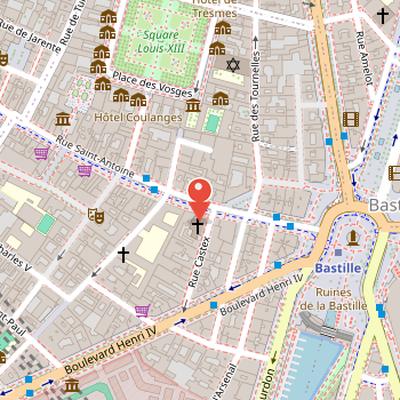
Nearby Objects
-
 Maison de Victor Hugo 160 m away
 -
 Place de la Bastille 200 m away
 -
 Bastille 200 m away
 -
 Le Génie de la Bastille 200 m away
 -
 Elephant of the Bastille 200 m away
From Catholic Church to Protestant Temple
The Temple du Marais is located at 17 rue Saint-Antoine in the Marais district of Paris. It was originally a Catholic church, but it was closed during the Revolution. In 1802, it was assigned to Reformed worship, and it is now a parish member of the Eglise protestante unie de France. Its history reflects a change in religious use rather than a change in location, making it a significant example of adaptation within the citys heritage.
From Visitation Convent to Protestant Temple
The history of the Temple du Marais begins with the Catholic Church Sainte-Marie, founded in 1619 by Francois de Sales and Jeanne-Francoise Fremyot. Francois de Sales was bishop of Geneva, with his seat exiled to Annecy since the Protestant Reformation. The church was located in the Petit-Bourbon hotel, at the corner of rue du Petit-Musc and rue de la Cerisaie. In 1628, its land was enlarged through the purchase of the Cosse hotel at 17 rue Saint-Antoine and an adjacent house.
A convent was built from 1632 to 1634 by master mason Michel Villedo, following plans by Francois Mansart, under the name Sainte-Marie-des-Anges. Noel Brulart de Sillery was a major patron of the convent. Under the Ancien Regime, the church and convent served as the mother house of the Order of the Visitation in Paris, alongside three other establishments in the city: Saint-Jacques convent, rue du Bac convent, and the Visitandines convent of Chaillot.
The site also held family burials. The family of superintendent of finances Nicolas Fouquet had a vault there, and Fouquet's body was transferred to the family vault in Paris one year after his death in 1680. The vault is now sealed and bears no commemorative inscription. Henri de Sevigne was also buried in the church. Other names cited in the history include Marie de Beze, who died in 1634, and de Coulanges, who died in 1636.
The convent grounds included a garden, extended eastward in the 1740s by acquiring part of the Lesdiguieres hotel garden. Under Consul Bonaparte, Sainte-Marie Church was assigned to the Reformed Consistory of Seine and became a Protestant temple, with Protestant worship beginning there on an unspecified date. Its first pastors were Paul-Henri Marron, Jean-Frederic Mestrezat, and Jacques Antoine Rabaut-Pommier. The facade statues were damaged during the Commune de Paris in 1870 and replaced afterwards. The building was later classified as a historical monument under the name temple Sainte-Marie.
Reformed Church Politics and Unification
Temple du Marais is linked to the internal divisions of the Reformed churches in France during the late 19th and early 20th centuries. In 1881, the Consistoire reforme was divided into autonomous parishes, and in 1882 the orthodox protests, described as orthodox by liberals, won all parish elections in Paris except at Oratoire du Louvre. The liberal central committee then recruited pastor Charles Wagner to prepare for elections at Sainte-Marie; Wagner later founded a new community that built the Temple protestant du Foyer de l Ame in 1907. From 1902, pastor Elisee Lacheret served as president of the permanent commission of the Union of Reformed Evangelical Churches of France. He refused compromise with liberal Protestants during efforts to unite the Reformed Churches of France around the 1905 law separating Church and State. Full unification was achieved only in 1938, after Lacheret's death.
History and Later Role of the Temple du Marais
The parish that became associated with the Temple du Marais began as the Temple de Bercy annex in the 12th arrondissement of Paris, founded in 1902. The church was first located at 5 rue Taine before moving to 13 rue de la Lancette. The street name was linked to small lances used in conflicts between Protestants and Catholics under the Ancien Regime. In 1953, the parish became autonomous. The Temple de Bercy was later destroyed.
The Temple du Marais has also had a public role in recent Protestant debates. After the synod of the Eglise protestante unie de France allowed pastors to bless homosexual couples, the paroisse du Marais opposed the decision during preparatory debates and later rejected it in a press statement by pastor Gilles Boucomont. A declaration was then published after a meeting at the Temple du Marais and signed by pastors and successors. These events contributed to the creation of the association Les Attestants. The Temple du Marais continues to host meetings, including the Forum des Attestants 2025.
Architecture and Interior Arrangement
Temple du Marais, also identified with Sainte-Marie church, is architecturally inspired by the Pantheon of Rome and differs clearly from the rectangular model typical of Visitation convent plans. Mansart created a rotunda 22 meters in diameter, arranged according to a centered plan with four chapels attached to it. The building is oriented north-south, with the entrance to the north and the communion table to the south, replacing geographical orientation with a symbolic direction toward the main altar and tabernacle. It is also aligned with the street in response to the urban topography.
The interior includes four chapels or niches on the east, west, south, and north sides. The east and west niches formerly held altars with retables, and visible remnants remain. Under the east niche is the vault of Nicolas Fouquet's family. The entrance niche contains a tribune organ acquired in 1806. Above the central space rises a remarkable circular dome surmounted by a lantern, while the choir has an ellipsoidal dome decorated with frescoes and sculpted motifs.
At the center stands a marble table, a gift from Louis XIII to the convent. This table did not replace the former richly decorated main altar, which was covered with silver and attached to the back wall. The marble table currently presents an open French Protestant lectern Bible printed in Amsterdam by the Elzevier brothers. The church also contains a modest tribune organ, some furniture, and several artworks.