Église Saint-Paul-Saint-Louis is a church on rue Saint-Antoine in the Marais quarter of Paris. Constructed between 1627 and 1641 by the Jesuit architects Étienne and François Derand on the orders of Louis XIII, it was the first church in Paris to adopt the Jesuit Baroque style rather than the Gothic style. Its plan was inspired by the Chiesa del Gesù in Rome, and its design had an important influence on Parisian religious architecture.
The site had earlier been occupied by Saint-Paul-des-Champs, a church dedicated around 1125 when the neighbourhood first became a parish. The dedication to Saint Paul was carried over to the new church, but transferred to Paul of Tarsus. The first stone of the new building was laid by Louis XIII in 1627, and the first mass was celebrated on 9 May 1641 by Cardinal Richelieu. The church also gives its name to Place Saint-Paul and to the nearby Saint-Paul Metro station.
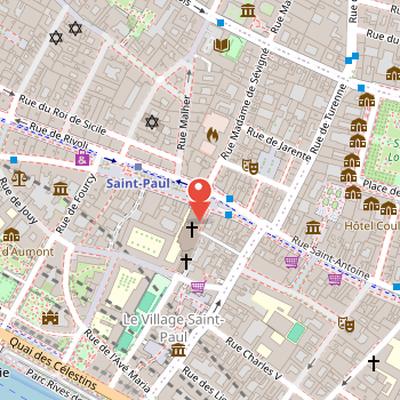
Nearby Objects
-
 La Force Prison 130 m away
 -
 Maison européenne de la photographie 200 m away
 -
 Hôtel Saint-Pol 200 m away
 -
 Place des Vosges 300 m away
 -
 Musée Carnavalet 300 m away
Architecture and urban influence
The church Saint-Paul-Saint-Louis is located on rue Saint-Antoine in the Marais quarter of Paris. It was constructed from 1627 to 1641 by Jesuit architects Etienne and Francois Derand on the orders of Louis XIII. The church was the first in Paris to use the Jesuit Baroque style instead of the Gothic style, and it had an important influence on Parisian religious architecture. Its presence also shaped the surrounding area, giving its name to Place Saint-Paul and to the nearest Metro station, Saint-Paul.
Historical Background of the Site
The first church on the site, Saint-Paul-des-Champs, was dedicated around 1125, when the neighbourhood first became a parish. It was originally dedicated to Paul the Hermit, a Christian monk in Egypt in the 3rd and 4th centuries. The old church also had notable links to Parisian life: Madame de Sevigne was baptised there in 1626 in the first chapel of Saint-Louis, and the chemist Antoine Lavoisier remained an important patron until 1794, during the French Revolution. Behind the church was a cemetery connected to the monastery of Saint-Eloi, founded by monks of Saint Eloi of Noyon and Dagobert I. This cemetery contained the remains of Francois Rabelais and the architect Francois Mansart. The monastic cemetery later disappeared, and the old church was demolished in 1799. The dedication to Saint Paul was then carried over to the new church, but transferred to Paul of Tarsus.
Construction and Early History
The first stone of the new church was laid by Louis XIII in 1627. Its original name was Eglise Saint-Louis de la maison professe des Jesuites, and the name of Louis IX was later added to it. The architect was the Jesuit priest Etienne Martellange, who drew the initial plans, while Francois Derand designed the facade. The church plan was inspired by the Chiesa del Gesu in Rome. It was also the first church in Paris to break away from Gothic style by adopting Baroque style. The first mass in the new building was celebrated on 9 May 1641 by Cardinal Richelieu, with oremuses pronounced by Bossuet.
Jesuit Worship, Music, and Memorials
Saint-Paul-Saint-Louis became closely associated with Jesuit religious life and public preaching. Between 1669 and 1693, the Jesuit preacher Louis Bourdaloue delivered Lenten and Advent sermons there, and in 1687 he also preached the funeral sermon for the Grand Conde in the church. Esprit Flechier also preached at the church. Bourdaloue is buried in its crypt, reinforcing this connection with Jesuit devotion and commemoration. The church also gained fame for its music, directed by Marc-Antoine Charpentier and Jean-Philippe Rameau. Charpentier, who was employed by the Jesuits, served as master of music there from 1688 to 1698, and other masters of music included Andre Campra and Louis Marchand. The churchs role within Jesuit culture was further marked by the fact that Jesuit priests became confessors or directors of conscience of the Kings of France. In the same environment, Jean-Jacques Olier was baptised in the church on 20 September 1608. After the Jesuits were expelled from France in 1762 by the Parlement of Paris following a dispute with the King, the church was transferred to the Congregation of France, or Genovefains. Its later history included the housing of urns containing the hearts of Louis XIII and Louis XIV, which were hidden during the French Revolution and transferred afterwards to the Abbey of Saint Denis. The church also displays Jacques de Letin's The Death of Saint Louis and Germain Pilon's La vierge del Douleur from 1586, while a nearly erased inscription reading Republique francaise ou la mort remains on a pillar on the right side of the nave.
Exterior Design and Architectural Influence
The exterior facade of Saint-Paul-Saint-Louis of Paris reflects several architectural influences, including the new Italian Baroque style, the Church of the Gesu in Rome, and the 1618 facade of the eglise Saint-Gervais-Saint-Protais de Paris by Salomon de Brosse. It is organized into three bays, with two levels on the side bays and three levels on the central bay. The design includes a projection and doubled columns, using Corinthian columns on the two lower levels and composite order columns above. The facade also shows influence from Flemish Baroque style through its abundant sculpture and ornament.
The churchs dome and bell tower rise to fifty-five meters, although they are largely hidden from street view by the high facade. The dome itself is 55 meters high and was one of the first domes constructed in Paris. It later served as a model for the domes of Les Invalides and Val-de-Grace.
Interior Design and Historical Associations
The interior of Saint-Paul-Saint-Louis was largely inspired by the Church of the Gesu in Rome, while also including some French additions. Its decoration was decreed by the Council of Trent between 1545 and 1563 and was meant to stand in contrast to the austere churches of the Protestants. In line with Jesuit doctrines, the interior includes numerous symbols and sculptures of the Virgin Mary. The plan is a compromise between the Gesu's single nave with side chapels and the French cruciform plan with long transepts. Tall windows in the transepts and a short eastern apse admit a large amount of light, and the dome under the crossing recalls Italian architecture of an earlier period, such as that of Carlo Maderno. The white marble high altar was moved and rebuilt under Louis Philippe I with fragments from Napoleon's tomb at Les Invalides. The church also has historical ties to the Hugo family: Leopoldine Hugo secretly married Charles Vacquerie there on 14 February 1843, and Victor Hugo donated two clam-shell holy water vessels for the baptism of his first child, as well as a seashell benetier that is still visible in the church.
Sculpture and Stained Glass
The church is notable for the extensive use of sculpture and stained glass in its decoration. White stained glass was used to maximize the light entering the windows, and many stained glass windows included the coat of arms of the family that donated them. Sculpture was applied on nearly all surfaces inside the church, including the vaults of the nave, the pendentives of the dome, a ceiling vault, and areas below the dome. The interior decoration also includes a sculpted column capital and lavish sculptural ornament on the dome and other interior architecture. Among the works recorded are The Virgin of Sorrow by Germain Pilon in 1588, Religion instructing an Indian by Nicolas-Sebastien Adam in 1745, and the bas-relief Saint Paul Preaching in Athens by Louis-Alexandre Romagnesi (1776-1852). The church also features the sculptures Saint Genevieve on the north facade and Saint Paul on the north facade, as well as Saint Vincent de Paul.
Paintings in the Transept
The church includes a series of three paintings depicting scenes from the life of Louis IX, or Saint Louis. Among these works is Saint Louis receives the Crown of Thorns from the hands of Christ by Simon Vouet, dated 1639. Another is The Death of Saint Louis by Jacques de Letin, which shows the king stricken with plague and receiving holy sacraments before death. Christ in the Garden of Olives by Eugene Delacroix, painted in 1827 and on loan to the Metropolitan Museum, is displayed in the left transept.
The Church Organs
The church's organ history reflects several stages of loss, rebuilding, and restoration. The existing gallery organ was dismantled and lost during the Revolution, when the church was secularized. In 1805, Pierre Dallery installed a new three-manual, 30-stop organ using components from two other instruments. This instrument was later modified and completely restored by Narcisse Martin of Rouen between 1867 and 1871, at a cost of 37,000 francs, and the restoration was approved by Cesar Franck. The organ case has been designated as an historical monument. In 1972, the instrument was tonally restructured and electrified by the firm of Gonzalez along neo-classical lines. Its tonal changes were then reverted in 1999 and 2005, restoring Narcisse Martin's concept, including a Romantic-styled Recit manual. The organ also acquired an electronic combination system. The current gallery organ has three manuals with a compass of 56 notes, a 30-note pedal board, 40 stops, and 46 ranks. A second, chancel organ was built in the nineteenth century by Krischer as a mechanical action instrument with two manuals and pedal, 13 stops, 16 ranks, 56-note manuals, and a 30-note pedal.