Musée Carnavalet is a history museum in Paris dedicated to the city’s past. It occupies two neighboring mansions: the Hôtel Carnavalet and the former Hôtel Le Peletier de Saint Fargeau. The Hôtel Carnavalet, a 16th-century historic monument, was purchased by the Municipal Council of Paris in 1866 on the advice of Baron Haussmann and opened to the public in 1880. The museum later expanded with the annexation of the Hôtel Le Peletier de Saint Fargeau, which opened to the public in 1989. The museum’s collection includes furnished rooms from different periods of Paris history, historic objects, and a large collection of paintings showing Paris life. Its works depict the city’s history, development, and notable characters. Musée Carnavalet is one of the fourteen City of Paris museums within Paris Musées and reopened in 2021 after major renovation works.
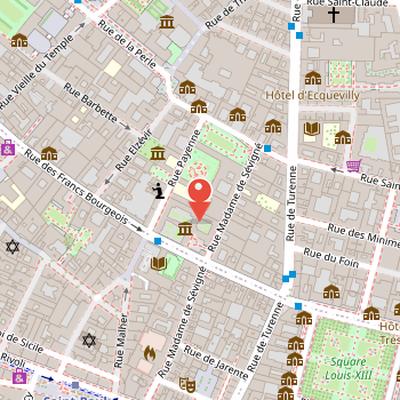
Nearby Objects
-
 Musée Cognacq-Jay 140 m away
 -
 La Force Prison 200 m away
 -
 Picasso Museum 250 m away
 -
 Place des Vosges 300 m away
 -
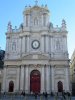 Église Saint-Paul-Saint-Louis 300 m away
Expansion and Collection of the Musee Carnavalet
Musee Carnavalet in Paris is dedicated to the history of the city and occupies two neighboring mansions: the Hotel Carnavalet and the former Hotel Le Peletier de Saint Fargeau. The Hotel Carnavalet, a 16th-century historic monument, was purchased by the Municipal Council of Paris in 1866 on the advice of Baron Haussmann and opened to the public in 1880. By the latter part of the 20th century, the museum was full to capacity, which led to the annexation of the Hotel Le Peletier de Saint Fargeau, opened to the public in 1989.
The museum contains furnished rooms from different periods of Paris history, historic objects, and a large collection of paintings of Paris life. Its works include artists such as Joos Van Cleve, Frans Pourbus the Younger, Jacques-Louis David, Hippolyte Lecomte, François Gerard, Louis-Leopold Boilly, Etienne Aubry, Tsuguharu Foujita, Louis Béroud, Jean Beraud, Carolus Duran, Jean-Louis Forain, Pierre Puvis de Chavannes, Johan Barthold Jongkind, Henri Gervex, Alfred Stevens, Paul Signac, and Simon-Auguste. These works depict Paris's history, development, and notable characters.
Musee Carnavalet is one of the fourteen City of Paris museums incorporated in the public institution Paris Musées since January 1, 2013. It was closed to the public in October 2016 for major renovation works and reopened in 2021 with new rooms, galleries, and an expanded collection.
From Private Townhouse to Paris History Museum
Musee Carnavalet stands on land purchased in 1544 by Jacques de Ligneris in Paris. He commissioned the architects Pierre Lescot and Jean Goujon to build a townhouse, but they were taken away from the project in 1548 to work on the Louvre Palace. The building was completed around 1560 by Jean Bullant, whose other notable works included portions of the Tuileries Palace, the Louvre, Chateau d'Ecouen, and the gallery of Chateau de Chenonceau.
In 1572, the property was purchased by Madame de Kernevenoy, the widow of a member of Henry II of France's Court and preceptor of the Duke of Anjou. Parisians altered her name to Carnavalet, giving the house its later identity. The collection was rebuilt gradually, and in 1880 the site formally became the museum of the history of Paris. The museum expanded in 1989 through the purchase and annexation of the Hotel Le Peletier de Saint Fargeau, originally known as Hotel d'Orgeval. It had been purchased by Michel Le Peletier and later passed to his grandson, Le Peletier de Saint Fargeau, who represented the nobility in the Estates-General of 1789, voted for the execution of Louis XVI in 1793, and was murdered on January 20, 1793. The opening of the annex in 1989 commemorated the bicentennial of the French Revolution.
By 2021, the museum had forty decorated rooms and galleries and displayed 3800 objects from a total collection of 625,000 objects. It was closed in 2017 for major renovation and reopened in 2021.
Historic Exterior and Courtyards
The exterior of Musee Carnavalet preserves several historic elements that reflect the layered history of the building. Among them is the original Renaissance portal on Rue de Sevigne, retained in the later structure from the 16th century, along with detail from the portal sculpture. The exterior also includes the Courtyard of Louis XIV and the Courtyard of Henry IV, as well as a facade facing the Courtyard of Drapers, formerly the offices of the Guild of Drapers, or cloth-workers.
The museum exterior is marked by a number of sculptural works. These include the statue of Louis XIV in the costume of a Roman emperor by Antoine Coysevox, which had been placed before the Hotel de Ville before the French Revolution and was moved to the museum in 1890. Another exterior sculpture is Immortality by Louis-Simon Boizot, and the museum also displays the original model of Immortality holding olive wreaths in both hands. In addition, the exterior features 16th-century bas-reliefs by Jean Goujon and his workshop depicting the Four Seasons.
Together, these preserved portals, courtyards, facades, and sculptures make the exterior of the museum an important record of its architectural and artistic history.
Museum Displays and Historical Collections
The collections of Musee Carnavalet are displayed within the Hotels Carnavalet and Le Pelletier de Saint-Fargeau residences, across 3900 square meters arranged in eight sequences of rooms called parcourses. The displays include furnished rooms from the 16th, 17th, 18th, 19th and 20th centuries, creating a sequence that combines interior settings with archaeological and historical objects.
On the lowest level, Rooms S1 to S6 present material from neolithic sites and Gallo-Roman Lutetia. These holdings include objects from the first permanent settlement in Paris at Bercy, found in the 1990s, as well as items related to agriculture, fishing, and livestock raising dated to 6500-4500 BC. Among the prehistoric objects are a whole pirogue made from a single tree trunk dating to about 2700 BC, earthenware cooking pots, early ceramics, wooden tools, necklaces of otter teeth, and carved female figures. The collections also include early coins minted by the Parisii between 90 and 60 BC and sculpted heads discovered near the Roman amphitheater in Paris in 1885.
The Medieval and Renaissance section presents objects and displays from the 5th to 16th century. This part includes a scale model of the Ile de la Cite as it appeared in 1527, objects from Saint-Gervais-Saint-Protais church from the 16th century, and material from six medieval churches destroyed by the construction of the Palais de Justice on the Ile de la Cite. The museum also acquired important objects from the medieval city discovered during the restoration of Notre Dame cathedral between 1844 and 1864, and it exhibits statues found in 1973 during the excavation of the Forum of Les Halles shopping and convention center.
Paris Rebuilt Under Strong Monarchs
The history presented in the collections places Paris in a period of division during the French Wars of Religion from 1562 to 1598, followed by reconstruction under a series of strong monarchs. New institutions emerged in the city, including the guild of Paris merchants and municipal magistrates. Under Henry IV of France, who reigned from 1589 to 1601, major new urban construction projects began. These included the transformation of the Louvre from a medieval fortress into a palace connected to the Tuileries Palace, as well as the creation of grand royal squares at Place Dauphine and Place Royale, now Place des Vosges. The Pont Neuf was also constructed over the Ile de la Cite, providing a major link between the two banks of the Seine.
Louis XIV later continued this monumental program and promised to do for Paris what Augustus did for Rome. He completed the Cour Carre of the Louvre and created two grand royal squares, Place des Victoires and Place Louis-Le-Grand, now Place Vendome. In 1670, he tore down the old city walls and gates and replaced them with four triumphal arches, two of which still remain at Porte Saint-Martin and Porte Saint-Denis. The squares and palaces of Paris were also decorated with monumental sculpture of the Kings, reinforcing the city's royal character and the visual language of power in its public spaces.
Historic Interiors and Revolutionary Memory
This section of the Musee Carnavalet brings together decorative interiors, sculpture fragments, paintings, and historic objects that trace major moments in Parisian history. It includes fragments of the original statue of Henry IV on the Pont Neuf and pieces of the statue of Louis XV that formerly stood in Place de la Concorde, while most monumental sculptures of the Kings were destroyed during the Revolution. The museum also preserves examples of courtly and academic art, including furniture by Andre-Charles Boulle, known for inlays of precious woods and metals, and many works by students of the Royal Academy of Painting and Sculpture, founded in Paris in 1648 during Anne of Austria's regency. Louis XIV had earlier founded royal workshops for cabinet-making, tapestries, and decorative items, and the museum section reflects that tradition through objects associated with refined craftsmanship.
Several reconstructed or preserved interiors are central to the display. The museum shows two 18th-century rooms from the Hotel de Breteuil on Rue Matignon, the Salon d'Uzes from the Hotel d'Uzes on Rue Montmartre, the Salon of Philosophers with the armchair of Voltaire, and the cabinet of the Hotel Colbert-de-Villacerf with a portrait of Cardinal Mazarin. It also contains decoration by Charles Le Brun for two salons of the Hotel La Riviere, made in 1652-55 and acquired by the museum in 1958. Le Brun, who primarily worked for Louis XIV, is represented here through this domestic interior setting as well as through the broader artistic context of the period.
The section also includes paintings and portraits connected to prominent figures and events. These include a painting of the marriage celebration of Louis XIII with Anne of Austria in April 1612, several paintings of Madame de Sevigne, who lived from 1677 until 1696, and the painting Jousting of the Boatmen on the Seine by Nicolas Jean-Bapiste Raguenet from 1756. Later portraits and sculpture are represented by the portrait of Juliette Recamier by Francois Gerard from 1805, the statue of Victory or Immortality by Louis-Simone Boizot made between 1806 and 1808, and the death mask of Napoleon Bonaparte.
A major focus of the collection is the French Revolution. The museum states that it holds the most extensive existing collection of historic objects and art relating to the Revolution. The part of the collection located at the Hotel Le Pelletier de Saint-Fargeau includes the ornate cast-iron stairway of honour to the upper floor, walls decorated with gilded woodwork and mirrors, and the cell at the Temple Prison where Louis XVI, Marie Antoinette, and their son were held starting August 13, 1792. It also documents Marie Antoinette's transfer to the Conciergerie for her trial on October 14, 1793, and her death two days later on the Place de la Concorde. Original furniture from the Temple Prison cell is also on display. Revolutionary symbolism continues with one of the original stones of the Bastille carved into a replica of the prison, and with reference to the eighty-three miniature Bastilles carved in 1790 and sent to each Department of France by the new government.
The Napoleon section extends the story into the 19th century, when Paris was administered by six different governments. It notes that beginning in 1800, Paris was governed directly by the Prefect of the Government of the Seine and a Prefect of Police under Napoleon Bonaparte. The displays show the arcades of the Rue de Rivoli constructed by Charles Percier and Pierre Fontaine after Napoleon's Coronation as Emperor in 1804, the column on Place Vendome with Napoleon's statue modeled after Trajan's column in Rome, and the decorated fountain on Place du Chatelet with a statue of victory celebrating Napoleon's Egyptian and Italian campaigns. That statue was moved to the museum courtyard in 1899. The section also includes personal souvenirs of Napoleon, including his case of dishes and silverware used on military campaigns.
Paris under Charles X and Louis Philippe
The collections describe a period of intense political and urban change in Paris in the first half of the 19th century. After Napoleon's downfall in 1815, Charles X faced political turbulence in the capital. In 1830, he ended freedom of the press and reduced the size of the Chamber of Deputies, which helped trigger the Parisians' rebellion from 27 to 30 July 1830 known as the Trois Glorieuses. Charles X abdicated and went into exile during the revolution, and Louis Philippe became his successor.
The July Revolution was commemorated through major monuments in Paris, including the Arc de Triomphe at Place de l'Etoile and the July Column at Place de la Bastille. In 1834, Louis Philippe also installed the Luxor Obelisk at Place de la Concorde.
The collections note that Paris then faced a cholera epidemic in 1832, which severely affected overcrowded central neighborhoods. In response, Louis Philippe initiated the construction of Paris sewers and wider streets. His reign later ended amid discontent during the February Revolution of 1848, when demonstrations and riots broke out in Paris and a new French Republic was proclaimed. Louis Napoleon was elected president after the revolution, before staging a coup d'etat and proclaiming himself Emperor at the end of 1851.
The Siege of Paris and the Commune
After the capture of Napoleon III at the Battle of Sedan on September 2, 1870, Paris was besieged by the Prussian army. The city endured shortages of food and water until January 1871, when an armistice was signed by the French government. This did not end political unrest. The Paris Commune, made up of leftist Parisians who refused to accept the armistice or the authority of the French government, seized a park full of cannon, killed two French army generals, and formed a separate government. The Commune lasted 72 days before the city was recaptured by the French Army during the Semaine Sanglante from May 21 to May 28, 1871. During this period, Commune soldiers set fires and destroyed many Paris landmarks, including the Hotel de Ville and the Tuileries Palace. Between 7,000 and 10,000 Communards were killed in street battles or executed immediately afterward.
Collections and Interior Displays
The Musée Carnavalet collections bring together artworks and interior settings that focus on Parisian history and visual culture. The museum's holdings on these events include the Binant Series of paintings, as well as an important collection of paintings by major illustrators of Paris life in the Belle Epoque period. Among the artists represented are Henri Gervex, Carolus-Duran, Louise Abbema, and Jean Beraud, and the museum holds more than eighty works by Beraud. It also keeps a painting collection donated by Francois-Gerard Seligmann in 2001, which is displayed in the corridor of the first floor.
The collections also include posters from the Belle Epoque by Alphonse Mucha and other artists, as well as posters for the Chat Noir and Moulin Rouge cabarets. Another work in the collection is a painting by Paul-Joseph-Victor Dargaud depicting the assembly of the Statue of Liberty, a subject linked to the iron pieces formed at the boundary of Gaget on rue de Chazelles in Paris before being disassembled and shipped to New York in pieces.
Beyond paintings and posters, the museum displays two landmark rooms in the Art Nouveau style, including a private dining room from the Cafe de Paris dated 1899 and the jewellery shop of Georges Fouquet designed by Alphonse Mucha in 1901. It also includes a recreation of the room of Marcel Proust with original furniture, where he wrote In Search of Lost Time from 1913 to 1927, a surrealist ballroom of the Hotel de Wendel from 1924, and rooms devoted to Paris history in the 20th and 21st centuries. The museum opened a renovated museum in 2021.
Gallery of Shop Signs
The Gallery of Shop Signs displays distinctive signs from Paris shops in the 18th and 19th centuries. The collection illustrates the profession or product of Paris shopkeepers through signs made for wigmakers, locksmiths, and makers of eyeglasses. Among its notable pieces is the black cat sign of the Le Chat Noir cabaret in Montmartre, dated 1881. The gallery also includes a model of the Bastille for an early 19th-century cafe in the 11th arrondissement. Together, these objects show how shop signs served as both commercial identifiers and visual markers of Parisian urban life.
Musee Carnavalet as a Paris Museum
Musee Carnavalet is identified with several museum categories that place it within the cultural landscape of Paris and France. It is listed as an art museum and gallery in Paris, a photography museum and gallery in France, a city museum, and a history museum in France. It is also categorized simply as a museum in Paris and as part of Paris Musees.
The museum is located in the Marais, within the 3rd arrondissement of Paris. It is also associated with the category of hotels particuliers in the 3rd arrondissement, indicating a historic urban building setting. In architectural terms, it is categorized among buildings and structures completed in the 16th century, which points to the long history of the site itself.
Musee Carnavalet was established in 1880, and it is also listed under 1880 establishments in France. These categories show that it has been functioning as a public cultural institution since the late 19th century. Its combined classifications as a city museum, history museum, and art-related museum reflect its broad public role in presenting urban, historical, and visual heritage within Paris.