La Force Prison, also known as the hôtel particulier La prison de La Force, was originally the Hôtel de La Force. Built from 1533 on the ruins of an old palace belonging to Charles d’Anjou, it was first called Hôtel du Roi de Sicile, on the rue du Roi-de-Sicile. Cardinal Antoine Sanguin de Meudon began construction in 1559, and Chancellor René de Birague completed it. The building was later transformed into a maison de détention and served as a prison for the city of Paris between 1780 and 1845.
Its history reflects changing prison conditions and political circumstances in Paris. John Howard visited in 1783, and the prison was discussed in relation to overcrowding, uncleanliness, and the treatment of detainees. Records from 1790 mention imprisonments for theft, public disorder, vagrancy, begging, and prostitution. On the day of the Bastille’s capture, Parisians freed debt prisoners held there, and prisoners detained by arbitrary power were released. In 1791, Claude Nicolas Ledoux was imprisoned there. During the start of the Terror, it became a place of political detention. Today, the building is almost entirely destroyed.
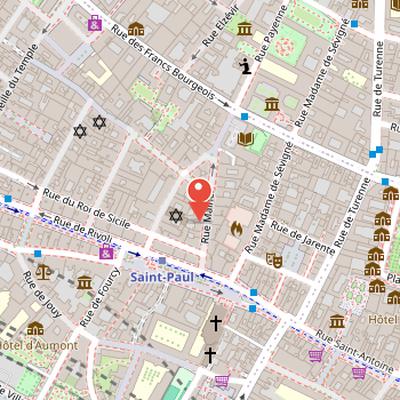
Nearby Objects
-
 Église Saint-Paul-Saint-Louis 130 m away
 -
 Maison européenne de la photographie 200 m away
 -
 Musée Carnavalet 200 m away
 -
 Musée Cognacq-Jay 250 m away
 -
 Place des Vosges 350 m away
From Town House to Prison
La Force Prison began as a hotel particulier known as La prison de La Force. It was later transformed into a maison de detention and served as a prison for the city of Paris between 1780 and 1845. The building is today almost entirely destroyed, leaving only limited traces of the original structure.
Construction History of Hotel de La Force
The history of Hotel de La Force began in 1533, when it was built on the ruins of an old palace that had belonged to Charles d'Anjou. Charles d'Anjou also gave the building the name Hotel du Roi de Sicile, located on rue du Roi-de-Sicile. Construction works were later started again in 1559 by Cardinal Antoine Sanguin de Meudon. The building was ultimately completed by Chancellor Rene de Birague. These successive stages show a long construction history tied to several prominent historical figures.
Prison Reform and the Planned Division of La Force
In 1870, an anonymous French magistrate published Projet concernant l'etablissement des nouvelles prisons for the capital, responding to wider concerns about prison conditions that had also been described by John Howard in The State of the Prisons in 1777. The magistrate condemned overcrowding, uncleanliness, old structures, and the treatment of detainees. He proposed that the prison be divided into six departments, each reserved for a different group: personnel, prisoners detained for not paying child nurses, condemned prisoners, those awaiting trial, women, and a depot for beggars. The plan also distinguished between richer and poorer detainees. Under the pistole system, wealthier prisoners could occupy four-bed rooms with fireplaces, while poorer detainees were placed in dormitories furnished with beds that had a mattress, bolster, and blanket.
La Force Prison in Revolution and Empire
La Force Prison was repeatedly associated with major political and social upheavals in Paris. John Howard visited the prison in 1783, and by the day of the Bastille's capture, Parisians had freed debt prisoners from La Force. On that same day, the prison also emptied prisoners held by arbitrary power. By 1790, police registers recorded imprisonments there for theft, public disorder, vagrancy, begging, and prostitution, showing that La Force held a mixed population of offenders and the socially marginalized.
In 1791, architect Claude Nicolas Ledoux was imprisoned in La Force. His confinement carried added political meaning because he symbolized tax oppression of the old regime after the abolition of Ferme generale in 1790. Even so, La Force was still called a model prison in 1791, despite memories of bad conditions at For-l'Eveque and Petit-Chatelet.
During the Revolution, Historique, a part of La Force, became a place of political detention. On August 10, 1792, accused persons and suspects were brought there while awaiting trial. At the start of the Terror, it held opponents of the new government and suspects, including Joseph Weber, the milk brother of Marie-Antoinette. It also housed pillagers, mostly women, who had benefited from the capture of the Tuileries. According to Le Moniteur universel in 1792, Historique evacuated debt prisoners from Grande-Force and twenty-four women from Petite-Force. That same year, prisoners suspected of making false assignats were killed there despite some efforts by communal members. Historique examined 408 detainees in 1792, and between 161 and 169 were executed.
The prison continued to receive political detainees. It received deputies arrested for hostility to the events of May 31, including Jean Dominique Blanqui, who documented the incarceration. Among the detained deputies were Francisco de Miranda, Pierre Daunou, Jean Dussaulx, Charles Eleonor Dufriche-Valaze, Pierre Victurnien Vergniaud, Achille Francois du Chastellet, Adam Lux, and Volney. Staff remembered for humanity included chief gatekeeper Ferney, guard Bault, and Bault's wife. On 9 Thermidor Year II, Historique held 79 detainees, and Petite-Force held three.
Under the Directoire, Consulat, and Empire, Historique was described as a detention house for delinquents and criminals with a reputation for rigor. Testimonies also said its detention conditions were superior to those of other prisons. Charles de Lacretelle, who spent twenty months in Historique after being transferred there from the prison du Bureau Central, described the institution. Detention records showed arbitrary arrests, and the prison remained a processing place for suspects connected to enemies of the State under the Empire. It also had a dedicated section for children. In 1809, General Malet was interned there before transfer to Sainte-Pelagie, and in 1812 he involved Generals Fanneau de Lahorie and Guidal, who were prisoners at Historique when he freed them, in a coup d'etat. Later in 1812, Minister of Police Savary, Prefect of Police Pasquier, and a police ministry official were detained there for a few hours, an event on which Parisians made ironical comments, calling it a tour de Force.
Temporary Hospital Use in 1815
In 1815, the invasion by foreign troops led to an outbreak of venereal disease among prostitutes. In response to the severity of the situation, Petite-Force was temporarily converted into a hospital. Conditions in the hospital were crowded, with four women sharing one bed. The arrangement did not last long: public protests and the continued visibility of prostitution led to the hospital being closed and the prison reopened.
La Force Prison in the 1820s
Under Louis XVIII, the prison records of Historique show many arrests for opinion crimes. Suspects could be detained because they were thought to show revolutionary feelings or nostalgia for the empire, and arrest mandates could be issued on the basis of denunciation or suspicion. These detentions were usually short, lasting from several days to weeks, and Historique also housed short-term convicts.
The prison was associated with notable detainees. The chansonnier Pierre-Jean de Béranger was sentenced to one year at Historique from 1828 to 1829 for opposing Charles X's ordinances, and Victor Hugo visited him in his cell.
In 1828, Petite-Force was reserved only for prostitutes in custody. In 1829, Historique was merged with the men's prison, which then received all newly arrested persons and short-term convicts who avoided transfer to Sainte-Pelagie. Those who avoided transfer were wealthy, and most other detainees at Historique also had some money and did not accept only the food and lodging provided by the prison. The men's prison was described as having the least bad lodging and the largest courtyards in the Seine department. It also contained an infirmary and nine solitary confinement cells.
Public Reputation and Prison Argot
La Force prison was associated with harsh confinement and a strong public reputation. Louis Rene Villerme described its solitary confinement cells as provoking indignation from all humane friends. The prison also became part of the experience and identity of individual prisoners: in 1831, Auguste Blanqui spent three weeks there, which earned him the nickname enferme.
The name La Force entered common and criminal language in several forms. For criminals, it was called la lorcef e or Lorcefee in argot, and the term appeared in the 1800 reedition of the 17th-century work Le Jargon ou langage de l'argot reforme. This prison slang was spread through literature of colportage and later used by Hugo and Sue. La Force itself became a generic term for a remand prison in common language. Related argot expressions also referred to other prisons, such as the Saint-Lazare womens prison, called la lorcef e des poniffes. In 1836, the Madelonnettes prison became a mens remand prison branch of La Force.
Administration and Traces of La Force Prison
In 1845, La Force Prison had a detailed staff structure that included a director, chaplain, doctor with two assistants, clerk and assistant, brigadier and sub-brigadier, 18 guards, two guards for children who also acted as teachers, a nurse, two canteen workers with one assistant, a barber, a female searcher, and four commissionaires. The prison held about 550 detainees that year. Its history is also marked by later commemorative traces: a panel titled Histoire de Paris recalls its past, and in the courtyard of the fire station on rue de Sevigne, a bricked-up window and its grille from La Force remain. Records also note the annual average mortality at the prison from 1815 to 1818.
Literary and Artistic References to La Force
Foreign newspapers and correspondences helped spread stories of the September massacres, and La Force became one of the emblematic prisons associated with those bloody days. The London Times published a horror report on the massacres in September 1792, and in the same month James Gillray issued a caricature in London titled Un petit souper a la parisienne - or A Family of Sans-Culottes refreshing, after the fatigues of the day, 1792. The image showed a miserable lodging where people were eating parts of their victims. Contemporary accounts often used the term cannibale to describe the events.
La Force was later presented as a place marked by brutality and horror. Louis-Marie Prudhomme's 1797 book emphasized the cruelty associated with the prison, and he described a black man massacred without stop for three days at La Force. The death of the princess de Lamballe, whose head was paraded in Paris, also became a recurring example of slaughterer fury in these references. Testimonies on the September days were later used by historians such as Carlyle and Michelet, as well as by novelists.
Charles Dickens drew on this memory in A Tale of Two Cities, published in 1859, where the September massacres appear and his hero Charles Darnay is first placed in La Force prison. In these descriptions, La Force is characterized as sinister, dark, filthy, and foul smelling.