Coulée verte René-Dumont, formerly named Promenade plantée, is a voie verte and parc linéaire in Paris, France. It follows the route of the former Vincennes railway line, which connected Gare de la Bastille to Verneuil-l'Étang and began operating in 1859. After the line was decommissioned in 1969, the Paris-Vincennes section remained abandoned for several years. Redevelopment of the area began in the 1980s, alongside broader urban changes including the demolition of Gare de Paris-Bastille in 1984 and the planning of ZAC Reuilly from 1986. The promenade project was created starting in 1988 by Jacques Vergely and Philippe Mathieux to reuse the disused railway route between Bastille and Porte de Montempoivre. The western part, on the Viaduc des Arts, is accessible by stairs and elevators at various points of Avenue Daumesnil and is reserved for pedestrians. The eastern part is below street level and arranged for separate circulation of pedestrians and cyclists.
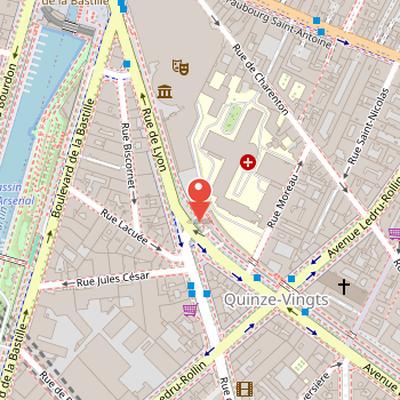
Nearby Objects
-
 Opéra Bastille 250 m away
 -
 July Column 400 m away
 -
 Elephant of the Bastille 400 m away
 -
 Place de la Bastille 400 m away
 -
 Le Génie de la Bastille 450 m away
Location and Identity
The Coullee verte Rene-Dumont is a voie verte and a linear park in Paris, France. It was formerly named Promenade plantee. As an urban green route, it forms part of the city's public landscape and is identified both as a pedestrian greenway and as a parc lineaire.
Location and Access
The Coullee verte Rene-Dumont follows the route of an old railway line extending from Place de la Bastille to Boulevard Peripherique, Porte de Montempoivre. Its western part, located on the Viaduc des Arts, can be reached by stairs and elevators at various points along Avenue Daumesnil, and it is reserved for pedestrians. The eastern part lies below street level and is arranged for separate circulation of pedestrians and cyclists. Nearby metro stations include Bastille, Gare de Lyon, Montgallet, Daumesnil, and Bel-Air.
From Abandoned Railway to Green Promenade
The Coul ee verte Rene-Dumont follows the Paris route of the former Vincennes railway line, which connected Gare de la Bastille to Verneuil-l'Etang from 1859. The line was decommissioned in 1969, and part of it was later integrated into RER A, while the Paris-Vincennes section remained abandoned. Redevelopment of the area began in the 1980s, after Gare de Paris-Bastille was demolished in 1984 for the construction of Op era Bastille.
Within this broader transformation, ZAC Reuilly was designed from 1986 between avenue Daumesnil and the rues Montgallet and de Reuilly. Its aim was to reintegrate the former freight station area into a neighborhood centered on green space. The promenade project was then planned to reuse the remaining disused line between Bastille and porte de Montempoivre. The Promenade plant ee was created starting in 1988 by Jacques Vergely and Philippe Mathieux.
The landscape development continued in stages with jardin de Reuilly designed from 1992 to 1998 and jardin de la gare de Reuilly created in 1995. The Promenade plant ee was later officially renamed coul ee verte Rene-Dumont following decisions by the Paris Council and the name commission. The name refers to French agronomist Rene Dumont (1904-2001), who was the first ecological presidential candidate in 1974.
Route and Spatial Form
The Coullee verte Rene-Dumont is a long green space built along the former railway line of the Vincennes line. It begins at Opera Bastille, at the start of the viaduc des Arts, and continues for 4.7 km to boulevard peripherique at porte de Montempoivre. Along its route, it first follows a south-east direction on the viaduc des Arts, running about ten metres above avenue Daumesnil. It then crosses avenue Ledru-Rollin by means of a former railway bridge, from which there is a view of the Saint-Antoine-des-Quinze-Vingts church in alignment with the avenue. The route passes above jardin de Reuilly via the passerelle Andre-Lleo near rue Montgallet and mairie du 12e arrondissement, before descending to street level and continuing as a promenade on allee Vivaldi. After bending eastward, it passes through a tunnel under rue de Reuilly and continues in the old railway cutting below the surrounding streets and buildings.
The path also goes through two tunnels under rue de Picpus and boulevard de Picpus near Bel-Air metro station on line 6, where the platform overlooks the promenade. At rue du Sahel, the path splits into two routes. One continues east toward boulevard peripherique at porte de Montempoivre, crossing avenue du General-Michel-Bizot near the roadway. The other crosses avenue du General-Michel-Bizot by a bridge and turns south on the former connection line to Petite Ceinture, continuing to square Charles-Peguy and joining the Petite Ceinture of the 12th arrondissement. Access at porte de Montempoivre is provided by a modern spiral staircase or a gentle slope, and the promenade is adorned with Wallace fountains.
Landscape Features
The promenade covers an area of 3.7 hectares. Along its route, it is adorned by several green spaces: jardin de Reuilly, square Charles-Peguy, jardin de la Gare-de-Reuilly, and jardin Hector-Malot. These features form part of the landscaped character of the Coullee verte Rene-Dumont.
Influence and Cultural Presence
The Coul ee verte Rene-Dumont is described as the first elevated green space built on a viaduct, and it later served as a reference point for other urban transformations. In New York, a portion of the High Line was converted into a park inaugurated in 2009, and this park was inspired by the Promenade plantee parisienne. Similar projects were also planned in Saint-Louis, Philadelphia, Jersey City, Chicago, and Rotterdam. In Paris, other conversions followed related principles, including a promenade on a section of the Auteuil line between porte d'Auteuil and La Muette metro station, and the promenade Pereire along the route of the Petite Ceinture line in the 17th arrondissement. The coul ee verte de Colombes in the suburbs also adopts the same principle. Beyond urban design, the site appeared in popular culture as a setting in the film Waking Life by Richard Linklater in 2004, and it was also used for the film Situation amoureuse : C'est complique and the music video Ailleurs by Keren Ann.