The July Column is a victory column erected in the Place de la Bastille in Paris between 1835 and 1840. It commemorates the three days of the July Revolution of 1830, known as the Three Glorious Days, which led to the fall of Charles X and the Restoration and to the establishment of the July Monarchy under Louis Philippe I, Duke of Orléans, who became King of the French. A plaque at the base of the column contains an inscription, and the shaft bears the names of the victims of the revolutionary days of July 1830. The top is crowned by a gilded bronze sculpture by Auguste Dumont titled The Genius of Liberty. The column stands above a necropolis that houses the bodies of revolutionaries who died during the July days. Its construction was prescribed by a royal ordinance of July 6, 1831.
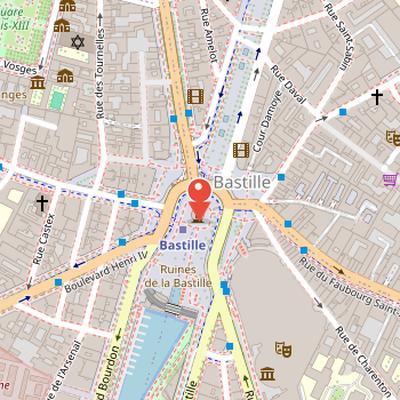
Nearby Objects
-
 Elephant of the Bastille 0 m away
 -
 Place de la Bastille 10 m away
 -
 Le Génie de la Bastille 20 m away
 -
 Bastille 30 m away
 -
 Opéra Bastille 150 m away
Design and commemorative meaning
The July Column was erected in the Place de la Bastille in Paris between 1835 and 1840. It commemorates the three days of the July Revolution of 1830, known as the Three Glorious Days, which led to the fall of Charles X and the Restoration regime and to the establishment of the July Monarchy under Louis Philippe I, Duke of Orleans, who became king of the French. The monument is built over a necropolis that contains the bodies of revolutionaries who died during those July days. A plaque at the base of the column bears an inscription, and the shaft lists the names of the victims of the 1830 revolutionary days. The top is decorated with a gilded bronze sculpture by Auguste Dumont titled Genius of Liberty.
Predecessors of the July Column
Before the July Column, the Bastille site was the subject of several revolutionary and imperial projects. On June 16, 1792, a square named Liberty was planned there, with a column intended for erection. During the Great Terror in Prairial of Year II, the guillotine was moved from Place de la Revolution to the Bastille site, where it was said to operate for only three days and to have caused 75 victims before being transferred to Place du Trone-Renverse. On August 10, 1793, the Fountain of Regeneration was installed for the Festival of Unity and Indivisibility of the Republic, which was organized under Jacques Louis David and Herault de Sechelles with a budget of two million. The procession for that festival was planned to pass through five symbolic Revolution stations from Champ de Mars to the Bastille via Place de la Concorde. The fountain, attributed to Jacques-Louis David, commemorated the capture of the Tuileries in 1792 with an Egyptian-style design and water jets from the breasts of an allegorical figure representing the Nation.
Under the Empire, plans shifted toward a large fountain fed by the Canal de lOurcq as part of Paris water supply works. Above it, a bronze military elephant was envisioned, measuring 16 meters long and 15 meters high, with a 24 meter base. A spiral staircase was planned inside it, leading to a viewing platform atop the tower. The first stone of the elephant pedestal was laid on December 2, 1808, marking the fourth anniversary of Napoleon Is coronation. Architect Jean-Antoine Alavoine continued the work of Jacques Cellerier and built the fountain base, which later became the base of the July Column. A full-scale wooden and plaster model of the elephant was erected south of the square and remained there until 1846.
Design and Commemoration of the July Column
The July Column was prescribed by royal ordinance on July 6, 1831, and Louis Philippe placed the first stone on July 27 of the same year. Jean-Antoine Alavoine designed the monument, which was inspired by the Column of Trajan in Rome. Construction began in 1835, when the bronze pieces were cast, and the work was later decorated by Joseph-Louis Duc in 1839. The column was completed in 1840, and the French government held a grand inauguration on July 28 of that year.
The monument commemorates the ten years of the revolution. It rises 50.33 meters from the ground to the torch held by the statue at the top and is made of bronze with a total mass of 179,500 kg. Its shaft features a Corinthian order, and the pedestal is adorned with inscriptions, palms, immortal crowns, oak branches, the arms of the City, the Gallic rooster, and the lion. The well of the column is divided into three parts with victims' names engraved in gold letters. At the top, the capital supports a statue by M. Dumont called the Genius of Liberty, shown with a torch in one hand, broken irons in the other, and spreading its wings. The ascent to the top requires 240 steps.
Inauguration and Commemorative Works
The inauguration of the July Column was marked by a commissioned musical work and commemorative medals. Charles de Remusat commissioned Hector Berlioz to compose a symphony for the event, and Berlioz wrote the Grande Symphonie Funebre et Triomphale for the inauguration. During the procession, Berlioz conducted a military band of 200 musicians. The occasion was also recorded through engraved medals, including one made for the inauguration and another engraved by Francois Augustin Caunois.
The Column in Revolutionary Memory
The July Column at the Bastille was repeatedly associated with revolutionary commemoration and republican symbolism. On February 25, 1848, during the Revolution of 1848, Parisians brought King Louis Philippe's throne to the Bastille and burned it at the foot of the column. The remains of 196 victims of the riots that overthrew Louis Philippe were later added to the monument. During the siege of Paris by Prussian troops, the Place de la Bastille and its column were described as essential symbols for Parisian republicans. Histories of the site note that on February 24, 25, and 26, 1871, thousands of citizen guards gathered there to commemorate the 1848 revolution and the proclamation of the Second Republic, and that the column occupied a prominent place in republican semiotics, influencing the violent events of February 26, 1871, when security officer brigadier Bernardin Vincenzini was lynched and sentenced to death by drowning.
After March 18, 1871, and the installation of the Commune elected on March 28, the place and its monument remained central to popular Paris. Federation guards and national barges continued to gather there for meetings and demonstrations. The Bastille was also a strategic point where the armies of the Thiers government met strong resistance during the Bloody Week. Later, Versailles writers attempted to discredit the federated insurgents and Commune supporters in a memorial struggle. Some sources claimed that insurgents tried to destroy the column by artillery fire from Montmartre heights, while archival discoveries indicate an attempt to destroy it by sending a barge loaded with fuel and explosives through the Canal Saint-Martin. According to the same account, the failed maneuver burned only the bones solemnly deposited at the base of the column. Other sources strongly doubt the artillery version, and the column's popular appeal is not presented as universally shared.
Heritage Classification
The July Column, also identified in the records as Historia da Coluna, was listed for the first time in 1926. It was later classified as a historical monument by decree on September 29, 1995. The protected classification is not limited to the visible column alone. It also includes the subterranean funerary arrangements, the foundations, the fence gate, and the small adjacent entrance pavilions. This designation reflects a broader approach to the monument, covering both the main structure and the associated architectural elements that form part of the site.
Physical Description
The July Column has a total building height of 50.52 meters, measured to include the entire structure crossing the canal. This figure gives an overall sense of the monument's scale and its presence in the urban setting. The stated height refers to the complete structure rather than a single isolated element, reflecting the full extent of the construction above and across the canal.