Bataclan is a performance hall located at 50, boulevard Voltaire in Paris. Built by the architect Charles Duval in 1864, it opened in 1865 as a café-concert, performance hall, dancing venue, cinema, and music hall. Its original name was Le Grand Café Chinois-Théâtre Ba-ta-clan, and the name refers to Ba-ta-clan, an operetta by Offenbach. The building was registered as a historic monument.
Bataclan is also associated with the November 13, 2015 attacks in France, when it was the site of a massacre of ninety people. The attacks were claimed by the Islamic State (EI or Daech). As both a performance venue and a place marked by this event, Bataclan holds a place in the cultural and historical memory of Paris.
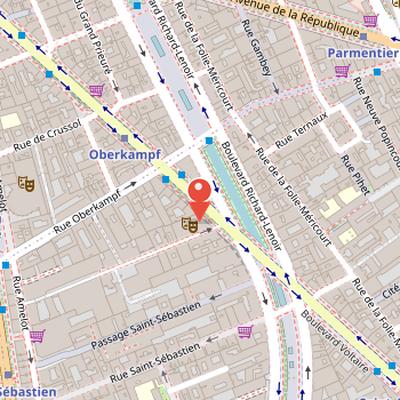
Nearby Objects
-
 Cirque d'Hiver Bouglione 250 m away
 -
 Boulevard du Temple 300 m away
 -
 Saint-Ambroise 450 m away
 -
 Cirque Olympique 650 m away
 -
 Temple 700 m away
Bataclan: History and Public Significance
Bataclan is a performance hall at 50, boulevard Voltaire in Paris. It was built by the architect Charles Duval in 1864 and opened in 1865 as a cafe-concert, performance hall, dancing venue, cinema, and music hall. It was originally named Le Grand Cafe Chinois-Theatre Ba-ta-clan, and its name refers to Ba-ta-clan, an operetta by Offenbach. The building was registered as a historic monument. It also became widely known as the site of a massacre of ninety people during the November 13, 2015 attacks in France, an attack claimed by the Islamic State (EI or Daech).
Early History and Use
The Bataclan, then known as Histoire, was built on boulevard du Prince-Eugene in 1863 to 1864. It was originally a large cafe-concert in a Chinese architectural style, with a cafe and theater on the ground floor and a large dancing hall on the first floor. The venue hosted vaudevilles by Scribe, Bayard, Melesville, and Dumersan, as well as concerts. It was inaugurated and soon after acquired and directed by Andre-Martin Paris, who had previously directed the Concert des arts hall at passage Vendome, which burned in 1863. During the war of 1870, the billiard halls in Histoire were used as ambulances.
The Bigophone and Its Popularity
In 1881, Bigot invented the bigophone for the comic Bienfait at Histoire. The instrument later gained immense fame in France and Belgium for more than fifty years. Its popularity led to the creation of hundreds of bigophone societies, which emerged and prospered over time. These facts point to a broad and sustained public interest in the bigophone and its place in popular culture.
Theatrical History and Later Transformations
The Bataclan, referred to in the provided facts as Histoire, has had a long and changeable performance history. Its first revue was presented in 1883, followed by its first operetta two years later. In 1892, the singer Paulus bought the venue, and it later hosted performers such as Harry Fragson, Aristide Bruant, and Buffalo Bill. The theater was then taken over by Max Dorfeuil, under whom it presented artists including Dranem and Felix Mayol.
Over time, the venue experienced several changes of ownership, with its fortunes varying accordingly. It gained renewed popularity after restoration and through programming centered on revues by Jose de Berys. Among the artists associated with its early success were Mistinguett and Maurice Chevalier, both of whom had their first successes there.
A 1926 Latin American tour connected to the venue was a commercial failure, after which Madame Rasimi abandoned the theater. The building was then resold and transformed into a cinema. It later became a theater again under Henri Varna, before being converted into a talking cinema. An accident caused a fire that destroyed part of the balconies, and the original building was partially destroyed to meet new safety standards. The cinema eventually closed its doors.
Concert Venue and Nightlife
In 1969, Histoire describes a concert organized by Asaad Debs with the English group Soft Machine at the Bataclan, and also records The Velvet Underground performing there for the TV show Pop 2 presented by Patrice Blanc-Francard on November 1, 1969. The venue continued to host major acts in the early 1970s, including Roxy Music, Beck, Bogert and Appice, Jane Birkin, Captain Beefheart, Can, Genesis, and MC5. Some concerts were marked by unrest: after an MC5 concert in 1972, mobile gendarmes intervened because of fan disturbances, and a New York Dolls concert ended in a fight that led to the cancellation of Pop 2.
The Bataclan remained active through the late 1970s and early 1980s, with Talking Heads performing on October 28, 1979, Iron Maiden on December 4, 1980, Motorhead on June 6, 1981, and UFO in 1983. In 1982, under director Andre Engel, the Bataclan regained its role as a performance venue. Histoire describes it as a post-punk music venue in the 1980s, when The Cure, Siouxsie and the Banshees, The Stranglers, and Rachid Taha also performed there. That same year, Bernard Zkri and Europe 1 organized the New York City Rap festival at the Bataclan, featuring artists such as Mick Jones, Futura 2000, and Afrika Bambaataa.
During the 1980s, the Bataclan was also transformed into a nightclub after concerts, and numerous hip-hop dancers, including Bintou Dembele, danced there. Histoire notes that the organizers endured several difficult months before the nightclub gained reputation in Paris. In the 1990s and 2000s, the venue continued to attract a wide range of performers, including Nine Inch Nails, Marilyn Manson, Courtney Love, Jeff Buckley, The Cure, PJ Harvey, Prince, and Metallica. Prince performed at the Bataclan in 1994, 1999, and 2002, and composed a piece titled Bataclan. Metallica performed there in 2003.
Recent Programming and Ownership Changes
In 2014, Bataclan hosted Kyary Pamyu Pamyu during the Nanda Collection World Tour for the album la Nanda Collection, and it also presented the show Qui est Malcolm X? featuring Medine, Kery James, Disiz, and Faada Freddy. In 2015, Lagardere Unlimited Live Entertainment owned part of Bataclan, while the French musician St Germain presented a new album there on November 12, and Damien Saez gave a series of three concerts on November 21, 22, and 24. In January 2018, Jules Frutos and Olivier Poubelle sold 30 percent ownership of Bataclan to Lagardere, and about 15 concerts were programmed there that year. In March 2018, rapper Medine announced the cancellation of concerts at Bataclan. In April 2021, Paris City Hall bought Bataclan through SAE POPB, and in 2022 the venue underwent new programming and identity changes under Paris Entertainment Company.
The Bataclan After the 2015 Attack
The Bataclan became closely associated with the 13 November 2015 terrorist attack, when three men armed with assault rifles and explosive belts entered the building during a concert by Eagles of Death Metal. The attack caused 90 deaths and several hundred injuries. Witnesses reported that the attackers referred to French military actions in Iraq and Syria, and the Islamic State later explicitly mentioned the Bataclan in its claim of responsibility.
The venue was already regarded as a flagship attraction in a Parisian neighborhood known for its cultural diversity, and the attack deeply affected its public image. On the same day, the Bataclan management published a declaration. Tributes soon appeared across Paris and beyond, including candles and impromptu gatherings despite the city curfew, while artistic and sports communities also expressed support. Members of U2 visited the Bataclan afterward, left flower bouquets, and Bono made a brief speech there. The French government also canceled U2 concerts planned for Paris-Bercy.
After renovation, the Bataclan management announced that the auditorium would reopen in 2016, and the venue was expected to reopen before 2017. The region of Ile-de-France provided a subsidy of 100,000 euros for digital creation and dissemination support. The Bataclan reopened nearly one year after the attack with a Sting concert on 12 November 2016. The reopening featured Franco-Lebanese trumpeter Ibrahim Maalouf and The Police cofounder Henry Padovani, and it was broadcast the following day on France 2 with tributes to the victims. The first American band to play there after the attack was The Pretty Reckless on 25 March 2017. Some artists, including Francis Cabrel and Nicola Sirkis, refused to perform again at the Bataclan.
Banksy at the Bataclan
In April 2017, graffiti artist Banksy painted La Jeune Fille triste on an emergency door at the Bataclan. The work was created in tribute to the victims of the Attentat terroriste du 13 novembre 2015. In May 2019, the artwork was stolen, and it was later found in Italy in May 2023.
Threats and Targeting
The Bataclan was targeted by Menaces after conferences or galas held by Jewish organizations such as Migdal. Migdal had supported the Israeli Border Police, Magav, during an Israeli army offensive in the Gaza Strip. In 2011, according to Le Figaro, Khaled Moustafa confessed to an act related to Menaces. His Franco-Albanian friend Dodi Hoxha provided information about that confession.