Cirque Olympique, also known as Cirque Franconi, was a French equestrian theatre company founded in 1782 by the Englishman Philip Astley. Originally known as Cirque d’Astley or Cirque Anglais, it is recognized as the first permanent circus in France. The company was associated with a wooden round theater in the Rue du Faubourg du Temple, with two levels of seating and lighting provided by 2,000 candles. Its performances were open four months a year and combined equestrian acts with juggling and other entertainment.
In 1793, during the French Revolution, the Paris circus was leased to Antonio Franconi. The enterprise later passed to his sons Laurent and Henri in 1807, who renamed the theater Cirque Olympique. That same year, the theater was relocated because of the construction of Rue de la Paix, and a new venue was rented from Francois Delpont between rue du Mont-Thabor and rue Saint-Honoré. The theater opened on December 28, 1807, but closed on May 27, 1816 due to planned Treasury construction. The Franconi brothers then returned to the old Astley theater, which was also renamed Cirque Olympique and reopened on February 8, 1817. After a fire in 1826, they built another Cirque Olympique theater on Boulevard du Temple, designed by Alexandre Bourla and inaugurated in 1827.
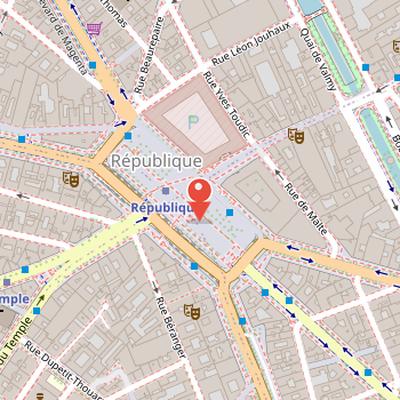
Nearby Objects
-
 Place de la République 20 m away
 -
 Monument to the Republic 50 m away
 -
 Temple 250 m away
 -
 École Duperré 300 m away
 -
 Synagogue de Nazareth 300 m away
Origins and Identity
The Cirque Olympique, also known as Cirque Franconi, was a French equestrian theater company founded in 1782 by the Englishman Philip Astley. It was originally known as Cirque d'Astley or Cirque Anglais. The company is recognized as the first permanent circus in France, giving it a notable place in the history of performance and popular entertainment in the country.
The Cirque Olympique in Paris
The Cirque Olympique was connected to the Teatro de Astley, the first permanent circus built for this purpose in France, on the Rue du Faubourg du Temple. Its early form was a wooden round theater with two levels of seating and illumination from 2,000 candles. The theater operated for four months each year, presenting equestrian acts together with juggling and other performances.
During the French Revolution, the circus in Paris was leased to Antonio Franconi in 1793. Franconi later moved the original theater to an old Capuchin Convent, where stables and a new theater were built. In 1807, he handed the enterprise over to his sons Laurent and Henri Franconi, who renamed the theater Cirque Olympique.
The theater was relocated again in 1807 because of the construction of Rue de la Paix. Its new site was between rue du Mont-Thabor and rue Saint-HonorE, and it was rented from Francois Delpont. The new theater was inaugurated on December 28, 1807. It remained in use until May 27, 1816, when it closed because Treasury construction had been planned for the site.
From Rue du Faubourg du Temple to Boulevard du Temple
The Franconi brothers returned to the old Astley theater on rue du Faubourg du Temple and renamed it Cirque Olympique. It was inaugurated on February 8, 1817. On March 15, 1826, pyrotechnic effects during a performance of L'incendie de Salins caused a fire that burned the building to its foundations. After this destruction, the Franconi brothers moved to Boulevard du Temple and built another theater under the same name. The new Cirque Olympique was designed by Alexandre Bourla and inaugurated on March 21, 1827.
The theater later underwent further changes in use and identity. The Paris Opera occupied it from June 18, 1844, until 1847, and architect Louis Theodore Charpentier remodeled it in 1847 for the Paris Opera. The building was then known as Theatre National until July 4, 1853, when it was renamed Theatre du Cirque Imperial. It was demolished in 1862 as part of an urban renewal project. After the demolition, director Hippolyte Hostein moved the circus to the Theatre du Chatelet.