Boulevard du Temple is a Paris boulevard opened between 1656 and 1705 through the bastion of the Temple in Charles V’s enclosure. Its layout preserved traces of the former bastion, with odd-numbered buildings following the rounded exterior contour and numbers 42 to 48 keeping the original orientation before later realignment at Place de la République. During the period from Louis XVI to the July Monarchy, it was known as boulevard du Crime and was a popular place associated with cafés and theaters. Among the theaters named on the boulevard were the Théâtre-Historique, Théâtre-Lyrique, Folies-Dramatiques, Cirque-Olympique, Théâtre de la Gaîté, Théâtre des Funambules, Théâtre des Délassements-Comiques, Théâtre Lazari, and Café des Mousquetaires. The boulevard was also the site of Giuseppe Fieschi’s assassination attempt against King Louis-Philippe on July 28, 1835. Haussmannian transformations later altered the area, leaving only Théâtre Déjazet and demolishing other theaters on the odd-numbered side for the expansion of Place de la République.
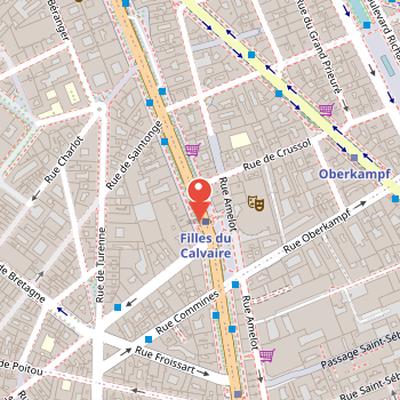
Nearby Objects
-
 Cirque d'Hiver Bouglione 80 m away
 -
 Bataclan 300 m away
 -
 École Duperré 400 m away
 -
 Temple 400 m away
 -
 Cirque Olympique 450 m away
Boulevard du Temple: theaters, cafes, and urban change
Boulevard du Temple opened between 1656 and 1705 through the bastion of the Temple in Charles V's enclosure. Its layout still reflected this origin: the odd-numbered side followed the rounded exterior contour of the former bastion, while numbers 42 to 48 retained the original orientation. Buildings after number 48 were later realigned at Place de la Republique.
During the period from Louis XVI to the July Monarchy, the boulevard was known as boulevard du Crime and was a popular place with many cafes and theaters. Histoire lists a dense theatrical landscape that included Cafe des Mousquetaires, Theatre-Historique, Theatre-Lyrique, Folies-Dramatiques, Cirque-Olympique, Theatre de la Gaite, Theatre des Funambules, Theatre des Delassements-Comiques, and Theatre Lazari. Three famous cafes stood between theaters: Cafe des Mousquetaires, Cafe de l'Epi-Scie, and Cafe d'Achille, also called Cafe de la Basse-Grece or Cafe de l'Allumage.
The cafes also had a darker reputation. Cafe de l'Epi-Scie was built on the site where Bobec he and Galimafre performed and was regularly raided by police. Cafe d'Achille was frequented by grecs operating illegal gambling dens that scammed visitors, especially provincial visitors who were targeted by denicheurs and then sold to grecs at social events. Charles Virmaitre stated that several murderers were arrested in Cafe d'Achille.
The boulevard also entered political history on July 28, 1835, when Giuseppe Fieschi carried out an assassination attempt against King Louis-Philippe there. The attack caused 18 deaths and 23 injuries. Later Haussmannian transformations significantly altered the Marais area, and only Theatre Dejazet and the theaters on odd-numbered Boulevard du Temple buildings remained after demolition for the expansion of Place de la Republique.
The Jacques Chabannes Hotel
Between 1758 and 1760, an hotel particulier for Jacques Chabannes was built facing boulevard du Temple in Paris. According to Dezallier d'Argenville, Pierre-Louis Moreau-Desproux completed this first Parisian construction. Designed in the Greek style, it is considered one of the first neoclassical buildings in Paris. Its architectural details included frettes in place of denticules under the cornice and a frieze of Greek keys between the floors.