Located in Paris, Cirque d'Hiver was constructed in 1852 by architect Jacques Hittorff. The building was previously known as cirque Napoléon and Cirque national, and it is registered as a historical monument. After being purchased in 1934 by the Bouglione family, it also became known as Cirque d'Hiver Bouglione. The venue has long served multiple cultural functions, including classical music concerts by Jules Pasdeloup, cinema Pathé of Serge Sandberg, and theatre by Firmin Gémier.
Its historic design reflects a distinctive circus structure: a twenty-sided polygon with forty windows and a forty-two-meter diameter. The hall was originally built with a wooden frame without intermediate points and illuminated by twenty-one gas chandeliers. It was designed for 4,000 spectators, while its current capacity is 1,765 under modern fire safety norms. Cirque d'Hiver continues to host traditional circus shows, variety shows, and political meetings, and it has been recognized by the international community for more than 80 years.
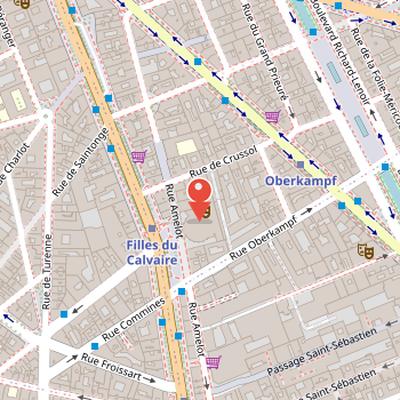
Nearby Objects
-
 Boulevard du Temple 80 m away
 -
 Bataclan 250 m away
 -
 École Duperré 450 m away
 -
 Temple 450 m away
 -
 Cirque Olympique 500 m away
History and Uses of the Cirque d'Hiver
The Cirque d'Hiver is located at Le cirque d'hiver de Paris in Paris. It was constructed in 1852 by the architect Jacques Hittorff and was previously known as cirque Napoleon and Cirque national. The building is registered as a historical monument, reflecting its recognized heritage status.
Over time, the venue has been used for a wide range of performances and public events. It hosted classical music concerts by Jules Pasdeloup, cinema Pathé by Serge Sandberg, and theatre by Firmin Gémier. In 1934, the building was purchased by the Bouglione family, after which it also became known as Cirque d'Hiver Bouglione. It continues to host traditional circus shows, as well as variety shows and political meetings.
The Cirque d'Hiver has been recognized by the international community for more than 80 years, adding to its long-standing public significance in Paris.
Design and Early History
The Cirque d'Hiver was authorized through the Duke of Morny, half-brother of Prince Louis-Napoleon, and its construction was commissioned by the owner of the Cirque d'Eté in Marigny square on the Champs-Elysees. Jacques Hittorff, who had also designed the Cirque d'Eté and Gare du Nord, was asked to create the new building. It was built on the land of a reservoir dating from 1740, which had been destroyed in 1779 for Grand Egout cleaning.
Construction began on 17 June 1852 and lasted eight months. The building was inaugurated by Prince Louis-Napoleon on 2 December 1852. Its design took the form of a twenty-sided polygon with forty windows and a diameter of forty-two meters. The structure used a wooden frame without intermediate points, and the hall was lit by twenty-one gas chandeliers. It was originally planned to hold 4,000 spectators, although the current capacity is 1,765 under modern fire safety norms.
The interior and exterior decorations were created by prominent sculptors and painters of the period. Among the named contributors to the decorations of Cirque Napoleon were James Pradier, Francisque Duret, Astyanax Scaevola Bosio, Nicolas Gosse, Felix-Joseph Barrias, and Antoine Laurent Dantan. The circus was primarily dedicated to equestrian art, and Franconi and Baucher were appointed as managers. It later marked the debut of Toulouse-born Jules Leotard, the first flying artist and inventor of the flying trapeze, on 7 January 1859. The venue was managed by Victor Franconi in 1870 and by Charles Franconi from 1897 to 1907. The building was renamed Cirque National before taking the name Cirque d'Hiver in 1873.
Pasdeloup and the Concerts populaires
Historique reports that Jules Pasdeloup gave the first of his Concerts populaires de musique classique at Cirque Napoleon, with an orchestra of 110 musicians from the Societe des jeunes artistes du Conservatoire. The program included the Oberon overture by Carl Maria von Weber, Symphony Pastorale by Ludwig van Beethoven, Austrian Hymn by Joseph Haydn, a Violin Concerto by Felix Mendelssohn, and La Chasse overture by Etienne Nicolas Mehul. The concerts drew strong public interest, with places stormed at the performances, and Historique notes that around thirty concerts took place with an average audience, for a total of auditeurs up to the date given in the source. Hector Berlioz also wrote about the concerts in the Journal des debats. In 1878, Pasdeloup's efforts were recognized by a subsidy allocated to the Concerts populaires. Financial difficulties appeared in the early 1870s after Edouard Colonne and Charles Lamoureux created their own concert societies. Lamoureux's attempt to promote Richard Wagner's music contributed to a downfall and bankruptcy in 1884. Two years later, he tried to revive the Concerts populaires with a festival devoted to Cesar Franck, but the attempt failed and the Concerts populaires ceased to exist.
From Electric Lighting to Cinema and Spectacle
In 1907, electric globes illuminated Cirque d'Hiver, replacing the gas chandeliers that had previously lit the building. The venue then went through a series of changes in programming and direction that reflected shifting forms of popular entertainment. Film producer Serge Sandberg installed a cinema for the Societe Patha in a space described as transformed into an Art Nouveau temple, where wild animals were said to exist only on screen. Sandberg later revived the Concerts populaires in 1918 and entrusted the direction to Rhene-Baton. Concerts and theater performances also took place there, including works by Firmin Gemier, who created Oedipe roi de Thebes and La Grande Pastorale in 1920 at Cirque d'Hiver. Concerts resumed in the same 1861 setting until Sandberg transferred the lease to Gaston Desprez in 1923.
The building also remained associated with spectacle and stage invention. It was described as a venue where one could jump with a parachute into a lion's cage, and from 1931 to 1958 it hosted narrative shows that revived the pantomime tradition. During this period, it staged the first and only representation of Tarzan: Le maitre de la jungle. A nautical ring was constructed for shows presented as operas of grand fairy and nautical spectacle. Gaeo Sandry directed most of these shows, while Raymond Brunel composed the music. Before and after World War II, the theatre hired the societe parisienne de spectacles Audiffred et Cie, headed by Emile Audiffred, who also worked as director of Theatre de l'Empire from 1924 to 1932 and later became director of Cirque Medrano. Emile and Roger Audiffred also produced the clown Grock at Cirque d'Hiver and launched Radio-Circus with a large tent.
Changing Uses and Performances
The Cirque d'hiver continued to serve as a major performance venue for a wide range of events after the mid-20th century. In 1954, it hosted Gilles Margaritis's television show La Piste aux etoiles, and in 1955 it was the setting for Carol Reed's film Trapeze, which featured Gina Lollobrigida, Burt Lancaster, and Tony Curtis. The venue received regular circus shows from the Bouglione family until 1984, while also presenting varied programs including musicals, songs, and recitals.
Its spaces were adapted for these changing uses, with former stables and menagerie areas converted into carpeted reception rooms. During the 1980s and 1990s, the Cirque d'hiver hosted a succession of productions and performers, including Barnum in 1981, Jacques Higelin in 1982 and 1994, Diane Dufresne with Dioxine de carbone in 1984, Emilie Jolie in 1985, Guy Bedos in 1986 and 2006, Les Aventures d'Asterix in 1988, Cirque chinois in 1989, Cirque du Soleil's Cirque reinvente in 1990, and Muriel Hermine's nautical show Crescend'O in 1997. It also hosted the Festival Mondial du Cirque de Demain, founded in 1977, showing its continued role in circus and stage entertainment.
Seasonal Programming and Public Meetings
From 1999 to 2026, Cirque d'Hiver hosted winter seasons of traditional circus shows produced by Historique under the new Bouglione generation. The annual productions formed a continuous sequence of themed performances, beginning with Salto in 1999, followed by Piste in 2000, Trapze in 2001, Le Cirque in 2002, and Voltige in 2003. The 2002 production, Le Cirque, marked the anniversary of the monument. Subsequent seasons continued each year with Bravo in 2004, Audace in 2005, Artistes in 2006, Vertige in 2007, Etoiles in 2008, Festif in 2009, Prestige in 2010, Virtuose in 2011, Eclat in 2012, Phenomnal in 2013, Geant in 2014, Rire in 2015, Surprise in 2016, Exploit in 2017, Extra in 2018, and Defi in 2019. The venue remained active through the following years with Dingue in 2020 and 2021, Fantaisie in 2022, Delire in 2023, Spectaculaire in 2024, and Tempo in 2025 and 2026.
Beyond circus programming, Cirque d'Hiver also hosted varied shows and political meetings of all kinds. Among the events noted there were a meeting with Fabien Roussel during the presidential election campaign and the tenth anniversary of Jeunes avec Macron. These uses show the building functioning not only as a circus venue but also as a place for public gatherings and political events.