Shakespeare and Company is an English-language bookstore on Paris’s Left Bank at 37 rue de la Bûcherie in the 5th arrondissement of Paris. Opened by George Whitman in 1951 under the name Le Mistral, it was renamed Shakespeare and Company in 1964. The store was named after Sylvia Beach’s earlier bookstore of the same name, founded in 1919, and Whitman modeled his shop after that example. The premises stand on the site of a 16th-century monastery near Place Saint-Michel.
The bookstore sells new and second-hand books and functions as an antiquarian bookseller. It also operates as a free reading library open to the public. In addition, it houses aspiring writers and artists in exchange for help around the shop, and more than 30,000 people have slept in beds tucked between its bookshelves. Its motto, Be Not Inhospitable to Strangers Lest They Be Angels in Disguise, is written above the entrance to the reading library.
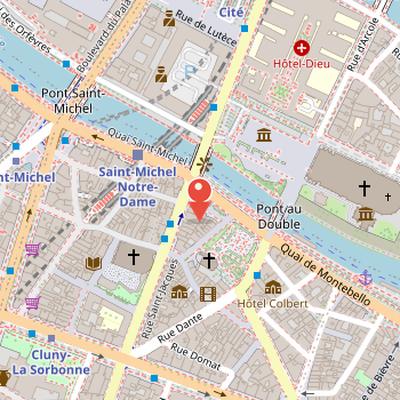
Nearby Objects
-
 Saint-Julien-le-Pauvre 50 m away
 -
 Saint-Séverin 100 m away
 -
 Charlemagne et His Guards 120 m away
 -
 Notre-Dame de Paris 200 m away
 -
 Place Saint-Michel 250 m away
Shakespeare and Company on the Left Bank
Shakespeare and Company is an English-language bookstore on Paris's Left Bank, located at 37 rue de la Buerie in the 5th arrondissement of Paris. It was opened in 1951 by George Whitman and was originally called Le Mistral. In 1964, Whitman adopted the name Shakespeare and Company, which had first been used by Sylvia Beach for her own bookstore founded in 1919 on the Left Bank.
The bookstore serves multiple functions. It is a purveyor of new and second-hand books and also operates as an antiquarian bookseller. In addition, it functions as a free reading library open to the public. The store is also known for housing aspiring writers and artists in exchange for help around the bookstore, and more than 30,000 people have slept in beds tucked between its bookshelves.
Its motto, Be Not Inhospitable to Strangers Lest They Be Angels in Disguise, is written above the entrance to the reading library.
History and Literary Role
Shakespeare and Company began in 1951, when American ex-serviceman George Whitman opened an English-language bookstore on Paris's Left Bank under the name Le Mistral. The shop is located at 37 rue de la B ucherie, near Place Saint-Michel, on a site that had once been a 16th-century monastery. Whitman modeled the bookstore after Sylvia Beach's earlier Shakespeare and Company, and in 1958 Sylvia Beach handed him the name for his bookshop. He formally renamed the store Shakespeare and Company in 1964, after Beach's death and on the 400th anniversary of William Shakespeare's birth.
The bookstore became a focal point of literary culture in expatriate bohemian Paris. Early habitu es included Allen Ginsberg, Gregory Corso, and William S. Burroughs, who researched sections of Naked Lunch in the store's medical section. Other visitors included James Baldwin, Ana s Nin, Julio Cort zar, Richard Wright, Lawrence Durrell, Max Ernst, Bertolt Brecht, William Saroyan, Terry Southern, and editors of The Paris Review. Whitman described the venture as a socialist utopia masquerading as a bookstore, while Henry Miller called it a wonderland of books.
After Whitman's death in 2011, at the age of 98, in his apartment above the bookstore, his daughter Sylvia continued to run the shop. The store also expanded its cultural role in 2010 with the launch of The Paris Literary Prize for unpublished novellas, offering a top prize of 10,000 euro provided by the de Groot Foundation. Rosa Rankin-Gee won the first contest with The Last Kings of Sark, and C. E. Smith won the second with Body Electric. In 2015, Shakespeare and Company opened a cafe next door to the bookstore in an abandoned garage that had stood empty since 1981. The cafe, developed with Bob's Bake Shop, serves primarily vegetarian food, with vegan and gluten-free options, and reflects George Whitman's earlier attempt to open a literary cafe in the same space since 1969.
Recent Business Challenges
During the COVID-19 period, Shakespeare and Company experienced significant business difficulties. The bookstore was closed for two months during the first lockdown in France in 2020, and it did not sell online during that time, following advice from the Syndicat de la Librairie francaise. History states that sales dropped by 80 percent since March 2020. After reopening the website, the owner informed media about the financial struggles the store faced, while also expressing gratitude for the orders received.
Literary Publications
Shakespeare and Company was linked to a notable sequence of literary publications that used the bookstore as an editorial and publishing base. The avant-garde journal Merlin had its editorial address at the bookstore. Publications state that Merlin was the first journal to publish Samuel Beckett in English, and that its editors included Richard Seaver, Christopher Logue, and Alexander Trocchi, with Jane Lougee as publisher. Another periodical, Two Cities, was published from the bookshop by Jean Fanchette from 1959 to 1964, and its patrons were said to include Anais Nin and Lawrence Durrell. Ted Hughes and Octavio Paz were published in Two Cities.
The bookstore also housed Paris Voices, which ran out of the upstairs library from 1978 to 1981. Publications state that Paris Voices published young writers including Tony Curtis and Sebastian Barry, with Kenneth R. Timmerman as editor-in-chief and Antanas Sileika on the editorial team. In addition, Shakespeare and Company established Frank magazine, edited by David Applefield with contributions from Mavis Gallant and John Berger. It also established The Paris Magazine, also called The Poor Man's Paris Review. Publications state that its contributors included Lawrence Ferlinghetti, Jean-Paul Sartre, Marguerite Duras, Pablo Neruda, Lucy Sante, Michel Houellebecq, and Rivka Galchen. The first issue appeared in 1967, and the most recent issue was released in 2010.
Published History and Founding Ethos
In 2016, publications issued Shakespeare and Company, Paris: A History of the Rag and Bone Shop of the Heart, a history book about the bookstore. It was edited by Krista Halverson and includes a foreword by Jeanette Winterson and an epilogue by Sylvia Whitman. The volume also features contributions from Ethan Hawke, Lawrence Ferlinghetti, Allen Ginsberg, Anais Nin, Robert Stone, Ian Rankin, Kae Tempest, and Jim Morrison. Its contents include an illustrated adaptation of Sylvia Beach's memoirs and a selection of George Whitman's letters and journals from his Great Depression hobo adventures. The bookstore's founding ethos is described as having been inspired by the kindness Whitman received during his travels: Give what you can; take what you need.
Shakespeare and Company in Popular Culture
Shakespeare and Company has appeared repeatedly in popular culture, especially in film and television. It features in Richard Linklater's Before Sunset, Nora Ephron's Julie and Julia, and Woody Allen's Midnight in Paris. The store and its owner, George Whitman, were also the subject of Portrait of a Bookstore as an Old Man, a 2003 documentary directed by Benjamin Sutherland and Gonzague Pichelin.
The bookstore is also showcased in the Hong Kong TVB drama Triumph in the Skies 2, where characters Ron and Myolie Wu are shown reading and sleeping there. In the third season of Highlander: The Series, it appears as a bookstore in Paris operated by Watcher Don Salzer. The series later returns to the location in its fourth season, when the Immortal Methos uses a hidden room in the cellar as storage for ancient journals.