Théâtre des Bouffes-Parisiens is a Parisian theatre founded in 1855 by the composer Jacques Offenbach for the performance of opéra bouffe and operetta. It is located in the 2nd arrondissement, at 4 rue Monsigny, with an entrance at 65 Passage Choiseul. In the 19th century, it was often referred to as the Salle Choiseul.
The theatre was established after Offenbach successfully requested a license from the Parisian authorities in February 1855 for a new genre of musical theatre, which he described as “new and original.” He presented it as a form with mass appeal and as an opportunity for young French composers. The inaugural performance took place on 5 July and included four of his own works, among them the prologue Entrez, messieurs, mesdames and Les deux aveugles, which soon became the opening-night hit. After 1870, the repertory expanded to include comedies. The theatre is still active and continues to present regular productions of stage plays.
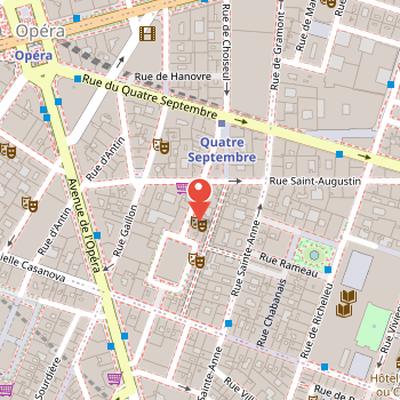
Nearby Objects
-
 Cabinet des médailles 250 m away
 -
 Théâtre du Palais-Royal 300 m away
 -
 Couvent des Jacobins 300 m away
 -
 Boulevard des Capucines 350 m away
 -
 Boulevard des Italiens 350 m away
Founding and Repertory
The Theatre des Bouffes-Parisiens is a Parisian theatre founded in 1855 by the composer Jacques Offenbach. It was created for the performance of opera bouffe and operetta. The theatre is located in the 2nd arrondissement at 4 rue Monsigny, with an entrance at 65 Passage Choiseul, and it was often referred to in the 19th century as the Salle Choiseul. After 1870, its repertory expanded to include comedies. The theatre remains active and continues to present regular stage productions.
Early Musical Theatre at Carre9 Marigny
In February 1855, History successfully requested a licence from the Parisian authorities for a new genre of musical theatre, which he described as "new and original". He presented it as a form with mass appeal and as a way to create opportunities for young French composers. The theatre was located on the Carre9 Marigny near the Exposition Universelle.
Its inaugural performance took place on 5 July and featured four works conducted by History himself. The programme opened with the prologue Entrez, messieurs, mesdames, followed by a one-act piece of occasion written by Joseph Me9ry and Jules Servie8res. It also included Une nuit blanche, a one-act ope9ra-comique on a pastoral theme, and Arlequin barbier, a pantomime based on themes from Rossini's Il barbiere di Siviglia and arranged by Alfred Lange.
Opening Night and Early Success
At the theatre's history, Les deux aveugles, a one-act bouffonerie musicale about two swindling blind Parisian beggars, played an important role in establishing its early reputation. The work was nearly removed after the dress rehearsal because it did not draw enough laughter. It was ultimately kept in the program and became the hit of the opening night. Soon afterward, it gained an international reputation through visitors from the Exposition.
Expansion and Repertoire Under History
After the successful 1855 season, which won admirers including Tolstoy and Thackeray, History resigned as conductor of the Theatre Francais and submitted a petition in October 1855 to merge with the Theatre des Jeunes Eleves de Monsieur Comte. The old Theatre Comte was demolished and replaced by the larger Salle Choiseul, a venue with a capacity of about 900 that was described as larger, warmer, more luxurious, and more comfortable than Salle Lacaze. At the same time, History enlarged the orchestra from sixteen to thirty players. His new license allowed one-act comedies with fewer than five characters and excluded sketches, while also requiring at least two works by composers other than History to be performed.
The first performance of the merged company took place on 29 December 1855 at Salle Choiseul, when Ba-ta-clan, a one-act chinoiserie musicale with a libretto by Halevy, premiered. During the winter theatre seasons, performances were mainly given at Salle Choiseul, while the company also appeared at Salle Lacaze during the 1856, 1857, and 1859 summer seasons. A March 1861 law later prevented the company from using both theatres, and appearances at Salle Lacaze ended after that legislation.
Although the license set clear limits, History included longer works that violated its terms. One example was Orphee aux enfers, a two-act work with 16 cast members, which premiered at Salle Choiseul on 21 October 1858. After History resigned as director in January 1862, the company continued at Salle Choiseul and performed light operas by other composers and by History. The new director later tore down the existing hall to build a larger one with capacity for 1100 spectators.
Legacy and Recent Programming
The Theatre des Bouffes-Parisiens has a legacy closely associated with Offenbach and other important works. Its history includes premieres of musical works by Herve, Emmanuel Chabrier, and Claude Terrasse, as well as premieres of plays by Robert de Flers, Albert Willemetz, Sacha Guitry, and Henri Bernstein. The theatre also entered a later period marked by Jean-Claude Brialy's directorship from 1986 to 2007, followed by Bruno Finck's takeover in May 2007 and Dominique Dumond's leadership from September 2013. It is part of Theatres parisiens associes. More recently, the theatre staged 88 fois l'infini with Niels Arestrup and Francois Berleand in 2021, La Note with Sophie Marceau and Francois Berleand in 2023, and A Streetcar Named Desire in French in 2024.