Au Lapin Agile is a cabaret located at 22 rue des Saules in the Montmartre district of Paris, near the Lamarck-Caulaincourt metro station. Established in the second half of the 19th century, it was acquired by Aristide Bruant in 1913. The venue became a meeting place for early 20th-century artistic bohemia, including Max Jacob, Pablo Picasso, Roland Dorgelès, Francis Carco, Blaise Cendrars, and Pierre Mac Orlan. It was also frequented in the 1940s and 1950s by Jean-Roger Caussimon and François Billetdoux. The cabaret remains active today.
Its history is connected to the changing character of Montmartre. In the 1880s, lower Montmartre hosted many cabarets, while upper Montmartre was described as village-like, with modest housing, small gardens, and limited shops. The cabaret was formerly named Cabaret des Assassins from 1869 because of wall engravings of famous assassins. Between 1879 and 1880, an owner commissioned André Gill to create a sign showing a rabbit escaping from a cooking pot.
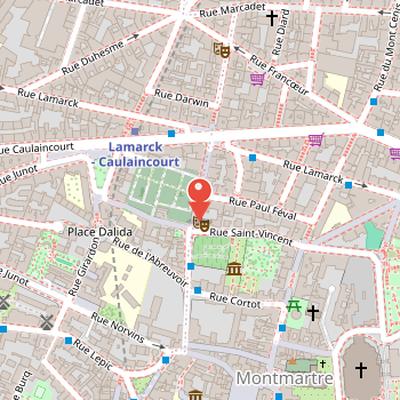
Nearby Objects
-
 Royal Abbey of Montmartre 70 m away
 -
 Saint-Vincent Cemetery 70 m away
 -
 Musée de Montmartre 110 m away
 -
 Place Dalida 140 m away
 -
 Montmartre 200 m away
History and Cultural Role
Au Lapin Agile is a cabaret located at 22 rue des Saules in the Montmartre district of Paris, near the Lamarck-Caulaincourt metro station. It was established in the second half of the 19th century and acquired by Aristide Bruant in 1913. The cabaret became a meeting place for the artistic bohemia of the early 20th century, with visitors including Max Jacob, Pablo Picasso, Roland Dorgeles, Francis Carco, Blaise Cendrars, and Pierre Mac Orlan. It was also frequented in the 1940s and 1950s by Jean-Roger Caussimon and Francois Billetdoux. The cabaret remains active today.
Montmartre Before and Around Au Lapin Agile
The history of Au Lapin Agile is closely linked to the changing conditions of Montmartre. The construction of the Fermiers generaux wall and the octroi tax on products entering Paris had an impact on the district, and by the end of the century lower Montmartre had become a pleasure zone. In the 1880s, this lower part of Montmartre hosted many cabarets, including Le Chat noir and Le Moulin-Rouge, and its population included prostitutes, their pimps, and various marginals.
By contrast, upper Montmartre kept a village-like character until 1914. It was known for fresh air, windmills, and low-cost housing, which attracted modest people and many artists, especially from 1890 onward. A description quoted from Roland Dorgeles's 1932 novel Le Chateau des brouillards evokes an older Parisian area before the Great War, with no buses, large buildings, or crowded sidewalks. Each intersection had a fountain stone, each house had a small garden, and only essential shops such as a bakery and a fruit seller served housewives. For other supplies, villagers went to the rue Lepic market, where vendors pushed goods in small carts.
The village also reflected social separation. Different classes coexisted without mingling: small bourgeois lived on rue Lamarck, retirees tended their peas on rue de la Bonne, and young criminals hid in small bars on rue des Abbesses.
From the Cabaret des Assassins to the Lapin Agile
The cabaret was originally called the Cabaret des Assassins from 1869, a name linked to wall engravings of famous assassins. Between 1879 and 1880, the owner commissioned the caricaturist Andre Gill to create a sign. Gill painted a rabbit wearing a green coat, red scarf, and three-bridge cap, shown escaping from a cooking pot. The cabaret then became known as Au Lapin a Gill and was soon renamed Lapin agile. A copy of Gill's sign has replaced the original since the early 20th century.
Au Lapin agile also attracted a lively artistic public. The chansonnier Aristide Bruant was a regular and brought Toulouse-Lautrec and Courteline. Amateur concerts were held there on Saturday evenings and Sunday mornings under police supervision. At the start of the 20th century, mother Adele sold the venue to Berthe Sebource, who lived there with her daughter Marguerite Luc, known as Margot. Margot later became the wife of Pierre Mac Orlan.
In 1903, Frederic Gerard, known as le pere Frede, joined the cabaret and helped make Au Lapin agile a key Montmartre artistic bohemian venue.
Frdric Gerard and the Cabaret
Frdric Gerard was born in Athis-Mons, Seine-et-Oise, and later married Pauline Gacogne in Gagny, Seine-et-Oise. He became associated with Montmartre through his work selling seasonal products on the sidewalks with a donkey named Lolo. He also became the owner of the cabaret Le Zut, located on rue Norvins or rue Ravignan. In addition to this role, he performed sentimental romances and realistic songs, accompanying himself on cello or guitar. He died at Le Lapin Agile and was buried at Saint-Cyr sur Morin, Seine-et-Marne.
Le Lapin Agile Under Frederic Gerard
During the period of Frederic Gerard, Le Lapin Agile became a cultural institution for the bohemians of Montmartre. Gerard offered meals and drinks to penniless artists in exchange for art, which helped give the cabaret a distinctive social role. He was later nicknamed Tavernier du Quai des Brumes in the poem Au Lapin Agile by Jean-Louis Vallas. Gerard also became friends with Aristide Bruant, who regularly visited the cabaret. In 1913, Bruant bought Le Lapin Agile to prevent its demolition, and Gerard managed it after the purchase.
The cabaret attracted a wide range of artists and writers. Pierre Mac Orlan visited often and sang regimental songs two to three nights a week, while Roland Dorgeles sang more rarely. Other frequent visitors included Max Jacob, Andre Salmon, Paul Fort, and Gaston Coute. Guillaume Apollinaire read poems from Alcools there, and Charles Dullin made his debut at Le Lapin Agile in 1902 with poem recitations. Picasso also painted Marguerite Luc and Arlequin drinking there in 1904 and 1905.
Le Lapin Agile was also frequented by anarchists from Le Libertaire and by criminals from Bas Montmartre and Goutte-d'Or. Francis Carco visited during the winter of 1910 to 1911, and the cabaret also witnessed violent incidents involving criminals brandishing razors.
Artists, Conflict, and Reputation
At the time of Frederic Gerard, the cabaret was intended to attract a clientele of artists. Gerard also sought to drive away unwanted patrons in order to preserve peace for the artists, but his presence was disliked by some gentlemen who wanted to take part in the festivities. This tension was reflected in a series of occasional violent incidents at the cabaret, including nights when gunshots were fired from outside through the windows. Police did not intervene during these events. Roland Dorgeles later mentioned such violence in his novel Le Chateau des brouillards, and one attack at the cabaret formed the basis of Pierre Mac Orlan's novel Le Quai des brumes. According to Mac Orlan, the troubled period lasted two or three years. Violence peaked in 1910, when Victor, one of Gerard's sons, was shot in the head behind the bar. After this period, Gerard remained master of the situation.
The Boronali Hoax and Artistic Debate
Au Lapin Agile was associated with a sharp antagonism between avant-garde artists and traditionalists around Roland Dorgelès. The traditionalists opposed abstract painting and argued that art should represent the real world in a recognizable way. In 1910, Dorgelès organized a hoax painting titled Et le soleil s'endormit sur l'Adriatique, which was presented as the work of a previously unknown Italian artist named Joachim-Raphael Boronali. Boronali was described as a theorist of a new artistic movement called excessiveism, and the Excessivism Manifesto was written by Dorgeles himself. In reality, the painting was made by Lolo, the donkey of Au Lapin Agile. Dorgeles, Warnod, and Depaquit attached a brush to the donkey's tail to paint the canvas. The name Boronali was an anagram of Aliboron, the nickname of the donkey. Dorgeles later revealed the hoax in the satirical newspaper Fantasio, with official verification. He said the aim was to show that the work of a donkey could fit among the artworks exhibited at the Salon des independants, while also criticizing artists who crowded the salon and, in his words, were fools, incapable, and vain.
Later History and Cultural Role
After the Great War, Le Lapin agile lost its position as a meeting place for avant-garde writers and artists, as the center of creative gravity moved first to Montparnasse and later, after World War II, to Saint-Germain-des-Pres. In 1922, Aristide Bruant sold the cabaret to Paulo, who was the son of Frederic Gerard and a student of Bruant. Even as its earlier role diminished, the cabaret remained connected to artistic life: some painters lived there, and painters continued the annual tradition of ending Salon d'Automne inauguration days at Le Lapin agile. Its clientele also included Pierre Brasseur, Georges Simenon, and American celebrities such as Rudolph Valentino, Vivien Leigh, and Charlie Chaplin.
From Occupation to a Continuing Cabaret Tradition
Le Lapin agile continued its activities during the Occupation, and after 1945 it became a meeting place and a springboard for artists. Its postwar role is marked by several notable encounters and early performances: the guitarist Alexandre Lagoya met Leo Ferre there in 1950, and Claude Nougaro made his first stage appearances at the cabaret in 1955, first as a poet and then as a singer. In 1972, Paulo Gerard transferred the management of the cabaret to his son-in-law Yves Mathieu, who is the current proprietor. Even today, the venue still organizes evenings featuring singers and humorists.