The Royal Abbey of Montmartre, also known as Notre-Dame de Montmartre, was an abbey for Benedictine nuns founded by King Ludwig VI in 1133/34, in place of a Cluniac priory belonging to Saint-Martin-des-Champs, Paris. The women’s monastery formed a large complex, founded in 1136 and abandoned in 1686, located east, south, and southwest of the church of Saint-Pierre-de-Montmartre. Its grounds included what is now Place du Tertre and parts of Rue du Mont-Cenis, Rue Azaïs, and Rue Saint-Eleuthère. The entrance was at the forecourt of Saint-Pierre church.
After a fire in 1559, the buildings were rebuilt around a cloister. The complex included a chapter house on the east side, a refectory on the south side, dormitories and cells on the upper floor, and passages linking the cloister and church. Another part of the abbey, the Abbaye d’en haut, was mostly destroyed; only the Chœur des Dames, an apse, and two chapels remained at the head of Saint-Pierre church. These remains were used for ceremonies and for the burial of abbesses.
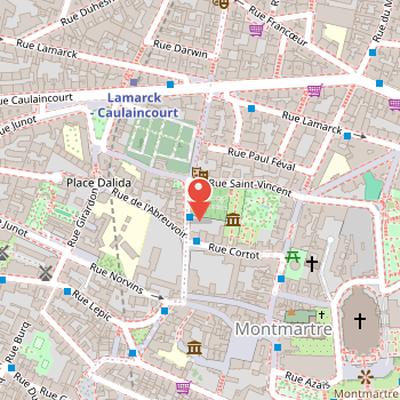
Nearby Objects
-
 Musée de Montmartre 60 m away
 -
 Au Lapin Agile 70 m away
 -
 Saint-Vincent Cemetery 120 m away
 -
 Montmartre 140 m away
 -
 Place Dalida 150 m away
Foundation of the Royal Abbey
The Royal Abbey of Montmartre, also known as Notre-Dame de Montmartre, was an abbey for Benedictine nuns. It was founded in 1133 or 1134 by King Ludwig VI. According to the available facts, the king established it instead of a Cluniac priory that belonged to Saint-Martin-des-Champs, Rue des Moines, Paris. This foundation marked the beginning of the abbey's religious role under royal patronage.
Layout of the Royal Abbey of Montmartre
The Royal Abbey of Montmartre was a 13 hectare complex founded in 1136 and abandoned in 1686. It was located east, south, and southwest of the church of Saint-Pierre-de-Montmartre. Its land later included Place du Tertre and the section of today's Rue du Mont-Cenis between the forecourt of Saint-Pierre church and Rue Azaais, and it also covered the area of Square Nadar, the reservoir, and Rue Azaais up to the southern part of Rue Saint-Eleuthere, formerly Rue de l'Abreuvoir. The abbey entrance was at the forecourt of the church, and another access point was east of today's Place des Abbesses, with Rue des Martyrs leading westward along the cloister wall toward today's Rue des Abbesses. The abbey church stood at the intersection of Rue Yvonne-le-Tac and Rue des Martyrs, while the abbey buildings were north at the intersection of Rue des Martyrs and Rue La Vieuville. Its gardens extended east to today's Marche Saint-Pierre.
After a fire in 1559, the abbey buildings were rebuilt around a cloister whose north side ran along the church up to the choir. A chapter house stood on the east side of the cloister, perpendicular to the church, and a refectory was on the south side. Dormitories and cells occupied the upper floor. The cloister connected to the choir by a door on the ground floor and to the galleries of the church nave reserved for nuns by a door on the upper floor. A courtyard ran perpendicular to the church and was lined with buildings including servant quarters and stables.
Part of the land was sold in 1635 to a religious community. The Abbaye d'en haut, replaced in 1686 by an abbey from a 1622 priory, was mostly destroyed except for the Choeur des Dames, an apse, and two chapels at the head of Saint-Pierre church. The Choeur des Dames was used for ceremonies and for the burial of abbesses. In 1794, it was crowned by a tower with a Chappe telegraph, the first of sixteen stations on the Paris-Lille line, and this building disappeared in 1866. Some of the abbey's building materials were reused in the construction of the new abbey.
The Two Successive Abbeys of Montmartre
The Royal Abbey of Montmartre consisted of two successive establishments. An earlier chapel had already existed on Montmartre hill in the 7th century, and a hamlet formed around it. In 835, the chapel beams had to be replaced because of worm damage. In 1096, the monks of Saint-Martin-des-Champs priory received the chapel, as well as the Chapelle du martyrium, which had been built around the 9th century on the slope of Montmartre hill near the present crossroads of Rue des Martyrs and Rue Yvonne Le Tac.
The upper abbey, called L'Abbaye d'en haut, was built in 1133 by King Ludwig VI in Montmartre. In the same year, Ludwig VI founded a convent for women at Queen Adelheid's request, exchanged Montmartre property with monks for the Church Saint-Denis-de-la-Chartre, and built a church and convent on the summit of Montmartre hill. Benedictine nuns from Saint-Pierre-les-Dames Abbey in Reims managed the convent from 1133. The abbey was founded with farmland, a hamlet, early Christian relics, Saint-Pierre church, an ancient necropolis, and the Martyrium chapel. Its buildings, gardens, and vineyards covered 13 hectares in Montmartre.
The upper abbey was abandoned in 1686 and was later replaced by the lower abbey, called L'Abbaye d'en bas. The lower abbey was destroyed in 1794.
History and Layout of the Royal Abbey
The religious community at the Royal Abbey of Montmartre included an abbess, a Dame du lieu, and about 55 nuns, including lay sisters. The abbey had an income of 30,000 livres and maintained high, medium, and low jurisdiction until Ludwig XIV abolished special jurisdictions in Paris in 1674. Before that reform, the abbess had a bailiff, procurators, courts, and a prison; after 1674, the abbeys jurisdiction was exercised only within its enclosure.
Several important sacred spaces are recorded in its history. The Chapelle du Martyrium was rebuilt in 1134, and its crypt contained a grotto reached by 60 steps, although it later became inaccessible after a collapse. Pope Innocent II confirmed the rule and possessions of the monastery in October 1136. Pope Eugene III consecrated Saint-Pierre church on Easter Monday, 11 April 1147, with Bernhard of Clairvaux and Petrus Venerabilis in attendance. In 1175, Ludwig VII limited the number of nuns to 60 because the convent was attracting many people.
The abbey was also the setting for later historical events. On 15 August 1534, Ignatius von Loyola, Pierre Favre, Franz Xaver, Alfonso Salmeron, Diego Lainez, Nicolas Bobadilla, and Simao Rodrigues took vows of poverty, chastity, travel to Jerusalem, and dedication to helping pagans and believers. The group named their order the Society of Jesus in 1537, and it was approved by Pope Paul III in 1540. After a major fire in 1559, the abbey was largely rebuilt. During the siege of Paris in 1590, Parisians referred to it as Magasin des putes de l armee because of moral negligence, though it is unclear whether this reflected the conduct of the nuns or earlier conditions. Marie de Beauvilliers became abbess in 1598 and restored order to the community.
In 1611, a staircase was rediscovered in the Chapelle du Martyrium de Saint Denis during work there, leading to a vaulted crypt with inscriptions interpreted as the martyrdom site of Saint Dionysius. Around 1686, the whole abbey moved to new buildings around the priory. The cloister of the upper abbey was demolished, and the dilapidated buildings were used only for grain and fodder storage. The nuns continued to pray in the reserved part of Saint-Pierre church, including the choir and the first three bays, called Choeur des Dames, while another part of the church was used for parish worship. The cloister walkway, the covered gallery, was preserved. The lower abbey included a chapel under a dome displaying relics, a piece of Christ s garment, and bones of several saints, as well as a cloister towards the hilltop.
Dissolution and Later Transformation
The abbey was closed in 1790, and in May 1794 its entire property was sold in ten lots. The holdings included the lower abbey, the remains of the upper abbey, the covered gallery, gardens, quarries, and farmland on the south side of the hill. Most of the buyers were masons, contractors, and quarry workers, reflecting the practical reuse that followed. One contractor acquired lot 1, including the buildings of the lower monastery around the crypt of Sanctum Martyrium, and then demolished everything on the lot in order to dig a gypsum quarry. The quarry was later filled to create roads such as Place des Abbesses, Rue Antoinette, and the northern part of Rue des Martyrs, and it was also used to build houses. The gallery between the two abbeys was destroyed by quarry workers. Of the original property, the Saint-Pierre church, a parish church not sold in 1794, is the only surviving remnant. The abbey also left a strong mark on local naming: Place des Abbesses and the Paris metro station were named after the 46 abbesses who led the abbey, and nearby streets such as Rue Catherine-de-La-Rochefoucauld, Boulevard Marguerite-de-Rochechouart, and Rue Marie-Eleonore-de-Bellefond were named accordingly.
Abbey Remains and Surviving Objects
The surviving remains associated with the Royal Abbey of Montmartre were located in the Rue de la Heaumerie and the cul-de-sac called For-aux-Dames. These single building parts contained an auditorium and a prison, and they belonged to the nuns as holders of jurisdiction. The site is described as having a history that reaches back to the origins of Paris, placing it among the oldest documented layers of the city. Some objects linked to the abbey are now held by the Societe du Vieux Montmartre, including a bell acquired in 2007. This bell dates from 1623 and was commissioned by Abbess Marie de Beauvilliers. It originally hung over the lower abbey chapel called Sanctum Martyrium, but was lost during demolition in a quarry excavated at the site. Rediscovered in 1880, it is now located in the choir of the Saint-Pierre de Montmartre church.
Abbesses and Leadership at the Royal Abbey of Montmartre
The Royal Abbey of Montmartre was shaped over the centuries by a long succession of abbesses, many of whom are documented with precise dates of leadership and death at the site. Early leadership included Adelheid von Savoyen from 1134 to 1137, Christine de Courtebrone from 1137 to 1153, and Adle until her death in 1174. Christine de Courtebrone received Pope Eugen III in 1147, showing that the abbey was a place of high-level ecclesiastical visitation.
Later abbesses continued this line of governance. Elisabeth led from 1179 to 1195 and died at the abbey in January 1199. Helisende or Heloise I governed from 1218 to 1231 and is noted for allowing nuns to wear lined boots because of winter cold, a detail that reflects daily life and practical adaptation within the community. Mahaut du Fresnoy, abbess from 1270 to 1280, is remembered through her tombstone in the church of the abbey.
The abbey's leadership remained closely tied to the site itself, with several abbesses dying there, including Alix de Don, who died on the first day of Lent, Adeline d'Ancilly, who died in 1300, Ada de Mincy, who died on the feast day of Saint Cosmas in 1317, and Jeanne IV du Coudray, who died in 1426. Simone d'Herville also died at the abbey in 1434, as did Pétronille II de La Harasse in 1477, Marguerite I Langlois in 1503, Claude I Mayelle in 1518, Antoinette Auger in 1539, and Jeanne V Lelièvre, who died on March 30, 1540 and was buried next to Antoinette Auger.
Several appointments also show the abbey's role in reform and outside connections. Marie I Cornu, from the Abbey Les Fontaines, was appointed by the Bishop of Paris to reform the Abbey Montmartre. Martine du Moulin, who had been a nun at Chelles and was related to the family du Moulin, lords of Fontenay en Brie and Servon, ruled until her death at age 86. Antoinette Auger was elected in 1519 and later led the abbey again from 1532 to 1539. Ignatius of Loyola and companions visited her on August 15, 1534, adding another notable episode to the abbey's history.
Across these centuries, the Royal Abbey of Montmartre appears as a religious institution marked by continuous female leadership, burial and memorial practices within its church, and occasional links to prominent church figures and reforming efforts.
Abbesses of the Royal Abbey of Montmartre
The history of the Royal Abbey of Montmartre in this period is marked by a succession of abbesses, several of whom were connected to prominent noble families. Marguerite II de Havard de Senantes, daughter of Jacques, Seigneur de Senantes, died on July 18, 1552. Leadership then passed to Catherine II de Clermont, who served from 1548 to 1589. She was a niece of Diane de Poitiers, was appointed by King Henry II, and died at the abbey on September 15, 1589.
Claude II de Beauvilliers led the abbey from 1589 to 1590. She was the mistress of King Henry IV and later abbess of Pont-aux-Dames. Catherine III de Havard de Senantes followed, serving from 1590 to 1598. On February 7, 1598, Marie-Catherine de Beauvilliers de Saint-Aignan was appointed abbess; she was the sister of Claude II and remained in office until 1657, dying at the abbey on April 21 of that year.
Françoise-Renee de Guise governed from 1657 to 1682. She was the daughter of Charles de Lorraine, Duc de Guise, and Henriette Catherine de Joyeuse, and had previously been abbess of Saint-Pierre-les-Dames in Reims in 1639 before being transferred to Saint-Pierre de Montmartre on July 31, 1644. During her leadership, the nuns included Elisabeth Le Coq. She was also a niece of abbess Renee II of Lorraine.
The next abbesses were Marie-Anne de Lorraine-Harcourt, from 1683 to 1699, Marie III Eleonore Gigault de Bellefond, from 1699 to 1717, and Marguerite III de Rochechouart de Montpipeau, who was received on February 14, 1718 and served until 1727. Marie-Anne de Lorraine-Harcourt was the daughter of François Louis de Lorraine and Anne d'Ornano, became abbess in March 1683, and died on October 29, 1699. Marie III Eleonore Gigault de Bellefond assumed leadership on December 24, 1699 and died on August 17, 1717. Marguerite III de Rochechouart de Montpipeau died on October 22, 1727.
Abbesses in the 18th Century
From 1727 to 1731, the Royal Abbey of Montmartre was led by Louise-Emilie de La Tour d'Auvergne. She was the daughter of Frederic-Maurice de La Tour d'Auvergne and Franziska von Hohenzollern-Hechingen, and had previously served as abbess of Villers-Cotterets for 20 years. She retired in 1731 and died in June 1737. After her retirement, Catherine IV. de La Rochefoucauld de Cousage took over the leadership of the abbey, serving from 1731 to 1760. She had previously been abbess of Saint-Jean-Baptiste de Duno near Orleans and was appointed on July 8, 1731. Catherine IV. de La Rochefoucauld de Cousage died on September 11, 1760.
Marie-Louise de Montmorency-Laval and the Abbey
From 1760 to 1790, the Royal Abbey of Montmartre was led by Marie-Louise de Montmorency-Laval. Born on March 31, 1723, she had originally been a nun at the Abbey Saint-Julien-du-PrE in Le Mans. She was also the patroness of the new bell of the old church Saint-Gilles in Bourg-la-Reine and served as lady of Bourg-la-Reine. After leaving the abbey, she worked on the reform of Abbey BiEvres and later retired, remaining Mere antique until her death.
Marie-Louise de Montmorency-Laval and other nuns were expelled from the abbey on August 19, 1792. She was sentenced to death on July 24, 1794, when she was paralyzed, deaf, and blind, and she was executed by guillotine on 26 July 1794.
Burials and Internal Layout
The surviving individual building parts included the Abbaye d’en Haut and the Abbaye d’en Bas. These parts were also associated with several burial places. Abbesses were buried under the floor of the choir, while nuns were buried in the garden called Jardin du Calvaire, in the church, and in the crypt under the apse. In some cases, the oldest graves were exhumed to create space, and the bones were later moved to the church attic and under the roofs of the side aisles. These burial arrangements show that the abbey included both sacred interior spaces and surrounding areas used for interment.