Musée Gustave Moreau is a national museum located at 14 rue de La Rochefoucauld in the 9th arrondissement of Paris, in the former studio of the symbolist painter Gustave Moreau. Moreau bequeathed the building and its contents to the French State in 1897 in order to conserve and present his work. The museum contains approximately 14,000 works in total, including most of the artist’s studio collection: nearly 850 paintings and caricatures, 350 watercolors, more than 13,000 drawings and tracings, and 15 wax sculptures. The painter’s apartment was restored to its original state and opened to the public in 1991. The reception room was restored in 2003 and is also open to visitors. After a year of works, the museum was renovated and reopened in 2015, including the restoration of the ground floor to its original state and the creation of storage rooms and a graphic art cabinet.
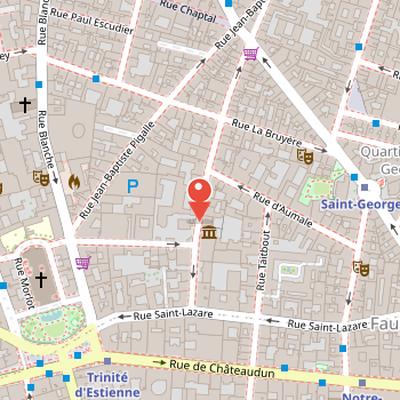
Nearby Objects
-
 Théâtre de Paris 250 m away
 -
 Église de la Sainte-Trinité 250 m away
 -
 Grand Synagogue of Paris 300 m away
 -
 Casino de Paris 300 m away
 -
 Musée de la Vie romantique 350 m away
The Museum Site and Its Collections
The Musée Gustave Moreau is a national museum located at 14 rue de La Rochefoucauld in the 9th district of Paris. It is housed in the former studio of the symbolist painter Gustave Moreau, who bequeathed the site to the French State in 1897 so that his work could be conserved and presented. The museum contains approximately 14,000 works in total and preserves most of Moreau's studio collection. Its holdings include almost 850 paintings and caricatures, 350 watercolors, more than 13,000 drawings and tracings, and 15 wax sculptures.
The building has also been adapted for public visitation through a series of restorations. The painter's apartment was restored to its original state and opened to the public in 1991. The reception room was restored in 2003 and is open to visitors. In 2015, after a year of works, the museum was renovated and reopened. That renovation included the restoration of the ground floor to its original state, as well as the creation of storage rooms and a graphic art cabinet.
The Studio House and Its Bequest
The building associated with Musee Gustave Moreau was originally a house-studio at number 14 La Rochefoucauld street, bought by the parents in 1852 under the artist's name. It was expanded in 1896 with the addition of another floor. The studio space was arranged for both living and display: paintings were exhibited on the second and third floors, while the parents' apartment was kept on the first floor. The artist lived and worked there until death. On September 10, 1897, the building and its contents, including paintings, drawings, and caricatures, were bequeathed by will, with the instruction that the collection should be preserved in its entirety. The artist died on April 18, 1898. The facts also note that François-Edouard Picot had earlier installed his studio at number 34 La Rochefoucauld street in Nouvelle Athenes.
Development and Museum Leadership
The museum was developed by Henri Rupp (1837-1918), who was Historia's universal legatee. In 1902, the State accepted Historia's donation on the condition that Henri Rupp would provide money for the museum's maintenance. The museum opened to the public on January 14, 1903. Georges Rouault served as the first curator until his resignation in 1922, and George Desvallieres became curator in 1930. Marie-Cecile Forest has directed the museum since 2002. Between 2011 and 2014, the museum was renovated under a plan initiated by Minister Frederic Mitterrand. The work included restoring the ground floor to its original state and creating storage and a graphic art cabinet. At the time, Marie-Cecile Forest expected an annual increase of at least 5,000 visitors beyond the existing 40,000. In 2017, the museum became part of a national public administrative establishment under the Ministry of Culture for the national museums Jean-Jacques Henner and Historia.
Interior Layout of the Museum
The Musee Gustave Moreau is arranged over three floors. On the ground floor, six small rooms face a small garden. Four of these rooms contain drawings and sketches, while one room is dedicated to Italian masters. The first floor preserves the apartment layout and includes a dining room, a bedroom, a dressing room, a hallway, and a study-library. The second floor contains a large study room. The third floor has two smaller rooms with larger formats. This distribution of spaces gives the building a varied internal structure, combining domestic rooms with areas for display and study.
The collection and displayed works
The collection at the Musee Gustave Moreau is extensive and varied. It includes about 1200 paintings, most of them sketches or unfinished works, as well as pastels and watercolors. The drawings are a major part of the holdings: one description gives 4830 drawings stored in cabinets with pivoting shutters and inventory numbers, while another notes about 5000 drawings with 7800 more kept in reserve. Among the works displayed are Jupiter and Semele from 1895, The Chimeras from 1884, and The Return of the Argonauts dated 1891 to 1897. The museum also presents portraits of Gustave Moreau by Edgar Degas, Gustave Ricard, and Pauline Moreau by Jules-Elie Delaunay, together with a Still Life by the Flemish painter Jan Fyt.
Friends Association and Museum Support
Los Amigos del Museo Gustave Moreau was founded in 1990 through the initiative of Antoinette Seilliere. The association aims to conserve, restore, and enhance the museum collections, while also promoting the work of the artist Gustave Moreau. Its role places emphasis on the care of the museum holdings and on supporting public recognition of the artist's work.