The Musée de la Vie romantique is located in the Nouvelle Athènes district of Paris, at 16 rue Chaptal, in the Hôtel Scheffer-Renan. This building was the former home of the Dutch-origin painter Ary Scheffer and was a center of romantic inspiration in the first part of the 19th century. The museum is set at the end of a somewhat secret garden with rose and fuchsia bushes and century-old trees, and a tearoom is installed in the greenhouse facing the garden.
The museum occupies the former studios of Ary Scheffer, used for public reception and temporary exhibitions. On the ground floor of the pavilion built in 1830, it presents memories of novelist George Sand, including paintings, drawings, sculptures, furniture, jewelry, and showcase objects from her residence at Nohant in Berry. The museum also holds items bequeathed in 1928, with usufruct to the City of Paris, by George Sand’s granddaughter Aurore Lauth-Sand. The upper-floor rooms evoke the memory of Ary Scheffer, his contemporaries, and philosopher Ernest Renan. The building was a private home until 1858, later became property of the French State in 1982, and is now among the museums managed by Paris Musées.
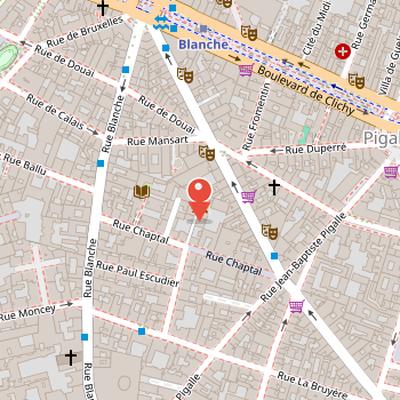
Nearby Objects
-
 Théâtre du Grand-Guignol 40 m away
 -
 Le Chat Noir 300 m away
 -
 Place Pigalle 300 m away
 -
 Théâtre de Paris 300 m away
 -
 Café de la Nouvelle Athènes 350 m away
Location and Historical Setting
The Musee de la Vie romantique is located in the quartier de la Nouvelle Athenes in Paris, at 16, rue Chaptal. It is installed in the hotel Scheffer-Renan, which was the former home of the painter Ary Scheffer, of Dutch origin. In the first part of the 19th century, this building served as a center of romantic inspiration, giving the museum a direct connection to the cultural atmosphere associated with that period.
Setting and Museum Layout
The Musee de la Vie romantique is located in the Nouvelle Athenes district on the slopes of Montmartre hill in Paris, at the end of a somewhat secret garden planted with rose and fuchsia bushes and century old trees. A tearoom is installed in the greenhouse facing the garden. The museum neighbors the former studios of painter Ary Scheffer, the first occupant of the building, and these studios are used for public reception and temporary exhibitions.
The museum is arranged across several spaces that reflect different parts of its history and collections. On the ground floor of the pavilion built in 1830, it exhibits memories of novelist George Sand, including paintings, drawings, sculptures, furniture, jewelry, and showcase objects from her residence at Nohant in Berry. It also holds items bequeathed in 1928, with usufruct to the City of Paris, by George Sand's granddaughter Aurore Lauth-Sand. The upper floor rooms evoke the memory of Ary Scheffer, his contemporaries, and philosopher Ernest Renan. The museum is one of fourteen museums managed by the Paris Musées administrative public institution.
From Ary Scheffer's House to a Museum
The building now associated with the Musee de la Vie romantique was formerly the house of the painter Ary Scheffer from 1830 to 1858. After 1858, it remained in the hands of the painter's lateral female descendants, and it was fixed as a place from 1858 to 1900. Scheffer also used the house as a social meeting point, hosting Friday evening gatherings that brought together figures such as Franz Liszt and Felicite de La Mennais, as well as Pierre-Antoine Berryer, Arthur de Gobineau, Jean-Auguste-Dominique Ingres, Ivan Tourgueniev, Alphonse de Lamartine, Pauline Viardot, George Sand, and Frederic Chopin. The property became the French State's in 1982, and the entire property was later transferred by the French State to the City of Paris. The museum opened with an active acquisition policy from the outset, drawing early Ary Scheffer holdings mainly from deposits from the Carnavalet Museum and the Historical Library of Paris, with loans from the Dordrecht Museum. The museum also developed broader collections through later donations and acquisitions, including the Romantic memorabilia donated by Pierre Berge in 1995, reference works on George Sand from the family of Georges Lubin after 2000, and additional Rachel-related objects and publications acquired by the Friends of the museum in 2012. In 2003, a complementary renovation of two workshops for temporary exhibitions was directed by Francois-Joseph Graf. The museum also includes scientific equipment, family archives related to Ernest Renan and Ary Renan, and a library. Its administration changed over time, with Daniel Marchesseau retiring, Jerome Farigoule succeeding him, and Gaelle Rio taking over museum direction in 2019.
The Lundis Romantiques at the Venue
Histoire du batiment hosted the lundis romantiques, a series of literary and musical evenings inaugurated by Jean d'Ormesson. These events were organized eleven times each year at the venue. Between 1999 and 2012, they welcomed many personalities, including writers Marc Fumaroli, Jean-Marie Rouart, and Marc Lambron. The program also featured piano performers such as Marc Laforet, Jean-Marc Luisada, Alain Planes, and Yves Henry, as well as younger artists including violinist Laurent Korcia and pianists Bertrand Chamayou, Khatia Buniatishvili, and Adam Laloum. Chamber music formations in trios and quartets also took part in the series.
Renovation and Museographic Renewal
The Musee de la Vie romantique became part of the museums managed by Paris Musees. It later reopened after renovation work carried out at a cost of 3.8 million euros. The restoration covered the roofs, glass roofs, and carpentries, while the facades were restored using traditional lime techniques. The permanent route was modernized with enhanced mediation, and the museum reopened with a renewed museographic route. Its focus remains on painter Ary Scheffer and the Romantic movement.
Collections and Exhibits
The museum presents a varied collection centered on George Sand and the Romantic era. Its displays include furniture, paintings, drawings, sculptures, art objects, jewelry, and memorabilia belonging to George Sand. It also shows major canvases by George Sand, as well as sculptures and art objects from the Romantic era. Among the items on view are numerous medallions displayed in a showcase and a selection of works on paper, especially signed pieces.
The museum also holds specific notable objects, including Satan, a bronze from 1833 donated by Les Amis du musee in 2011; La Mort d'Harold, a bronze from 1842 purchased in 2012; Jeanne d'Arc, a bronze circa 1837 that was purchased; and General Cavaignac's silver-plated bronze box, donated by Les Amis du musee in 2002.