Théâtre de Paris is a theatre building in Paris associated with a long sequence of uses on the same site. The first theatre there was built by the Duke of Richelieu in 1730. In 1779, Baron Ogny bought the property and renamed it Folie-Richelieu. During the First Empire, it was directed by Fortunée Hamelin. The Folie-Richelieu was turned into a park in 1811 and completely demolished in 1851 under Baron Haussmann’s redevelopment.
The site later became the location of the church of Sainte-Trinité de Paris and also included a roller skating rink. Part of the rink became the Palace Théâtre in 1880, using plans by Aimé Sauffroy and Ferdinand Grémailly, and the Casino de Paris was restored in 1891 by Édouard Niermans. The remaining part of the rink near rue Blanche was demolished for the Nouveau-Théâtre, whose first director was Aurélien Lugné-Poe. His work there included productions that formed part of the broader theatrical history of the site.
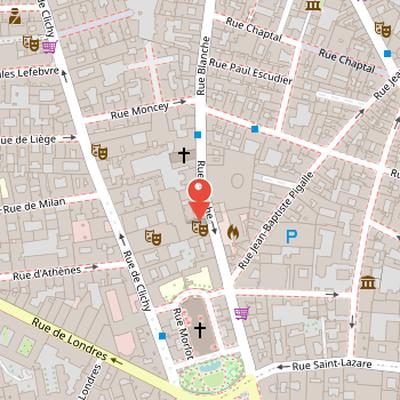
Nearby Objects
-
 Casino de Paris 100 m away
 -
 Église de la Sainte-Trinité 150 m away
 -
 Musée Gustave Moreau 250 m away
 -
 Musée de la Vie romantique 300 m away
 -
 Théâtre du Grand-Guignol 350 m away
From Folie-Richelieu to Theatre Site
The site of the Theatre de Paris has undergone several major transformations. The first theatre on the site was built by the Duke of Richelieu in 1730. In 1779, Baron Ogny bought it and renamed it Folie-Richelieu. During the First Empire, Fortunee Hamelin directed it, and in 1811 the Folie-Richelieu was turned into a park. It was completely demolished in 1851 as part of Baron Haussmann's redevelopment. The site later became occupied by the church of Sainte-Trinite de Paris. At one stage, part of the land included a roller skating rink, and this rink became the Palace Theatre in 1880, based on plans by Aime Sauffroy and Ferdinand Gremailly. The Casino de Paris was restored there in 1891 by Edouard Niermans, while the remaining part of the rink near rue Blanche was demolished for the Nouveau-Theatre.
From Nouveau-Theatre to Theatre de l'Oeuvre
The early history of the theatre is closely linked to Aurelien Lugne-Poe, who was the first director of the Nouveau-Theatre. Before taking on that role, he acted in the Theatre Libre company from 1888 to 1890, completed four months of military service in early 1891, and then joined Paul Fort's Theatre d'Art in 1891. Theatre d'Art had already been presenting poetry recitations and dramatic works by Marlowe, Shelley, and Hugo from 1890 to 1892, as well as new plays by Rachilde, Paul Verlaine, and Maurice Maeterlinck. In 1893, Lugne-Poe took control of Theatre d'Art and renamed it Theatre de l'Oeuvre. Under this name, the theatre pursued Symbolist programming from 1893 to 1897. It also helped introduce Paris audiences to Henrik Ibsen's modern drama, with Lugne-Poe premiering nine Ibsen plays during this period.
Lugne-Poe and the Nouveau-Theatre Season
Lugne-Poe secured the Nouveau-Theatre space for the first time for the May 1894 production of Henri Bataille and Robert d'Humieres' Sleeping Beauty. He then assumed the directorship for most of the 1894-95 season and presented a series of premieres there, including Maeterlinck's adaptation of John Ford's Tis Pity She's a Whore (Annabella), Beaubourg's The Mute Voice, Strindberg's The Father, Sudraka's The Little Clay Cart, and Maeterlinck's Interieur. He returned to conclude the 1894-95 season with Ibsen's Brand, and later staged the second half of the 1895-96 season beginning in March 1896.
Premieres at the Nouveau-Theatre
Under Lugne-Poe, the Nouveau-Theatre served as a major venue for premieres from 1896 to 1899. The sequence began with Ibsen's Pillars of Society on 22-23 June 1896, followed by Ibsen's Peer Gynt on 11-12 November 1896 and Alfred Jarry's Ubu Roi on 9-10 December 1896. The theatre continued to present new works in close succession, including Bjornson's sequel to Beyond Human Power in January 1897, Hauptmann's fairy drama The Sunken Bell in March 1897, Bataille's Your Blood in May 1897, Ibsen's Love's Comedy in June 1897, and Ibsen's John Gabriel Borkman in November 1897. In 1898, the repertoire included Gogol's The Inspector General in January, and two works by Romain Rolland, Aert in May and The Wolves later that month. Premieres continued in 1899 with Paul Sonnie's Fausta and Lucien Mayrargue's The Yoke. These productions indicate the theatre's role as a site for new dramatic writing and repeated first performances during this period. Lugne-Poe's work for the Theatre de l'Oeuvre later ended at the Theatre des Bouffes-Parisiens.
Artistic Direction and Name Changes
Under Rejane's artistic direction, the theatre became associated with notable productions, including the French premiere of Maeterlinck's L'oiseau bleu in 1911 and performances of Victorien Sardou's Madame Sans-Gene. In 1919, a stipulation in the sales contract prevented the theatre from retaining the name Rejane. Later, the artistic direction passed to Alain de Leseleuc from 1965 to 1975, and then to Robert Hossein from 1975 to 1990.
Premieres and Notable Productions
The Theatre de Paris, then known as the Nouveau-Theatre, was associated with a series of notable premieres in the late 19th and early 20th centuries. In 1892, it premiered Rabelais, a play by Oscar Metenier. Other early premieres included Nos bons chasseurs, a vaudeville by Charles Lecocq with text by Paul Bilhaud and Michel Carre, in 1894, followed by Brouillard du matin by Jacques Copeau in 1897 and Le Reformateur by Edouard Rod in 1906.
The venue also presented important premieres by Lugne-Poe's Theatre de l'OEuvre. These included Le Pere, a tragedy in three acts by August Strindberg in 1894; The Little Clay Cart, a drama in five acts by Sudraka in 1895; Intérieur by Maurice Maeterlinck in 1895; Brand, a play in five acts by Henrik Ibsen in 1895; Les Soutiens de la Societe in 1896; Peer Gynt in 1896; Ubu Roi by Alfred Jarry in 1896; and John Gabriel Borkman in 1897. In 1908, the theatre also premiered Qui perd gagne by Pierre Veber. These productions show the venue's role as a site for a broad range of dramatic works and premieres over several years.
Notable Premieres and Productions
The Theatre de Paris has been the venue for several notable premieres and productions. In 1911, it hosted the first modern staged performance of L'Orfeo, the opera by Claudio Monteverdi. Between 1929 and 1931, it premiered the first two parts of Marcel Pagnol's Trilogie marseillaise, Marius and Fanny, featuring Orane Demazis, Raimu, and Pierre Fresnay. Later premieres included Tovaritch by Jacques Deval with Elvira Popesco in 1948, Tea and Sympathy by Robert Anderson with Ingrid Bergman in 1956, and 'Tis Pity She's a Whore by John Ford, directed by Luchino Visconti and featuring Romy Schneider and Alain Delon, in 1961. The theatre also presented The Seagull by Anton Chekhov, directed by Sacha Pitoeff and featuring Romy Schneider, in 1962, and Henri IV by Luigi Pirandello, also directed by Sacha Pitoeff, with Claude Jade, in 1967.
Notable Productions at the Theatre
The Theatre of Paris has hosted a series of notable premieres and productions over several decades. In 1989, it premiered Cats by Andrew Lloyd Webber, directed by Gillian Lynne and produced by Mel Howard. Later premieres included Tailleur pour dames by Georges Feydeau in 1993, with Jean-Paul Belmondo, and Variations enigmatiques by Eric-Emmanuel Schmitt in 1998, with Alain Delon. In 1999, the theatre presented Les portes du ciel by Jacques Attali, featuring Gerard Depardieu, as well as One Flew Over the Cuckoo's Nest after the film by Milos Forman, with Bernard Tapie. The venue continued with Becket ou l'honneur de Dieu by Jean Anouilh in 2000, starring Bernard Giraudeau, and Mrs. Doubtfire after the movie from Chris Columbus in 2001, with Michel Leeb. In 2005, Amadeus by Peter Shaffer was staged with Lorant Deutsch and Jean Piat, followed by On Golden Pond by Ernest Thompson in 2008, with Jean Piat, Maria Pachomius and Beatrice Agenin. In 2011, Peter Pan by J. M. Barrie was presented under the direction of Irina Brook.