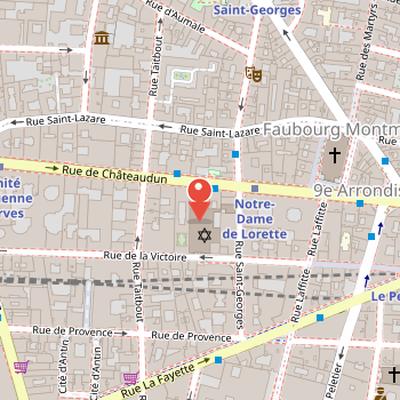
The Grand Synagogue of Paris, also known in French as Synagogue de la Victoire, is the largest synagogue in France. It stands at 44 Rue de la Victoire in the 9th arrondissement of Paris, near Notre-Dame-de-Lorette Métro station on line 12. The building was inaugurated in 1874 and declared a Monument historique in 1987.
The synagogue was built after the first synagogue of the Consistory of Paris, on Rue Notre-Dame-de-Nazareth, became too small a few years after its inauguration. In 1865, the city of Paris and the Consistory agreed to build two more synagogues, with the city covering half the construction costs and providing plots in Rue des Tournelles and Rue de la Victoire. Construction of the Rue de la Victoire synagogue began in 1867, was interrupted by the Franco-Prussian War of 1870/71, and was completed in 1876. The architect was Alfred-Philibert Aldrophe. The building also became the setting for the marriage of Alfred Dreyfus and Lucie Hadamard in 1890, with Chief Rabbi Zadoc Kahn officiating.
Nearby Objects
-
 Notre-Dame-de-Lorette 200 m away
 -
 Musée Gustave Moreau 300 m away
 -
 Salle Le Peletier 350 m away
 -
 Théâtre Mogador 400 m away
 -
 Église de la Sainte-Trinité 400 m away
Location and Heritage Status
The Grand Synagogue of Paris, also known in French as Synagogue de la Victoire or Grande Synagogue de Paris, is the largest synagogue in France. It is located at Rue de la Victoire No. 44 in the 9th Arrondissement of Paris, near Notre-Dame-de-Lorette Metro station on line 12. The building was inaugurated in 1874 and was declared a Monument historique in 1987. These details place it as a significant religious and heritage landmark within the city.
Construction of the Rue de la Victoire Synagogue
The first synagogue of the Consistory of Paris was the synagogue of Rue Notre-Dame-de-Nazareth, but it became too small only a few years after its inauguration. In 1865, the city of Paris agreed with the Consistory to build two additional synagogues and committed to cover half of the construction costs for both projects. The city provided two plots, one in Rue des Tournelles in the Marais district and one in Rue de la Victoire in the 9th arrondissement. The Marais had been a district with a larger Jewish settlement in the 18th century, while the 9th arrondissement had developed into a new business district since the July Monarchy, and Jewish banker James de Rothschild had settled in Rue Laffitte there. Construction of the synagogue in Rue de la Victoire began in 1867 and was interrupted by the Franco-Prussian War of 1870/71. The building was inaugurated in 1874 and completed in 1876.
Architecture and Historical Role
The Grand Synagogue of Paris, located in Rue de la Victoire, was designed by Alfred-Philibert Aldrophe, who lived from 1834 to 1895. Aldrophe also built synagogues in Versailles and Enghien-les-Bains in Ile-de-France. The building is associated with several important historical moments. Alfred Dreyfus and Lucie Hadamard were married there on April 21, 1890, by Zadoc Kahn, the Chief Rabbi of France, who later supported Dreyfus during the Dreyfus Affair. The synagogue also continues to serve as a place of remembrance, with a ceremony held there on the Sunday before the Jewish New Year, Rosch ha-Schana, to commemorate victims of deportations in the Second World War.
Architecture of the Grand Synagogue of Paris
The Grand Synagogue of Paris on Rue de la Victoire accommodates 1,800 people and measures 38 meters high, 44 meters long, and 17 meters wide. It is classified as a neoromanesque synagogue because of its Romanesque elements, while its four-story wall elevation corresponds to early Gothic style. The facade is flanked by two three-story stair towers with round-arched window openings. The middle part of the facade is crowned by a gable with a large rose window, a Hebrew inscription containing the words of Jacob, and the tablets of the law at the upper gable. The ground and middle floors are divided by three large round-arched arcades, and a Hebrew verse from the Book of Isaiah is placed on the cornice between the first and second floors. Inside, stairs from the ground-floor vestibule lead to the women's galleries. The nave is three times the width of the side aisles, with five bays corresponding to five arcades opening to the side aisles. Two tiers of galleries adjoin the side aisles, a frieze with the Ten Commandments in Hebrew script runs over the first-floor arcades, and a triforium extends to the choir above it. Rose windows form the clerestory of the nave, and a monumental round arch opens the nave to the elevated choir.
Interior Symbolism and Ritual Spaces
The synagogue interior combines liturgical function with symbolic decoration. The Bima stands in front of the choir and is called the Tevah by Sephardic Jews. In the central choir, an Adikula houses the Torah ark and is reached by ten marble steps. A rosette illuminates the Adikula, which is topped by the tablets of the law. Hebrew letters JHWH appear in the middle of the gable, signifying the name of God. Five large choirstalls symbolize the five books of the Torah, while twelve large windows display symbols of the Twelve Tribes of Israel. Rosettes with David's star in the center depict scenes of Abraham, Moses, David, Isaiah, and Ezra. To the right of the choir is a rectangular room known as the small temple, used for daily prayers. Next to it is a sukkah in a small courtyard for celebrating the Sukkot festival. An eight-branched silver Chanukkia in the synagogue was donated by Gustave de Rothschild.