Casino de Paris is a concert hall and event venue in Paris with a long history of changing uses and reconstructions. The name comes from the Italian word casino, meaning “little house,” and later came to mean “party hall” or “performance hall” in French; it does not refer to gambling. Around 1730, under Louis XV, the duke of Richelieu built a place for spectacles in a large tree-planted countryside. The site was later renamed Folie-Richelieu, then transformed into the Tivoli amusement park, and eventually demolished and rebuilt at a new location under Baron Haussmann. In 1880, part of the skating rink became the Palace-Théâtre, which was restored in 1891 by Édouard Niermans with a rococo hall and glass-covered interior. The Casino de Paris opened in 1891. Its later history includes renovations, a real ice rink called Le Pôle Nord, a fire, conversion into a cinema and music-hall, and major revues presented in the 20th century.
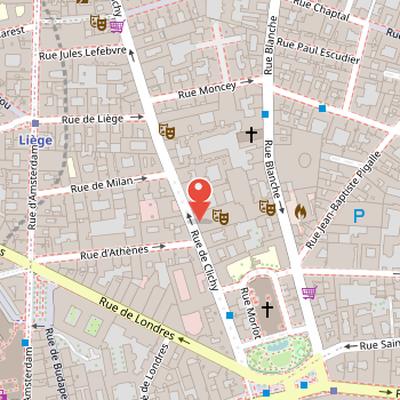
Nearby Objects
-
 Théâtre de Paris 100 m away
 -
 Église de la Sainte-Trinité 150 m away
 -
 Musée Gustave Moreau 300 m away
 -
 Théâtre Mogador 350 m away
 -
 Musée de la Vie romantique 400 m away
Meaning of the Name
The name Casino de Paris does not refer to a place for gambling or games of chance. According to the origin of the name, the Italian word casino literally means little house. When the term was adopted into French in the mid-18th century, it acquired the meaning of a party hall or performance hall. This usage explains the name as a reference to a venue for entertainment rather than gambling.
From Folie-Richelieu to Casino de Paris
The history of Casino de Paris begins on a site that was repeatedly transformed for leisure and spectacle. Around 1730, under Louis XV, the duke of Richelieu built a place to organize spectacles in a large tree-planted countryside. In 1779, the baron d'Ogny bought the place and renamed it Folie-Richelieu. During the First Empire, Folie-Richelieu was directed by Fortunee Hamelin, described as a prominent young woman of Parisian society.
In 1811, the site became an amusement park called Tivoli, directed by the firework master Ruggieri. Tivoli was demolished in 1851 to make way for the church of Sainte-Trinite. Later, baron Haussmann demolished the location again and rebuilt it at its current site, about a hundred meters lower. He replaced the former site with a leisure hall stretching from rue de Clichy to rue Blanche, including a roller skating rink.
In 1880, part of this skating rink became the Palace-Theatre, designed by architects Sauffroy and Gremailly. In 1891, the building was restored by Edouard Niermans, who added a vast rococo hall covered with glass panes and twenty columns supporting winged female statues holding chandeliers. The new Casino de Paris opened that same year. Around the same time, the skating rink was demolished to make room for the Nouveau-Theatre, later known as the theatre de Paris.
The Casino de Paris also became associated with popular social practices. In 1891, its administrator, Monsieur Lue, started the paper confetti fashion during a costume party for the Paris Carnival. In 1892, further renovations created entry at 18 rue de Clichy to a new hall converted into a real ice skating rink named Le Pole Nord, inaugurated on December 18, 1892.
From Theatre-Museum to Music-Hall
The Casino de Paris underwent several major changes in the 20th century. After a fire destroyed the whale of Villerville turned into theatre-museum by Simon-Max on the night of the 25th, it was purchased by Raphaeacl Beretta in 1914 and transformed into a cinema and music-hall designed by architect Marcel Oudin. Its first revue took place in 1917 under the direction of Leon Volterra, featuring Gaby Deslys and the first jazz orchestra in France.
The venue later presented the revue Paris qui remue, inspired by the 1931 Colonial Exhibition, with Josephine Baker performing for thirteen months. It also hosted La Joie de Paris in 1932 and a show with Tino Rossi in 1934, while Varna remained in charge until 1969. The Casino de Paris closed in spring 1940, then reopened under German Occupation with performances by Maurice Chevalier and Mistinguett.
In the postwar period, the venue continued to stage notable revues. In 1959, Line Renaud made her debut as revue leader in Plaisirs de Paris by Henri Varna, with the Golden Gate Quartet. This revue ran for four years and included songs such as Viva Cuba, C'est l'amour, and Un jour je reverrai Paris. In 1963, Mick Micheyl appeared in Avec frenesie, produced by Varna with decor supervision, scenography, and song lyrics. That show featured 100 performers nightly, 45 decors, and costumes made of fabric, including the song L'amour c'est comme le cafe. In 1965, Line Renaud returned from Las Vegas to lead Desirs de Paris at Varna's proposal. The Casino de Paris was acquired by the Lagardere group in 2014.
Hall of Fame and Musical Memory
Hall of Fame is associated with the musical Fame, which recalls the musical tradition of the Casino de Paris. It is also directly linked to Fame at the Casino de Paris, connecting the venue with a production that reflects its performance heritage. These references place Hall of Fame within the cultural memory of the site and underline the continuing association between the Casino de Paris and musical entertainment.