Théâtre Hébertot is a theatre located on boulevard des Batignolles in the 17th arrondissement of Paris. Inaugurated in 1838, it was originally named Théâtre des Batignolles. Its history is tied to the creation of the commune of Batignolles-Monceaux after a royal ordinance separated the city of Clichy into two communes. In 1830, the new municipality requested the construction of a performance hall from the Minister of the Interior.
The project was affected by an existing privilege concerning small theaters near Paris, originally granted to Pierre-Jacques Seveste and then transferred to his sons Edmond and Jules Seveste. The Seveste brothers held exclusive rights to theaters outside the barriers of the Farmers-General Wall in Seine communes. The Ministry of the Interior authorized construction of a new theater on Boulevard des Batignolles on November 20, 1837. The building was managed by a company of merchants and commune owners under architect Adolphe Azémar. Over time, the theatre passed through several managements, including Seveste, MM. Libert and Gaspari, and Chotel, before later changes in ownership and name.
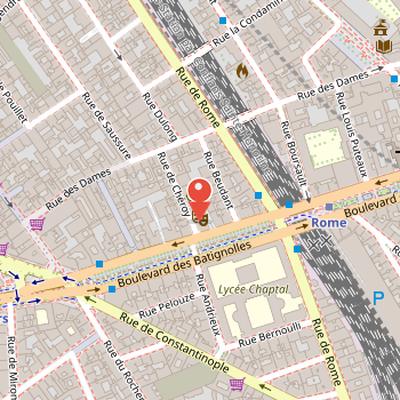
Nearby Objects
-
 Errancis Cemetery 200 m away
 -
 Musée Cernuschi 550 m away
 -
 Musée Nissim de Camondo 550 m away
 -
 Place de Clichy 650 m away
 -
 Monument to Maréchal Moncey 650 m away
Location and Early History
Theatre Hebertot is located on boulevard des Batignolles in the 17th arrondissement of Paris. It was inaugurated in 1838. These basic facts place the theatre within a long-established urban setting in the city, and mark its origins in the early 19th century.
Early History and Authorization
The history of Theatre Hebertot is closely tied to the administrative changes that created the commune of Batignolles-Monceaux after a royal ordinance separated the city of Clichy into two communes. In 1830, the new municipality requested the construction of a performance hall from the Minister of the Interior. This request was made within the framework of a privilege, dated before 1830, concerning small theaters near Paris. The privilege had originally been granted to Pierre-Jacques Seveste and was later transferred to his sons and heirs, Edmond and Jules Seveste, who held exclusive rights to theaters outside the barriers of the Farmers-General Wall in Seine communes.
Also in 1830, Besancon Souchet commissioned architect Torasse to build a new theater on Rue Lemercier. Although Souchet obtained permission from the mayor, he was fined 500 francs because he lacked authorization from the Minister of the Interior. He reapplied in July and received approval after consulting the Seveste brothers. The Ministry of the Interior nevertheless criticized the situation because there was no official director responsible for the theater's repertoire.
Souchet was ultimately forced to sell the performance hall in 1832. Several years later, on November 20, 1837, the Ministry of the Interior officially authorized the construction of a new theater on Boulevard des Batignolles, between the Monceaux and Clichy barriers. These events show that the theater's early development was shaped by municipal requests, ministerial control, and the theater privilege system governing small performance venues near Paris.
Early Management and Name Changes
Th treatre was constructed under the direction of architect Adolphe Azemar by a company formed with capital founded by merchants and commune owners. The Seveste brothers directed the new venue, which was granted exploitation privileges for suburban theaters including Montparnasse, Montmartre, and Belleville. It was initially named Theatre des Batignolles. In 1843, residents submitted a petition to the king concerning its direction, and a ministerial decree appointed Seveste as theater director for the period from 1843 to 1857. The theater later came under the management of MM. Libert and Gaspari, followed by Chotel, identified as an artist, director, and declamation professor. Its ensembles performed alternately in the Montmartre and Batignolles theaters. After Chotel's death, his widow took over the theater. The management company was declared bankrupt on February 23, 1869, and later management efforts did not improve the theater's condition, creating a risk of closure. In 1906, Maurice Landay took over the theater and renamed it theatre des Arts in 1907.
Direction, Renovation, and Later Development
Theatre Hebertot, known as Historique before taking its definitive name in 1940 under Jacques Hebertot, has passed through a long sequence of directors and changes in use. After Robert d'Humieres directed Historique until 1909, the season opened with La Tragedie de Salome, starring Loie Fuller. Rodolphe Darzens then directed the theatre from 1917 to 1935, during a period associated with actors such as Sacha Guitry, Edwige Feuillere, Georges Pitoeff, Ludmilla Pitoeff, and Charles Dullin. Jacques Hebertot remained in charge until his death, after which Francois Daviel, his nephew, took over. The theatre later passed to Andree Delattre, and in 1972 Simone Valere and Jean Desailly attempted to take it over. In 1973, Delattre refused to renew Jean Desailly's lease and entrusted the theatre to Patrick Barroux, who carried out important safety-related renovations. The theatre then reopened in 1976 as theatre des Arts-Hebertot.
Jean-Laurent Cochet later directed the theatre, organizing the artistic program and introducing a theatre of alternation. Serge Bouillon managed the administrative and technical organization under his direction. Cochet's first season featured 21 different shows and 330 performances, and his directorship lasted three seasons. Alain de Leuseleuc took over in 1986, followed by Felix Ascot. Philippe Caubere created two productions at the theatre in 1988 and 1989. The building contains an Italian-style auditorium with 630 seats. From 2003 to 2013, Daniere and Pierre Franck directed the theatre and created a second hall, Petit-Hebertot, with 110 seats. Xavier Jaillard became the artistic director of Petit-Hebertot, which was later renamed studio Hebertot. In 2013, Francis Lombrail and Stephane Prouve bought the theatre, continuing its long history of successive artistic and managerial changes.
Status and Institutional Role
Theatre Hebertot has been listed as a historical monument since an unspecified date, marking it as a protected part of the urban heritage. It is also connected to key professional theater organizations, as it belongs to the Association for the support of private theater (ASTP) and the National Union of private theater directors and touring managers (SNDTP). In 2010, it joined the collective brand Theatres parisiens associes, further placing it within a network of Parisian private theaters. Its future artistic direction has also been announced: from January 2027, Alexis Michalik will lead the theater with Benjamin Bellecour, Camille Torre, and Caroline Verdu.