The Petit Palais is a historic building and fine arts museum located in the 8th arrondissement of Paris, on Avenue Winston Churchill in the Champs Élysées area. Designed by architect Charles Girault for the 1900 Universal Exposition, it forms part of a monumental ensemble with the Grand Palais and the Pont Alexandre III. Girault conceived the building with a trapezoidal plan in an eclectic style, organized around a semi-circular garden surrounded by a peristyle. The exhibition spaces are situated on the first floor, while the ground floor was originally reserved for cabinets and deposits.
The facade is marked by an Ionic colonnade about 150 meters long and a large central monumental portico crowned by a dome. Inside, galleries are illuminated only by natural light through large glazed surfaces and transparent domes, with large windows creating a stronger link to the exterior. The decoration includes numerous bas-reliefs, sculptural figures, busts, reliefs, wrought iron elements, stained glass, mosaics, and floors made of noble stones. The museum opened on December 11, 1902, under the name Palais des Beaux-Arts de la Ville de Paris, and its collection has expanded from works funded by the Paris municipality to donations spanning from classical antiquity to the end of the 19th century.
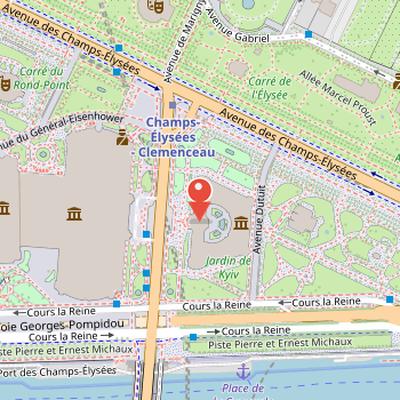
Nearby Objects
-
 Palais de l'Industrie 110 m away
 -
 Grand Palais 150 m away
 -
 Palais de la Découverte 250 m away
 -
 Hôtel de Lassay 450 m away
 -
 Fontaines de la Concorde 500 m away
Historic Setting and Design
The Petit Palais is a historic building and fine arts museum in the 8th Arrondissement of Paris, on Avenue Winston Churchill in the Champs Elysees area. It was designed by architect Charles Girault for the 1900 Universal Exposition. The building forms part of a monumental complex together with the Grand Palais and the Pont Alexandre III, placing it within a coordinated urban and architectural ensemble in this part of Paris.
Architectural Design and Decorative Program
Charles Girault conceived the Petit Palais as a trapezoidal building in an eclectic style. Its plan is organized around a semi-circular garden surrounded by a peristyle, while the exhibition spaces are located on the first floor. The ground floor was originally reserved for cabinets and deposits. The facade is ornamented by an Ionic colonnade about 150 meters long and includes a large central monumental portico crowned by a dome.
The interior was designed to receive abundant natural light. Its galleries are illuminated only by large glazed surfaces and transparent domes, and a series of large windows creates a stronger connection between the interior and the exterior. Decoration plays a major role throughout the building. It includes numerous bas-reliefs, rich mural paintings added between the inauguration in 1902 and 1925, and sculptural elements such as allegorical figures, busts, and reliefs. Wrought iron is also essential, especially on the entrance gate and staircases, and the building is further ornamented with stained glass, mosaics, and floors made of noble stones.
The museum opened on December 11, 1902, under the name Palais des Beaux-Arts de la Ville de Paris. Its architectural composition and motifs also had an influence beyond Paris, as the facade of the Musee royal de l'Afrique centrale in Tervuren partially reprises them.
Architectural Comparison
Historia states that the architecture of the Petit Palais closely resembles the Opera House of Saigon, which was located in the former capital of French Indochina. The comparison places the Petit Palais in relation to a specific historical building whose construction was completed in 1900. Based on this description, the Petit Palais is presented as sharing a similar architectural character with a landmark from the same broad colonial context.
The Collections of the Petit Palais
The collections of the Petit Palais began to take shape with works funded by the Paris municipality from 1870, developed through art salons and direct commissions. They have since expanded through large donations and now cover works from classical antiquity to the end of the 19th century, while 20th century art is held in the Palais de Tokyo. The museum's holdings include the largest collection of Orthodox icons in France, along with important donations that have shaped its character.
The collections are organized into several departments and use a mixed museography, with works of different genres displayed together in the same space. One wing is devoted to permanent exhibitions and another to temporary exhibitions. The holdings include paintings by Gustave Courbet and a broad range of French art, from Hubert Robert, Fragonard, and David to Giraud, Delacroix, Monet, Sisley, Pissarro, and Cabanel. They also bring together symbolism, impressionism, and avant-garde art, with works by Cezanne, Bonnard, and Renoir.
Sculpture is represented by figures such as Maillol, Rodin, Camille Claudel, and Jean-Baptiste Carpeaux, while official art from major salons and diverse Art Nouveau decorative objects are also present. The collections further include pieces from the Restoration to the Third Republic, a print section with works by Gustave Dore, and four special rooms devoted to tapestries, furniture, precious metal decorations, porcelains, and enamels. A major part of the museum is the Auguste and Eugene Dutuit donation, which includes books, drawings, prints, and a notable group of Dutch paintings.
Collections of the Petit Palais
The Petit Palais collections bring together paintings, furniture, and decorative objects from France, Italy, Northern Europe, and the Islamic world. Notable holdings include Venetian glass, Moorish faience, Italian majolica, Iznik ceramics, and a section devoted to medals, clocks, and small Italian bronzes. The museum also groups decorative objects, paintings, and sculptures illustrating religious life in the Middle Ages from the Netherlands, Germany, France, and Italy. Other sections include ivories, enamels, manuscripts, and a fine group of wooden statues from Germany and southern Austria. The collections mainly contain icons donated by Roger Cabal, forming the most important collection of such pieces in France, from Greece, the Byzantine Empire, and Russia. They also present rare virtuoso works in various techniques, with archaic Greek bronzes, Italian necropolis vases, and Mediterranean terracottas.
The Art Gallery Collection
The Petit Palais includes a gallery of art works with a varied collection spanning paintings, sculpture, decorative objects, and antiquities. Among the works listed are Gustave Courbet's Moocas junto ao Sena, Sisley's Avenida das Castanheiras perto de La Celle-Saint-Cloud, and Daumier's Jogo de xadrez. The gallery also includes historical and allegorical pieces such as Schnetz's Revolucao de 1830, Philippoteaux's Lamartine rejeitando a bandeira vermelha, and Carpeaux's Ugolino e seus filhos. Decorative arts are represented by objects such as a Vaso Galle and Massignon's Bule de cha Le Tetard. The collection further includes Moreau le Jeune's Parlatorrio, Dubois's Eva nascente, and a terracotta horse from Campania from the 4th century. Antiquities are also present, including an Estela funeraria de Palmira from the 2nd century. Together, these works show the gallery's broad scope across different periods and artistic media.
The 2001 to 2005 Renovation
The Petit Palais underwent renovation between January 2001 and June 2005, with the works managed by Atelier d'architecture Chaix and Morel et associes. The museum reopened to the general public on December 10, 2005, with an exhibition of works by the photographers Flora, Patrick Tourneboeuf, and Bruno Delamain.
The renovation reorganized the building and added new visitor facilities. It created additional exhibition spaces on the ground floor totaling 22,000 square meters, relocated the reserves to the basement, and placed the permanent exhibition to the left of the entrance and temporary exhibitions to the right. Offices were installed above the temporary exhibitions, and an amphitheater was created on the ground floor below the garden. A cafe was also established at the back of the garden between the two wings.
The project also restored natural lighting to the exhibition windows and to the stained glass of the permanent collection, strengthening the display conditions within the building.