Rue du Faubourg-Saint-Honoré is a shopping street in Paris that runs from rue Royale to place des Ternes. It is one of the most luxurious streets in the capital and includes the Élysée Palace, the official residence of the President of the French Republic. The street is also associated with embassies, luxury stores, haute couture shops, art galleries, and prestigious antique shops.
The name of the street comes from its position outside the enclosing wall serving the church Saint-Honoré and from its continuation of rue Saint-Honoré. Historical forms include forsborc around 1200 and forbours around 1260. In the Middle Ages, it was a road extending from rue Saint-Honoré to pont du Roule and was already called rue du Faubourg-Saint-Honoré. Its name was reserved in 1633 for the street west of the rebuilt porte Saint-Honoré.
Since autumn 2024, an evening event organized by the MaSH association has brought most art and antique galleries in the Matignon-Saint-Honoré district into public view, with partial traffic restrictions on avenue Matignon and rue du Faubourg-Saint-Honoré.
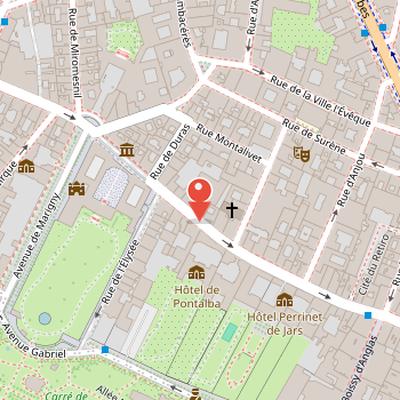
Nearby Objects
-
 Élysée Palace 150 m away
 -
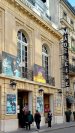 Théâtre de la Madeleine 200 m away
 -
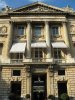 Hôtel de Crillon 350 m away
 -
 La Madeleine 450 m away
 -
 Palais de l'Industrie 450 m away
Location, Access, and Public Profile
Rue du Faubourg-Saint-Honoré runs from rue Royale to place des Ternes. It is regarded as one of the most luxurious streets in the capital and is home to the Elyssee Palace, the official residence of the president of the French Republic. The street also hosts embassies, luxury stores, haute couture shops, art galleries, and prestigious antique shops.
Since autumn 2024, an evening event organized by the MaSH association has been held there. During this event, most art and antique galleries in the Matignon-Saint-Honore district open to the public, while traffic is partially restricted on avenue Matignon and rue du Faubourg-Saint-Honore. The street is served by metro line 9 at Saint-Philippe du Roule station.
Origin of the Name
Rue du Faubourg-Saint-Honoré got its name because it crossed the hamlet and extended rue Saint-Honor? as a street outside the enclosing wall serving the church Saint-Honor?. The term faubourg originally referred to a quarter described as fors le bourg, from Old French fors, meaning outside, and bourg, from Old French bors or borc. Historical forms of the term include forsborc around 1200 and forbours around 1260.
History and development of rue du Faubourg-Saint-Honoré
In the Middle Ages, the road extending from rue Saint-Honore to pont du Roule was already known as rue du Faubourg-Saint-Honore. In 1633, the name was reserved for the street west of the rebuilt porte Saint-Honore, and the same year it was also called nouveau faubourg Saint-Honore. A 1636 manuscript mentions it as Chausssee du faulxbourg Saint Honnore. Beyond the Grand Egout near rue du Colisee, it extended to the faubourg du Roule and later became the chausssee du Roule at the village of Roule. Different sections subsequently took the names rue du Bas-Roule, rue du Haut-Roule, and rue du Faubourg-du-Roule.
After the 17th century, the suburb developed rapidly, especially as wealthy financiers built hotels particuliers there. Its growth was also shaped by demographic pressure, the decline of the Marais, and the presence of Philippe d'Orleans at the Palais-Royal. Speculation was then slowed by royal declarations in 1724 and 1726, which forbade new streets and houses with porte cochere. Inhabitants protested and asked for privileged treatment. The porte Saint-Honore was removed in 1733 as the city expanded to the mur des Fermiers generaux, and the octroi was transferred to Roule that same year. Building restrictions were later extended to rue des Saussaies in 1740 and to rue de Chaillot on February 7, 1744. Speculation increased again with the creation of place Louis-XV in 1757.
In more recent times, the street was twinned in 1964 with Fifth Avenue in New York by the Comite du Faubourg Saint-Honore, and it was also twinned with Rome's Via Condotti. It partially delimited the ZAC Beaujon. Since 2015, it has been closed to unauthorized vehicle traffic between rue de Duras and place Beauvau under the Vigipirate plan. Access points near the Elysee Palace have vehicle barriers and a strong police presence, and pedestrian circulation is strictly regulated and often forbidden during official events. These security measures have significantly reduced visits to luxury stores on this section of the street.
Townhouses and Official Buildings
The odd side of rue du Faubourg-Saint-Honoré is lined with townhouses arranged between courtyard and garden, with parcels extending to Avenue Gabriel and facing the Champs-Elysées. Many of these townhouses now serve as official buildings. Among them are the Hotel de Pontalba, which is the residence of the United States ambassador, and the Hotel de Charost, which houses the headquarters of the United Kingdom embassy. In the first quarter of the street, Place Beauvau marks an important point in the layout, and the Hotel de Beauvau there houses the Ministry of the Interior. Farther along, between Place Beauvau and Avenue Matignon, the street includes the Hotel Le Bristol, as well as numerous high-quality art galleries and antique dealers. These uses give the street a strong administrative and commercial character alongside its residential architecture.
Notable Buildings and Historic Sites
Bâtiments remarquables et lieux de mémoire notes that the first houses of rue du Faubourg-Saint-Honoré were set on fire by the Communards in 1871, as was part of rue Royale. The street includes several identified addresses and historic buildings, among them 22 rue du Faubourg-Saint-Honoré and 24 rue du Faubourg-Saint-Honoré in Paris 8e. Number 31 is identified as Hotel Pillet-Will. Other listed properties include Hotel Perrinet de Jars, which currently hosts the Cercle de l'Union interalliee, and Hotel Chevalier and Hotel de Charost, which host the chancery of the British embassy and the UK residence in France. The list also includes hotel Bouret, then hotel d'Andlau, formerly at 31.
Hôtels Along Rue du Faubourg-Saint-Honoré
Several notable properties on rue du Faubourg-Saint-Honoré are linked to the career and transactions of Bouret. In 1777, Bouret committed suicide by arsenic poisoning in the hôtel Bouret. After his death, the hôtel was purchased by the count and countess d'Andlau. The count d'Andlau later installed panels painted by Jean-Baptiste Oudry for the château de Voré in the hôtel d'Andlau.
The street also included the hôtel de Brunoy, listed in Bâtiments remarquables et lieux de mémoire as the former number 33 bis. It was commissioned by Jeanne Françoise Ãmilie de Pérusse des Cars, who bought it from Bouret in 1774. Built between 1775 and 1779 by the architect Etienne-Louis Boullée, it was accessible by a passage opened in 1774 between the hôtels d'Andlau and de Sabran. The hôtel de Brunoy was destroyed in 1930.
Another listed property was the hôtel de Sabran, formerly number 35. It was completed by Mathurin Cherpitel in the 1770s. Bouret had sold an unfinished hôtel in order to build the hôtel de Sabran.
Ownership of the hotel de Sabran
Françoise Eleonore de Jean de Mandeville was the owner of the hotel de Sabran. She was married to comte Elzear Joseph de Sabran-Grammont. The couple had two children, Elzear and Delphine. These facts identify the family connections associated with the property on rue du Faubourg-Saint-Honore.
Notable Hotels and Sites on Rue du Faubourg-Saint-Honore9
Among the memorable buildings listed for rue du Faubourg-Saint-Honore9 is the former hotel de Villemorien, also identified as ancien 41. Its construction was likely entrusted to Le Boursier and was underway in 1772. The building communicated with the hotel at 43 through an underground passage, showing that the properties were physically connected in a way that affected their use and circulation.
The ownership history of the former hotel de Villemorien was complex. Bouret sold it to Philippe Charles Legendre de Villemorien on July 8, 1775, but Legendre de Villemorien never occupied it. Instead, he rented it and sold the usufruct rights to Charlotte Ore on July 16, 1775. The usufruct then passed to Henry Gedeon Ignace de Paulian, deputy of Saint-Domingue, on December 19, 1789. From 1792, the building was rented to the widow de La Tour du Pin. The usufruct ended on November 9, 1807, upon the death of the widow de Breteuil, after which the vicomtesse de Berenger held full ownership. Antoine Raymond de Berenger sold the property to Maria Assunta Leonida Butini on May 4, 1815. She was the widow of Edmond, comte de Bourke, and died in 1845. Her son sold the building in 1847 to the duc de GalliEra, who in turn resold it to Charles Tavernier. Tavernier lived there until 1851. On January 13, 1851, Emil Pereire acquired the former hotel de Villemorien and demolished it for rental building construction.
The same section of the street also included the former hotel de Verges, later called hotel de Saxe and then hotel Sebastiani. It stood at the site of rue de l'Elysee and had a porte cochere with two Doric columns and an entablature on the Faubourg Saint-Honore. The property belonged to Marshal Horace Sebastiani, who was several times minister and remained faithful to Louis-Philippe. It was also the scene of the assassination of Fanny by the duc de Praslin on August 17, 1847.
A second hotel de Villemorien, later known as hotel de Castellane, was destroyed and incorporated into the palais de l'Elysee in the 1850s. Another connected property was the hotel at 18 rue du Faubourg Saint-Germain, leased for life by Bouret to Charles-Maurice de Monaco, comte de Valentinois, on April 14, 1771. The planned apartment transformations were not carried out, and the lease was annulled in 1774. Bouret later sold the hotels at numbers 18 and 20 to Philippe Charles Legendre de Villemorien. He lived in the hotel du 18, which had access to the Champs-Elysees gardens through a narrow passage along the wall of the palais de l'Elysee. This passage was later leased in 1847 to femme Poiriot, a goat milk vendor, and a small cafe pavilion with a view was built at its outlet on avenue Gabriel.
The hotel du 20 was incomplete when sold on February 28, 1774, and was likely completed by architect Guillaume-Martin Couture. After Legendre de Villemorien's death, his widow remarried baron Grimaldi and left the hotel. The vicomtesse de Berenger inherited it and lived elsewhere on the Faubourg Saint-Honore, renting the main apartment to General de Gouvion-Saint-Cyr. At her death in 1818, the property passed to Antoine Raymond de Berenger, who sold it to the marlechale de Castellane nee Greffulhe. She lived there until her death in 1847, after which the hotel passed to her daughter, the spouse of comte Maximilien de Hatzfeld. The state acquired the hotel to enlarge the palais de l'Elysee following the law of May 14, 1848. It was demolished in 1854 after some transformations, and some decor elements were reused at the palais de l'Elysee. Six paintings by Jean-Pierre Houel from 1774 were sent to the musee du Louvre.
Notable Buildings and Memory Sites
Beneath the heading of Bâtiments remarquables et lieux de memoire, rue du Faubourg-Saint-Honoré is presented through a series of landmarks that reflect its institutional, diplomatic, commercial, and historical character. Among the most prominent sites is the Elysee Palace, the official residence of the French president, whose entrance, honor gate, facade, and the republican guard stationed in front of it are all shown. The street also includes the facade of the Colombian embassy in France, as well as the Embassy of Canada in France and the Canadian Cultural Centre.
Several buildings linked to state administration and memory appear as well. These include the portal and rear facade of the hotel de Beauvau, headquarters of the Ministry of the Interior. The street also features plaques at 165 and 185 rue du Faubourg-Saint-Honoré, and views of 86 rue du Faubourg-Saint-Honoré. Historical documentation is also represented through images by Eugene Atget, including the hotel de Coigny at 89 rue du Faubourg-Saint-Honoré in 1901 and the street view of the hotel de Preaulx, described as the old hotel de Coigny, in the same year.
The commercial identity of the street is shown through the Pierre Cardin boutique at the corner of avenue de Marigny and rue du Faubourg-Saint-Honoré, the Azzaro boutique on the street, the Galerie d'Art Saint-Honore, and the entrance of 114 Faubourg. Hospitality is represented by the Bristol hotel, with both its entrance and gardens shown.
Religious and charitable architecture also forms part of the street's documented landscape. The Church of the Annunciation, constructed in 1860, is shown together with its interior, the Christ Pantocrator by James Tissot, the cloister of the Convent of the Annunciation, and the atrium of the Convent of the Annunciation. Nearby references include the old Beaujon hospice and the Square du Roule. Other recorded sites along the street include the hotel de Rigny at 135 rue du Faubourg-Saint-Honoré and 137 rue du Faubourg-Saint-Honoré, reinforcing the street's mix of residences, institutions, shops, and places of memory.