Palais des congrès de Paris is a business, congress, and entertainment center located at Porte Maillot in Paris, at the border of Paris, Bois de Boulogne, and Neuilly-sur-Seine. Its address is 2, place de la Porte-Maillot. The complex is part of the same site as the Hyatt Regency Paris Étoile skyscraper hotel and is managed by Viparis. Its facilities include salons, shops, restaurants, meeting rooms, and exhibition spaces.
The site has a layered history. It was located on land at the border of the Plain of Sablons and Sablonville and occupied the former site of the Thiers fortifications bastion, Luna-Park, and the Notre-Dame de Compassion chapel. After the destruction of the Paris fortifications around 1920, the land served as a temporary summer amusement park and later housed ministry accommodation buildings. Construction began in 1970 on the former Luna Park site, alongside the Concorde Lafayette hotel. The buildings were designed by Guillaume Gillet, Serge Maloletenkov, Yves Betin, and Henri Guibout, and were later extended between 1997 and 1999. The rehabilitation added an inclined facade designed by Christian de Portzamparc, as well as four amphitheaters, a shopping gallery on two levels, and expanded exhibition spaces.
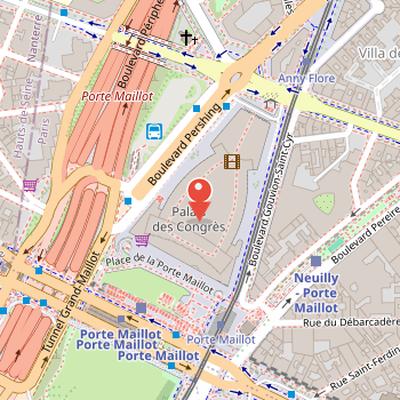
Nearby Objects
-
 Hyatt Regency Paris Étoile 130 m away
 -
 Avenue Foch 700 m away
 -
 Place Charles-de-Gaulle 1000 m away
 -
 Arc de Triomphe 1000 m away
 -
 Tomb of the Unknown Soldier 1000 m away
Location and Functions
The Palais des congres de Paris is a business, congress, and entertainment center located at Porte Maillot in Paris. It stands at the border of Paris, the Bois de Boulogne, and Neuilly-sur-Seine, at 2, place de la Porte-Maillot. The building is part of the same complex as the Hyatt Regency Paris Etoile skyscraper hotel. Its facilities include salons, shops, restaurants, meeting rooms, and exhibition spaces, giving the site a mixed use focused on business and public events.
Site History and Architectural Development
The Palais des congres de Paris was built on land at the border of the Plain of Sablons and Sablonville, on a site that had earlier contained the Thiers fortifications bastion, Luna-Park, and the Notre-Dame de Compassion chapel. After the destruction of the Paris fortifications around 1920, the land served as a temporary summer amusement park, and after the war it housed ministry accommodation buildings. Construction began in 1970 on the former site of Luna Park, alongside the Concorde Lafayette hotel located just behind it. The project also included the small Notre-Dame-de-Compassion church, which was dismantled and rebuilt stone by stone about one hundred meters away.
The buildings were designed by Guillaume Gillet, Serge Maloletenkov, Yves Betin, and Henri Guibout, and they were inaugurated on an unspecified date. The construction and excavation near the boulevard peripherique caused a complete redevelopment of the parallel Parisian area, underlining the scale of the intervention. The complex later underwent an extension between 1997 and 1999. Its imposing inclined facade from the rehabilitation was designed by Christian de Portzamparc, adding a later architectural layer to the original development.
Architecture and Expansion
The Palais des congres de Paris is known for its inclined architectural design, which has gained international recognition. Its facade includes the Bordeaux amphitheater, built in the form of an inverted cone and visible from the outside. Since 1999, the building has contained four amphitheaters spread across four floors, along with many conference rooms and a shopping gallery on two levels. The 1999 extension also doubled the exhibition spaces by adding three floors and two new flat rooms. The complex is managed by Viparis. It is located next to the Hyatt Regency Paris Etoile hotel.
Programming and Stage Performances
The programming of the Palais des congres de Paris has included several notable stage performances and musical events. Robert Hossein presented Danton et Robespierre in 1978, La liberte ou la mort in 1988, and De Gaulle - Celui qui a dit non in 1999. The venue also hosted the main musicals of Chantal Goya, written by Jean-Jacques Debout. Serge Lama appears repeatedly in the programming record, with performances in 1975, 1977, 1979, 1981, 1995, and 2009. He was also the first singer to perform there in 1975.