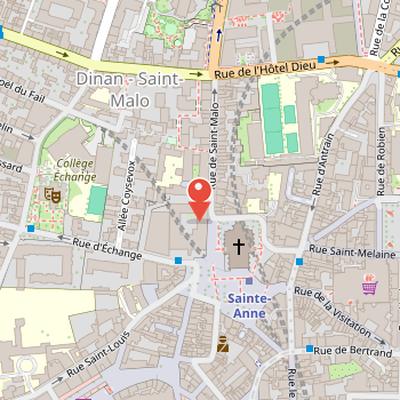
Couvent des Jacobins is an ancient religious building and former barracks located in the Centre district of Rennes, north of the historic center and at the northwest corner of Place Sainte-Anne. The site extends along Rue d’Échange to the south and Rue de Saint-Malo to the east, which separates it from the basilica Notre-Dame-de-Bonne-Nouvelle. The ensemble includes a church, a cloister, and convent buildings. In 2018, it became the Rennes Metropole congress center.
The site has a long history. Excavations led by Gaétan Le Cloirec under INRAP in 2012 and 2013 identified traces of human occupation dating to the 1st century and revealed a Gallo-Roman intersection beneath the convent in Condate. The findings also mention a monument at that crossroads, later replaced by a temple. After the fall of the Roman Empire, Rennes enclosed itself within walls, and the area outside the walls was abandoned in the 7th century. The convent later developed fully in the 17th century, when it housed about sixty Dominican friars and functioned as a center of formation with a library of up to 10,000 books. The convent ended during the Revolution. In 2023, the building was targeted by an attempted arson during protests against the pension reform project, and its door was damaged.
Nearby Objects
-
 Basilique Notre-Dame de Bonne Nouvelle 70 m away
 -
 Place Sainte-Anne 120 m away
 -
 Maison du Peuple de Rennes 150 m away
 -
 Place du Champ-Jacquet 250 m away
 -
 Place des Lices 350 m away
Architecture and Recent History
The Couvent des Jacobins is an ancient religious building and former barracks located in downtown Rennes. It includes a church, a cloister, and convent buildings. In 2018, the site was converted into the Rennes Metropole congress center, giving it a new public function while retaining its historic structures. In 2023, it was targeted by an attempted arson during protests against the pension reform project, and its door was damaged.
Location and Urban Setting
The Couvent des Jacobins is situated in the Centre district, north of the historic center of Rennes. It occupies the northwest corner of Place Sainte-Anne, with Rue d'Echange to the south and Rue de Saint-Malo to the east. Rue de Saint-Malo also separates the site from the basilica Notre-Dame-de-Bonne-Nouvelle. This position places the complex within a defined urban setting, closely connected to surrounding streets and nearby religious architecture.
Archaeological History Beneath the Convent
Excavations led by Gaetan Le Cloirec under INRAP in 2012 and 2013 identified a Gallo Roman site beneath the convent. The earliest traces of human occupation discovered there date from the 1st century. Archaeologists also found the intersection of the cardo maximus and another street in Condate, with a monument erected at that crossing that became a temple three centuries later. After the fall of the Roman Empire, Rennes enclosed itself within walls, and the area outside the walls was abandoned in the 7th century.
History of the Couvent des Jacobins
The Couvent des Jacobins in Laval was founded by the Dominicains de Rennes, with François Mallet arriving with letters from the pope and the French king to establish the convent. In the 17th century, it developed fully and was home to about sixty Dominican friars. It was also recognized as a center of formation, and its library is said to have held up to 10,000 books.
The convent was closely connected with the cult of Notre-Dame-de-Bonne-Nouvelle, a painting of the Virgin housed in the basilica. In 1624, the city of Rennes offered a silver votive to Notre-Dame-de-Bonne-Nouvelle in response to plague, and the silver model was later melted around 1794.
The convent declined and ended during the Revolution. Some friars refused the oath, while others served as priests in Rennes. After the confiscation of its books, Felix-Alexis Mainguy sorted them and became Rennes' first librarian. In 1793, the building was allocated to the army and converted into a barracks, and it later housed the military garrison's sports club. The former Bon-Nouvelle convent was listed as a historic monument on March 29, 1927, and the couvent was classified as a historic monument by decree on April 20, 1995.
From Convent Site to Congress Center
Between 2005 and 2009, city officials considered creating a congress center in the Rennes agglomeration, and intercommunal officials chose the Couvent des Jacobins site after studying alternatives. In 2011, architect Jean Guervilly was selected to design the project. From October 2011 to May 2012, INRAP carried out a full excavation of the site, where approximately thirty archaeologists documented nearly one thousand medieval and modern burials. The burials were found mainly in the chapter house, the enfeus gallery, and the church, and four prestigious 15th-century tombs were discovered in the church choir. Among these, Louise de Quengo, described as a widow and probable nun, was identified.
In 2014, Sogea Construction led the company group assigned to build the Congress Center, which was scheduled for delivery in late 2017. While the building was being finished, open house events were held on December 16 and 17. The congress center was inaugurated on December 17, 2017, with a concert by the Orchestre symphonique de Bretagne. During this period, the site also experienced tension: the edifice was targeted by an arson attempt amid protests against retirement reform, and its door was damaged. Histoire sold the monument to Rennes Metropole for one symbolic euro.
Cloister Layout and Monastic Spaces
The Couvent des Jacobins is organized around a cloister with a central garden surrounded by a gallery. This cloister gives access to several rooms used for monastic life. The conventual church stands on the south side of the cloister, the chapter house on the east side, and the refectory on the west side. In the south-east corner of the cloister garden is the Bonne-Nouvelle chapel, while a gallery of enfeus runs along the south part of the cloister near the church. The main building is also bordered by two courtyards to the north and west, each enclosed by a separate gate. The prior's lodging is located at the north-west of the site.