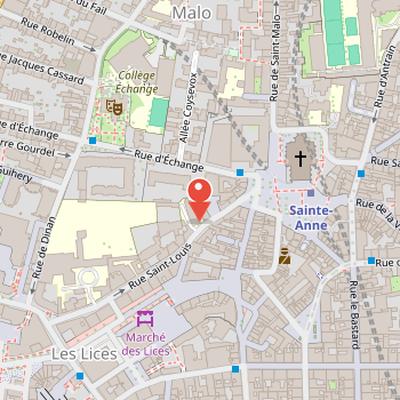
Maison du Peuple de Rennes is a meeting hall for unions and politics and a performance hall in Rennes, Brittany. Located in the Centre district north of the historic center, near Place Sainte-Anne, it has entrances on rue Saint-Louis to the south and rue d’Échange to the north, facing the Couvent des Jacobins. It is served by the Sainte-Anne metro station.
Designed by Emmanuel Le Ray and built in 1925, the building was created in the spirit of the 19th-century labor movement and the bourses du travail. It was intended to support the social project and union functions by hosting public meetings. Le Ray equipped it with a projection cabin and a stage, and Camille Godet decorated the interior. Godet also made sketches of workers during construction and transformed them into an oil fresco on canvas, now classified as heritage. The building later served multiple functions, including as a cinema and performance hall, and the fresco was hidden behind curtains in 1960. After several renovations, rehabilitation and compliance work were completed in 2021, and new activities, including artist residencies, are planned.
Nearby Objects
-
 Place Sainte-Anne 140 m away
 -
 Couvent des Jacobins 150 m away
 -
 Basilique Notre-Dame de Bonne Nouvelle 150 m away
 -
 Place des Lices 200 m away
 -
 Halles Martenot 200 m away
Architecture and Changing Uses
The Maison du Peuple de Rennes is a meeting hall for unions and politics, as well as a performance hall, in Rennes, Brittany. Designed by Emmanuel Le Ray and constructed in 1925, it was created in the context of the labor movement of the 19th century. During the 20th century, the building served several functions, including use as a cinema and a performance hall, and it was renovated several times.
The building also contains a painting by Camille Godet that is classified as heritage. In the 2010s, its use for musical festivals became less frequent because of its proximity to the neighborhood. The building was occupied during protests against the labor law, and a rehabilitation project began after the 2015 movement. Renovation and compliance work were completed in 2021. It is now planning new activities, including hosting artist residencies.
Location and Access
The Maison du Peuple de Rennes is located in the Centre district, north of the historic center of Rennes, near Place Sainte-Anne. It has a southern entrance at 10 rue Saint-Louis and another entrance to the north on rue d'Echange. On rue d'Echange, it faces the Couvent des Jacobins. The building is also served by the metro at Station Sainte-Anne.
Construction, Use, and Artistic Decoration
Built in 1925 and associated with the Maison du Peuple, the building emerged from the labor movement in the spirit of the bourses du travail. It was designed to serve social aims and the practical needs of union activity, including the holding of public meetings. Architect Emmanuel Le Ray equipped it with a projection cabin and a stage, reflecting its collective functions. The decoration was entrusted to painter Camille Godet, who made numerous sketches of workers on site during construction before transferring them into an oil fresco on canvas inside the building. In 1960, the space was converted into a cinema hall, and the fresco was hidden behind curtains. It was rediscovered and restored in 1994. The building was classified as a historic monument in 1997.
La Cite et la Musique in Rennes
La Cite et la Musique entered a new period of notoriety starting in 1977. It became associated with the development of contemporary and amplified music in the daily life of Rennes, giving it a notable place in the city's cultural activity. The venue also hosted the first edition of Rencontres Trans Musicales on December 14, marking an important moment in its history and in the musical life connected to Rennes.
2010s Rehabilitation and Access
The Maison du Peuple building once hosted the CGT premises and concealed the salle de la Cite from the street. After the destruction of the Maison du Peuple, the rehabilitation in the 2010s gave the site a dedicated entrance. Its reopening was scheduled following a rehabilitation plan of 1.6 million euros, intended both to restore the monument and to bring it into compliance with current standards. During spring 2016, the rehabilitated space was occupied by actors from the opposition movement.