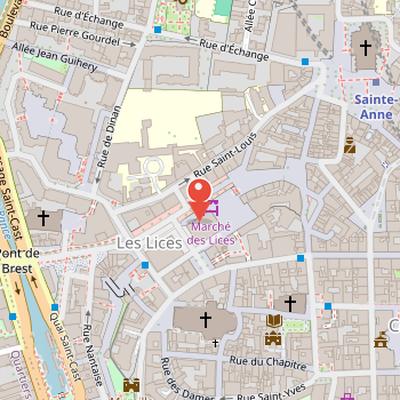
Place des Lices is a square located northwest of the city center. It receives the rues Saint-Louis, de Juillet, de la Monnaie, Rallier-du-Baty, and des Innocents, as well as the places de la Trinité and Saint-Michel. The square is bordered by numerous monuments and includes several distinct parts, with buildings, private mansions, and adjoining spaces arranged around its edges. Among its components are the rear of the former hôtel des Monnaies buildings, place de la Trinité, place du bas des Lices, rue des Portes Mordelaises, and the eastern tower of the gates on the west side. On Saturday mornings, it hosts the market des Lices. Over the centuries, the site served as a place for fairs, camps, commerce, executions, and celebrations. Its name refers to a former jousting ground where horsemen were separated by a barrier, and it is associated with an early tournament involving Bertrand du Guesclin in 1337.
Nearby Objects
-
 Halles Martenot 30 m away
 -
 Rennes Cathedral 130 m away
 -
 Porte Mordelaise 130 m away
 -
 Basilique Saint-Sauveur de Rennes 150 m away
 -
 Maison du Peuple de Rennes 200 m away
Location, access, and historical uses
Place des Lices is located northwest of the city center and is served by the rues Saint-Louis, de Juillet, de la Monnaie, Rallier-du-Baty, and des Innocents, as well as the places de la Trinite and Saint-Michel. The site is bordered by numerous monuments and includes several parts. Along its northern side, a row of buildings and private mansions forms an alignment crossed from east to west by rue des Innocents.
Over the centuries, Place des Lices has served in several capacities, functioning as a place for fairs, camps, commerce, executions, and celebrations. It also hosts the market des Lices on Saturday mornings. The name of rue des Innocents is linked to the gallows that stood at the top of place des Lices, reflecting one aspect of the site's historical use.
Spatial Arrangement and Access
Place des Lices is defined by a set of surrounding urban elements that frame its edges and access points. On the east side, it includes the rear of the former hotel des Monnaies buildings, the place de la Trinite, and a second group of buildings, and it extends further eastward into place Saint-Michel. On the west side, rue de Juillet runs northward, place du bas des Lices opens toward Bourg-l'Eveque, and a small group of buildings lies west of that square. The western edge also includes rue des Portes Mordelaises and the eastern tower of the gates. Together, these elements describe Place des Lices as a space closely integrated with adjacent streets, squares, and building fronts.
Origin and Symbolic Role
Place des Lices is linked to its origin as a jousting ground, where two horsemen were separated by a barrier during jousts. It is also associated with Bertrand du Guesclin, who took part in his first tournament there in 1337. A 1663 plan identifies Place des Lices as number 4 in the upper right section, and the place and its market are referenced around 1892. The two Martenot halls are described as symbolic of the place.
Historical Development of Place des Lices
Place des Lices is located outside the walls at the entrance to the Porte Mordelaise, one of the city gates. It also sits at the arrival point of commercial roads, including rue de Dinan and carrefour Jouaust. In 1455, it extended as far as rue Saint-Louis and included houses and gardens. A cistern was dug in the lower part in 1595, which separated it from place du Bas des Lices, and the area was repaved in 1614. In 1622, during a plague epidemic, it hosted the market des Lices, established outside the walls.
The northern part was leased by the city in 1657 for the construction of townhouses that still exist today. After that date, the space was clearly delimited from rue Saint-Louis. The southern part had a different use history: after the 1720 fire of Rennes, temporary barracks were built there, and the area along the wall and the zone now occupied by markets was used for barracks. Rue Neuve was created on this southern part. More recently, an underground parking facility was built in 1989 under rue Neuve.