The Fontaine de l'Observatoire is a monumental fountain in Paris, situated in the garden dedicated to explorers Marco Polo and Cavelier de la Salle. It forms part of the extension of the avenue de l'Observatoire toward the Luxembourg Garden in the sixth arrondissement of Paris. Inaugurated in 1874, it was listed as a historic monument by an ordinance dated 28 April 1926.
The fountain was first proposed in 1866 as part of the Avenue du Luxembourg project within a Paris reconstruction plan. Gabriel Davioud directed the project as service director of parks and plantations at the Paris prefecture. The planned ensemble included two new squares with lamps, ornamental columns, statues, and a fountain placed on the tree-lined axis between the Paris Observatory and the Luxembourg Palace. The sculpture was meant to relate to the observatory while preserving views of its dome and the palace. Jean-Baptiste Carpeaux was chosen to design the figure, with Eugène Legrain commissioned for the celestial sphere. Emmanuel Frémiet created the horses in the basin, and Louis Villeminot produced garlands of shells and aquatic plants. Work was interrupted by the Franco-Prussian War and the Paris Commune, then completed in 1874 with casting by the Thiébaut brothers foundry.
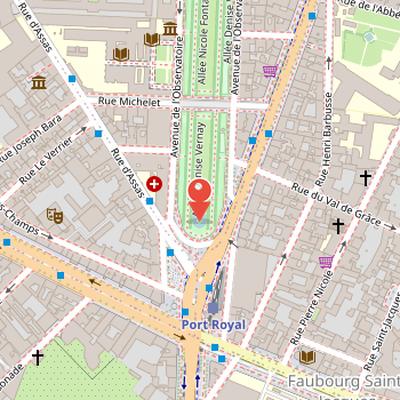
Nearby Objects
-
 Schola Cantorum de Paris 350 m away
 -
 Église du Val-de-Grâce 400 m away
 -
 Académie Colarossi 450 m away
 -
 Académie de la Grande Chaumière 500 m away
 -
 Hôpital Cochin 500 m away
Location and Status
The fontaine de l'Observatoire is a monumental fountain in Paris. It is located in the garden dedicated to explorers Marco Polo and Cavelier de la Salle, where it extends the avenue de l'Observatoire toward the Luxembourg garden in the sixth arrondissement of Paris. The fountain was inaugurated in 1874. It was later listed as a historic monument by an ordinance dated 28 April 1926.
Planning and Design of the Fountain
The fountain was first proposed in 1866 as part of the creation of Avenue du Luxembourg within a reconstruction plan for Paris. Gabriel Davioud directed the project as service director of parks and plantations for the Paris prefecture. During the French Second Empire, he designed fountains, squares, gates, lampposts, benches, and other architectural features. The Avenue du Luxembourg project included two new squares with lamps, ornamental columns, statues, and a fountain. The fountain was intended for the tree lined axis between the Paris Observatory and the Luxembourg Palace, and its sculpture had to relate to the observatory without blocking views of the dome or the palace.
Design and Creation of the Fountain
Jean-Baptiste Carpeaux was chosen as the sculptor for the Fontaine de l'Observatoire. He had studied under Francois Rude and won the Rome prize in 1854. His earlier work had explored similar themes, including four standing female figures representing the compass points around a celestial sphere, and he later developed the idea into women personifying the four corners of the world moving the sphere. For this fountain, Eugene Legrain, one of Carpeaux's students, was commissioned to sculpt the celestial sphere and also designed a zodiac band around it. Emmanuel Fremiet created the horses in the basin surrounding the statue, while Louis Villeminot made garlands of shells and aquatic plants for the basin decoration.
The project was interrupted during the Franco-Prussian War and the Paris Commune uprising. Work resumed in 1872, when plaster models were exhibited at the Paris Salon. That same year, observatory management corrected the placement of the zodiac symbols on the sphere's equatorial band. The fountain was completed in 1874, with casting by the Thiébaut brothers foundry. Carpeaux, who was in poor health, observed the installation from a distance. He died the following year. Ten years later, Clarietie praised the fountain as a masterpiece.
Design and Decorative Details
The fountain's theme is directly related to the nearby Paris Observatory, linking the work to its surrounding setting. Its base features hippocamps and dolphins, while the basin contains small turtles. One horse hoof sculpture on the fountain was signed by Fremiet, adding a signed artistic detail to the composition.
The Four Figures of the Celestial Sphere
The most notable part of the fontaine de l'Observatoire is the group of four women supporting the celestial sphere. The original sculpture is displayed in the Musee d'Orsay. These figures represent Africa, America, Asia, and Europe. Africa is symbolized by a black woman, America by a Native American woman, Asia by an East Asian woman, and Europe by a European woman. The women wear minimal clothing associated with their peoples: Africa holds a lion fur, America wears a loincloth and feather headdress, and Asia has her hair tied in a long braid. Carpeaux modeled the face of the Asia figure on a man, based on a Chinese bust study. The group is noted for the strong sense of movement typical of Jean-Baptiste Carpeaux's works, although it also received contemporary criticism for the entanglement of the legs in the sculpture. Related study material also addresses the theme of slavery in a bust titled Why Be Born a Slave!, which depicts a woman wrapped in ropes.