Folies Bergère is a cabaret music hall and theatre building in Paris, France, located at 32 Rue Richer in the 9th Arrondissement. It was built as an opera house by the architect Plumeret and opened on 2 May 1869 under the name Folies Trévise. The venue originally offered light entertainment including operettas, comic opera, popular songs, and gymnastics. On 13 September 1872, it took the name Folies Bergère, drawn from the nearby Rue Bergère.
The Folies Bergère was especially popular from the Belle Époque of the 1890s through the 1920s. Its revues were known for extravagant costumes, sets, effects, and often nude women. Josephine Baker performed there in 1926. Today, the venue is still in business and is regarded as a strong symbol of French and Parisian life.
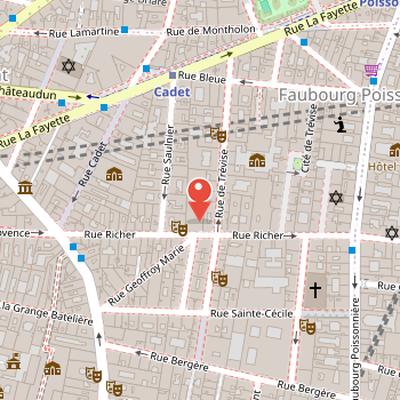
Nearby Objects
-
 Musée de la Franc-Maçonnerie 160 m away
 -
 Église Saint-Eugène-Sainte-Cécile 200 m away
 -
 Musée Grévin 350 m away
 -
 Boulevard Montmartre 400 m away
 -
 Théâtre des Variétés 400 m away
History and Performance at Folies Bergere
Folies Bergere is a cabaret music hall in Paris, France, located at 32 Rue Richer in the 9th Arrondissement, near the Cadet and Grands Boulevards metro stations. It was built as an opera house by the architect Plumeret and opened on 2 May 1869 under the name Folies Trevise. At that time, it offered light entertainment such as operettas, comic opera, popular songs, and gymnastics. The venue adopted the name Folies Bergere on 13 September 1872, taking its name from the nearby Rue Bergere.
The Folies Bergere became especially popular from the 1890s, during the Belle Epoque, through the 1920s. Its revues were known for extravagant costumes, sets, and effects, and they often included nude women. One of the venue's notable performers was Josephine Baker, the African-American expatriate singer, dancer, and entertainer, who appeared there in 1926 in a costume made of jewelry and a bikini bottom with rubber bananas attached. The Folies Bergere is still in business today and remains a strong symbol of French and Parisian life.
From Folies Trévise to Folies Bergere
The Folies Bergere is located at 32 Rue Richer in the 9th Arrondissement of Paris. It opened on 2 May 1869 as the Folies Trevise, an opera house designed by Plumeret, a building inspector of the French crown. The design was patterned after the Alhambra music hall in London. The term folies referred to pleasure houses and vacation homes built near large cities from the end of the 18th century, often used to discreetly shelter the adulterous loves of the bourgeoisie and aristocrats.
As the Folies Trevise, the venue offered light entertainment including operettas, opera comique, popular songs, and gymnastics. Its original name came from the street of that name by the stage door, but the Duc de Trevise objected to it. On 13 September 1872, the venue was renamed Folies Bergere, taking its new name from the nearby Rue Bergere. The word bergere means shepherdess.
Revues, Stars, and Art Deco Changes
The history of the Folies Bergere is closely tied to the development of revue-style music hall entertainment. In 1886, Eduard Marchand conceived the revue genre for the venue, placing women at the center of his concept. On 30 November 1886, the Folies Bergere staged Place au jeune !, its first revue-style music hall show. The production, which featured scantily clad chorus girls, was a tremendous success. The theater later attracted major performers, including the American dancer Loie Fuller in the early 1890s.
Marchand left the Folies Bergere in 1902 because of illness after 16 years, but the venue continued to play an important role in revue history. Yvonne Printemps was dancing there in 1907 at the age of 13. In 1918, Derval made his mark on the revue, introducing productions with extravagant costumes, sets, effects, and small nude women. These small nude women became a hallmark of the Folies Bergere. Over 48 years at the theater, Derval launched the careers of many French stars, including Maurice Chevalier, Mistinguett, Josephine Baker, and Fernandel.
The venue remained associated with sensational performance into the 1920s. Josephine Baker caused a sensation in La Folie du Jour in 1926, performing Fatou in a costume made of a skirt of artificial bananas. She also appeared in Un Vent De Folie in 1927, and her erotic dancing and near-nude performances were renowned. In the same year as her 1926 success, the theater facade was given a complete makeover in Art Deco style. The Folies Bergere also appears in art history, as Edouard Manet painted A Bar at the Folies-Bergere in 1882, depicting a bar-girl standing before a mirror.
Revues, Performers, and Later Musical Productions
The Folies Bergere continued to develop through a sequence of revues that included Nulls de Folies, followed by Folies en Folie and then En Super-Folies. In 1931, the act Sur le plateau de la negresse in L'usine a folies featured the Malian dancer Melka Soudani alongside the Senegalese dancer Feral Benga. In 1936, Josephine Baker returned from New York City and was signed by Derval to lead the revue En Super Folies, and in 1937 Margaret Kelly hired Constance Tomkinson. The production also had a notable visual identity, with a poster for En Super Folies designed by a Hungarian from Balassagyarmat, who remained associated with the Folies Bergere for 56 years.
Leadership of the Folies Bergere later passed through several hands. Paul Derval's funeral was held on 20 May 1966, when he was 86 years old. He was succeeded in managing the Folies Bergere by Antonia Derval, supported by Michel Gyarmathy. In August 1974, Antonia Derval passed the direction of the business to Hélene Martini, who had been a showgirl in the revues 25 years earlier before becoming director. Since 2006, the Folies Bergere has also presented musical productions with Stage Entertainment, including Cabaret from 2006 to 2008 and Zorro from 2009 to 2010.
Related Revues and Later Adaptations
The Folies Bergere influenced a number of later venues and productions in different countries. In the United States, the Ziegfeld Follies were inspired by the Folies Bergere, and similar productions were staged in the 1930s and 1940s by impresario Clifford C. Fischer. These included the Folies Bergere of 1939 at the Broadway Theater in New York and the Folies Bergere of 1944 at the Winterland Ballroom in San Francisco. Other related examples included the Teatro Follies in Mexico and Faceboyz Folliez, a monthly burlesque and variety show at the Bowery Poetry Club in New York City. In Las Vegas, the Folies Bergere revue at the Tropicana Resort and Casino opened in 1959 and continued until the end of March 2009, when it closed after nearly 50 years of operation.
Popular Culture References
Folies Bergere has been mentioned in popular culture, including in the movie The Last Time I Saw Paris and in the movie Nine. These references indicate that the venue has remained recognizable beyond its physical setting and has been used as a cultural reference point in film.
Posters, Performances, and Interior Spaces
The available images show both the interior spaces and the performance culture associated with the Folies Bergere. One image presents the auditorium, while another shows the foyer, indicating the venue's public and architectural interiors. Several posters document productions and performers linked to the site in the late 1890s, including Loie Fuller, The Rainbow, Liane de Pougy, Lina Cavalieri, and La Jolie Thero. The posters are credited to artists such as Henri de Toulouse-Lautrec, Jules Cheret, Paul Berthon, and PAL, and they date from about 1895 to 1898. Together, these images suggest the Folies Bergere as a place closely tied to stage entertainment and poster art. A later image shows Josephine Baker dancing the Charleston for a silent film in 1926 at the Folies Bergere in Paris, extending the venue's documented cultural presence into the 20th century.