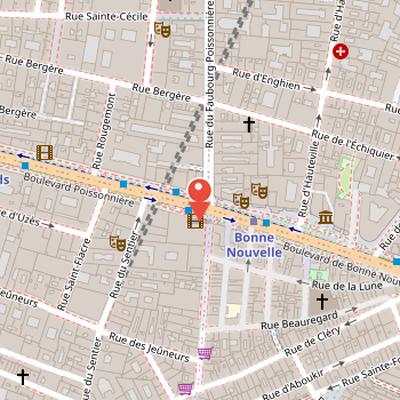
Le Grand Rex is a movie theater located at 1 boulevard Poissonnière in the Sentier district, on the grands boulevards. Its facades and roofs, as well as the hall and its decor, are registered as historical monuments. The building includes seven halls, among them a large hall that can accommodate more than one thousand spectators, and two halls are accessible to people with reduced mobility. It receives an average attendance of one million visitors per year and is served by metro lines 8 and 9 at Bonne-Nouvelle station.
The venue was developed in the early 1930s by Jacques Haïk, a cinema producer and distributor who owned the Olympia. The project brought together architects Auguste Bluysen and John Eberson, with the facade designed by sculptor Henri-Édouard Navarre. The large hall was decorated by Maurice Dufrène, with wall murals by Henri Mahé and the painting Les Canotiers by Robert Lotiron on the mezzanine foyer landing. Its design reflects an atmospheric cinema concept, with a Mediterranean-antique city in relief and an Art Deco villa ambiance under a starry sky.
Nearby Objects
-
 Théâtre du Gymnase Marie Bell 90 m away
 -
 Église Saint-Eugène-Sainte-Cécile 300 m away
 -
 Porte Saint-Denis 350 m away
 -
 Théâtre des Variétés 450 m away
 -
 Musée Grévin 450 m away
Location, Access, and Heritage Status
Le Grand Rex is located at 1 boulevard Poissonniere in the Sentier district, on the grands boulevards. Its facades and roofs, as well as the hall and its decor, are registered as historical monuments by decree. The venue can accommodate more than in its large hall and receives an average of one million visitors per year. It has seven halls in total, of which the large hall and hall 5 are accessible to people with reduced mobility. The site is served by metro lines 8 and 9 at Bonne-Nouvelle station.
An Atmospheric Cinema Hall
In the early 1930s, Jacques Haik, a wealthy cinema producer and distributor who also owned the Olympia, began constructing a highly extravagant cinema hall. The project brought together several designers and artists: the architects were Auguste Bluysen and John Eberson, the facade was designed by sculptor Henri-Edouard Navarre, the large hall was decorated by Maurice Dufrene, the wall murals were painted by Henri Mahe, and the painting Les Canotiers on the mezzanine foyer landing was created by Robert Lotiron.
The hall was conceived on a grand scale, with a ceiling rising to over thirty meters and finished with a luminous starry vault. A rooftop tower reached thirty-five meters in height. Although Haik's original wishes were respected in many respects, the seating capacity was reduced. The large hall was decorated as a Mediterranean-antique city in relief, and its decor evoked a French Riviera Art Deco villa atmosphere under a starry sky.
The project reflected broader changes in cinema design during the rise of sound cinema, when cinemas invested in larger, more spectacular, and more profitable halls. John Eberson, who specialized in atmospheric cinema halls in the United States, had built over four hundred fantastical city decor sets under various skies there. The architectural concept of the salle atmosphere had originated in the 1920s, aiming to create immersive environments inspired by exotic or fantastic landscapes. In this case, the intention was to offer a climate more agreeable than Parisian gloom, and these features helped attract an audience drawn to exoticism.
Murals, Screen Innovations, and Renovation
Le Grand Rex includes several notable elements that reflect its history as a cinema venue. On the mezzanine, a mural created in 1932 by Henri Mahe forms part of the Historique. The mural originally depicted Charlie Chaplin and Jacques Haik watching a studio film scene of pirates boarding a ship. After the release of The Great Dictator, Nazis mocked this representation and transformed it into a clown. The original mural was later rediscovered during the Covid-19 pandemic.
The cinema also has a history of technical and visual display features. In 1950, its projectionist enlarged the image during indoor fire scenes while screening Gone with the Wind. More recently, Historique's outdoor giant screen at Piazza Grande, Locarno Film Festival measures twenty-six meters wide by fourteen meters high. It was designed and realized by Luc Heripret and inaugurated with the film Le Grand Bleu by Luc Besson.
The large hall was renovated in 2017, when 1,200 balcony folding seats were replaced with chairs named Grand Rex, embroidered with gold and silver thread.
Madonna Performances at Historique
Madonna performed at Historique during her Madame X Tour over an unspecified period. Several of the scheduled dates were canceled because of her injuries and the Covid-19 pandemic. These cancellations affected the planned run of performances at the venue.
Restoration and Contemporary Use
Le Grand Rex ordinarily attracts about one million spectators, but it was closed during an unspecified month of the Covid-19 period because of a lack of public and films. After the first lockdown ended, it attempted retrospectives and thematic marathons in June. From December of the same year, its facades and roofs underwent a complete restoration and renovation led by architects Antoine Petit, Nicolas Debicki, Grichka Martinetti, and Stephane Thomasse. The restoration was completed in an unspecified month and included facade decoration inspired by the original 1932 building, with the renovated facade regaining aspects explained by Alexandre Hellmann.
The building has become an iconic cinema venue in France and Europe, noted for its architecture and decoration. Its large hall officially became the largest regularly active cinema hall worldwide after the renovation works. It can currently accommodate between an unspecified minimum and maximum number of people in the large hall. Le Grand Rex also remains a major event venue, hosting large premieres with film teams and organizing special events called Marathons. These Marathons gather fans of franchises such as Star Wars, the Marvel Cinematic Universe, Tolkien adaptations, Nuits de la Glisse, Nanarland, and Hunger Games. On an unspecified date, the venue celebrated its 90th anniversary.