Église Saint-Eugène-Sainte-Cécile is a church building in Paris constructed from 1854 to 1856, at the request of Napoléon III, by Louis-Auguste Boileau and Adrien-Louis Lusson in twenty months. It was built on the site of the hôtel des Menus-Plaisirs and was influenced by the ideas of abbé Coquant, the parish priest, art lover, and historian. The church is described as the first Paris church with an entirely metallic structure, and its façade is presented as a pastiche of Gothic architecture using a non-traditional material instead of stone. Its vaults rest on slender colonnettes inspired by those of the Saint-Martin-de-Champs refectory. The church originally bore the name Église Saint-Eugène and has had the joint dedication to Saint Eugène and Saint Cecilia since the mid-20th century. Jules Verne married Honorine Viane here, and the building was classified as a historical monument by decree.
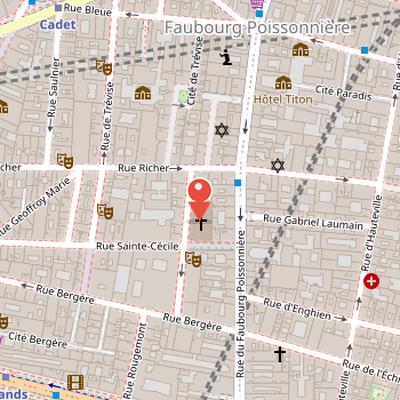
Nearby Objects
-
 Folies Bergère 200 m away
 -
 Théâtre du Gymnase Marie Bell 300 m away
 -
 Le Grand Rex 300 m away
 -
 Musée de la Franc-Maçonnerie 350 m away
 -
 Musée Grévin 400 m away
Construction and Historical Status
The church was constructed between 1854 and 1856 at the request of Napoleon III, taking twenty months to complete. It was designed by Louis-Auguste Boileau and Adrien-Louis Lusson and built on the site of the former hotel des Menus-Plaisirs. Its construction was influenced by the ideas of Abbe Coquant, who was the parish priest as well as an art lover and historian. The building also entered cultural history as the place where Jules Verne married Honorine Viane. At a later date, it was classified as a historical monument by decree. The available facts also note that its construction cost and cost per square meter were recorded, and that its price per square meter was seven times lower than that of the Madeleine building.
Dedication to Saint Eugene and Saint Cecilia
The church was originally named Eglise Saint-Eugene, but since the mid-20th century it has had a joint dedication to Saint Eugene and Saint Cecilia. In 1952, the parish priest, Canon Bony, requested authorization from Rome to add a second dedication to the church.
The dedication to Saint Eugene recalls a figure said to have been born in Rome, one of the main companions of Saint Denis, and later an evangelizer of Spain. He is also described as having held the seat of Toledo in Spain before coming to Gaul. According to the tradition attached to him, he became a victim of anti-Christian persecutions by Maximien in the Paris region, was arrested at Deuil, and was decapitated. His remains were thrown into Lac Marchais, then his body was found and placed at the Abbey of Saint Denis before being transferred to Toledo at the request of the Spanish.
Architecture and Interior Decoration
The facade of the Church of Saint-Eugene-Sainte-Cecile is described as a pastiche of Gothic architecture, using a non-traditional material rather than stone. It is also identified as the first Paris church with an entirely metallic structure. The vaults rest on slender colonnettes inspired by those of the Saint-Martin-de-Champs refectory, and the slenderness of the columns gives the interior a strong effect of perspective. Their small diameter also provides acoustic advantages in the nave. The use of iron and cast iron for supports and ornamentation was presented as a response to savings in both material and labor.
The walls, columns, and vaults are entirely painted, and the interior is fully covered with polychrome paintings. This decoration was restored between 1982 and 1984. The building contains 48 stained-glass windows created by Laurent and Gaspard Gsell, Antoine Lusson, Eugene Oudinot, and Pierre Petit-Gerard of Strasbourg. The lower stained-glass windows on the aisles represent the Stations of the Cross. The first stained-glass window was made by Antoine Lusson, while the other lower windows were made by Eugene Oudinot based on Gerard Seguin's cartoons. The upper stained-glass windows by Gaspard Gsell depict the private life of Christ.
The interior also includes a large organ case with a richly carved oak facade, a pulpit with a light and elegant design, four staircases leading to the galleries, and a workbench, stalls, and carved wooden confessionals. The tribune organ was made by Joseph Merklin and Friedrich Schutze, designed for the 1855 Universal Exposition, restored in 1995 and 2005 by Olaf Dalsbaek. Notable organists include Raoul Pugno from 1872 to 1892 and Pierre Pincemaille from 1982 to 1987.
Interior Furnishings and Liturgical Elements
The church contains several described interior elements that contribute to its liturgical and decorative character. These include a chair, a choir bench, and a wooden staircase. It also features a baptistery and a statue of Joan of Arc. Together, these elements indicate a furnished interior with both functional and commemorative details, reflecting the church's usage as a place of worship in Paris IX.
Liturgical Life and Musical Tradition
The liturgical life of Eglise Saint-Eugene-Sainte-Cecile combines the Roman Rite of Paul VI with the 1962 Tridentine Rite, and on occasion also includes masses in the pre-1954 form used before Pope Pius XII's Holy Week reform. Traditional mass was reintroduced in the parish on the patronal feast day, and the parish applies the 1984 circular letter Quattuor abhinc annos. Since 1980, it has held Gregorian Latin masses in post-conciliar form, alongside Sunday Tridentine masses led by the Schola Sainte Cecile choir.
The Schola Sainte Cecile is a Paris-based liturgical choir of about thirty singers, directed by Henri de Villiers since 2000. De Villiers also conducts the choir of the Russian Catholic Church of the Trinity in Paris. The choir focuses on traditional sacred vocal music, especially French Baroque and Gregorian chant. Its role at the church also includes an annual solemn Tridentine Requiem mass on January 21, commemorating Louis XVI. During this service, the Schola Sainte Cecile performs Gregorian chants and works by major French Baroque and Classical composers.
Controversy During the Covid-19 Pandemic
During the Covid-19 pandemic, the church became the focus of controversy after an Easter mass was celebrated on a Saturday without respect for sanitary rules. A Tridentine rite office lasting about four hours was also held without barrier gestures. In response, the Archdiocese of Paris distanced itself from the initiative through Auxiliary Bishop Denis Jachiet, who indicated that sanctions were possible. Cardinal Robert Sarah expressed compassion toward the priest and sent blessings to the faithful. The Paris prosecutor's office then opened an investigation for endangering the lives of others.
The same period also coincided with a change in parish leadership. Curé Guelfucci's functions were not renewed after a six-year mandate ending on a specified date, and he was replaced by Abbé Julien Durodiie. The bishop partially took the controversy into account in this replacement.