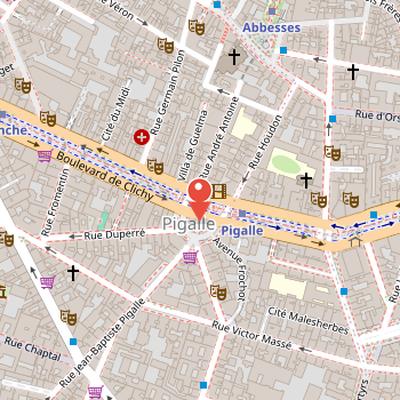
Place Pigalle is a circular square with a diameter of 70 meters, situated on the main axis of Boulevard de Clichy near the Basilica of Sacré-Cœur at the foot of Montmartre hill. Several streets, including Rue Jean-Baptiste-Pigalle, Rue Frochot, Rue Duperré, Rue Houdon, and Rue André Antoine, lead into the square. The Métro station Pigalle is located here.
The square was established on the site of an old customs station and opened on 16 January 1789. It was reopened after redesign in 1826 and originally named Place de la Barrière Montmartre. In 1862, architect Gabriel Davioud presented a fountain project for the center of the square, which was completed by 1863. The square was renamed Place Pigalle in 1864 after Rue Pigalle, now Rue Jean-Baptiste Pigalle.
The surrounding area became associated with artists, and the Café de la Nouvelle Athènes at Place Pigalle 9 was frequented from 1855 by figures including Edgar Degas, Édouard Manet, Vincent van Gogh, and Claude Monet. Place Pigalle also played a role in the events of the Paris Commune in 1871. Today, the name Pigalle is closely associated with the entertainment district, the nearby Moulin Rouge, and the area’s reputation as a red-light district.
Nearby Objects
-
 Café de la Nouvelle Athènes 40 m away
 -
 Saint-Jean-de-Montmartre 200 m away
 -
 Le Chat Noir 300 m away
 -
 Wall of Love 300 m away
 -
 Musée de la Vie romantique 300 m away
Location and Contemporary Significance
Place Pigalle is a circular square with a diameter of 70 meters. It lies on the main axis of Boulevard de Clichy, near the Basilica Sacre Coeur at the foot of Montmartre hill. Several streets lead into it, including Rue Jean-Baptiste-Pigalle, Rue Frochot, Rue Duperre, Rue Houdon, and Rue Andre Antoine. The Place is also served by the metro station Pigalle. The surrounding area around Place Pigalle and Boulevard de Clichy is closely associated with the entertainment district of Pigalle, which is named after the square. It is near the Moulin Rouge and is today regarded as a synonym for the erotic, disreputable, and underworld affected Paris. The district is also known as a red-light area and for its ethnically diverse character.
From Customs Station to Artists' Square
Place Pigalle was established on the site of an old customs station and opened on January 16, 1789. It was first named Place de la Barriere Montmartre, after the fence that separated Montmartre from Paris for customs purposes. The square was reopened after redesign on September 27, 1826, and later received an ornamental fountain project by architect Gabriel Davioud, presented on May 22, 1862 and completed by 1863. On December 30, 1864, it was renamed Place Pigalle after Rue Pigalle, now Rue Jean-Baptiste Pigalle, itself named for the sculptor Jean-Baptiste Pigalle.
The area around Place Pigalle attracted artists, including painters, sculptors, and writers. The Cafe de la Nouvelle Athenes at Place Pigalle 9 was frequented from 1855 by artists such as Edgar Degas, Edouard Manet, Vincent van Gogh, and Claude Monet. The fountain also became a point of public concern: on June 29, 1868, the Paris Water and Sewage Department complained that it was accumulating dirt, stones, debris, and fish waste. A garden was later built around the fountain to restrict direct access. During the Franco-Prussian War, German soldiers occupying the area began washing their uniforms in the fountain on January 22, 1871.
Place Pigalle in the Paris Commune
From March 18, 1871, Place Pigalle and nearby Montmartre became a center of the Paris Commune's revolutionary efforts. General Bernard de Susbielle moved about 6,000 soldiers to Montmartre near Geschichte, where 171 cannons were positioned and later confiscated. At Place Pigalle, the first and possibly only shots of the civil war were fired. During the fighting, which lasted about 20 minutes, a captain of the hunters' troops was shot down. General Lecomte ordered his troops four times to fire on unarmed people at Place Pigalle and was eventually shot himself.
Pigalle in Song and Film
Place Pigalle has often been romantically portrayed in songs and feature films, and this image has helped make it one of the best-known squares in Paris, even though it has lost its former significance. It was named La Rue Pigalle by Edith Piaf on her LP with the title song Elle frequentait la rue Pigalle, recorded on May 31, 1939. Georges Ulmer described it in a chanson written in 1944 and released on September 29, 1950, as a large market of love in Musette style. The title Place Pigalle was recorded by Maurice Chevalier on April 9, 1946, and the square was also featured in the hit song Pigalle (Die grosse Mausefalle), with music by Heinz Gietz and lyrics by Hans Bradtke, sung by Bill Ramsey and recorded on December 10, 1960. In cinema, it was the setting of Drei Uhr nachts, which premiered on August 24, 1956, and it appears in Pigalle, released on February 1, 1995, which shows the shabby, neon-lit underworld of the area. It was also premiered in the famous revue Folies Bergere. In addition, Place Pigalle and the book are the subjects of a cultural program by France Culture, made available as a free download in October 2017 and on January 1, 2018.