Café de la Nouvelle Athènes was a café in Paris located at Place Pigalle No. 9 in the 9th Arrondissement, where it had been open since 1855. In the second half of the 19th century, it became a meeting place for numerous notable figures, including opposition politicians, writers, artists, and photographers. During the Second Empire, it hosted people such as Léon Gambetta, Jules-Antoine Castagnary, Alfred Delvau, Édmond Duranty, Gustave Courbet, and Nadar. After the Franco-Prussian War, writers including Stéphane Mallarmé, Émile Zola, Paul Verlaine, Guy de Maupassant, Auguste de Villiers de L’Isle-Adam, and Joris-Karl Huysmans also visited. From the mid-1870s, Impressionist painters moved there from Café Guerbois, and artists such as Edgar Degas, Jean-Louis Forain, Jean-François Raffaëlli, and Federico Zandomeneghi were associated with it. Claude Monet, Camille Pissarro, Paul Cézanne, Vincent van Gogh, Georges Seurat, Paul Gauguin, Henri de Toulouse-Lautrec, Henri Matisse, Erik Satie, and Maurice Ravel are also named among its visitors. The café served as a subject or motif for painters present there, although many works were completed in studios after preliminary sketches made on site.
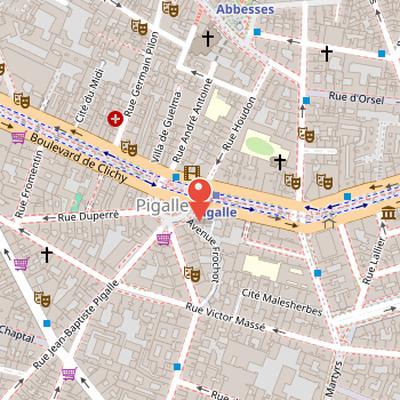
Nearby Objects
-
 Place Pigalle 40 m away
 -
 Saint-Jean-de-Montmartre 250 m away
 -
 Wall of Love 300 m away
 -
 Le Chat Noir 300 m away
 -
 Musée de la Vie romantique 350 m away
Caf de la Nouvelle Athnes in Paris
Cafe de la Nouvelle Athnes was a cafe in Paris located at Place Pigalle No. 9 in the 9th Arrondissement since 1855. In the second half of the 19th century, it was frequented by numerous notable artists. It also became a subject for paintings by notable painters of the period, which reflects its visibility within the artistic life of the city.
CafE de la Nouvelle Athens and its district
Cafe de la Nouvelle Athenes opened in 1855 in the Nouvelle Athenes district, an area named after the district around Metro Saint-Georges and bounded by Rue Clichy, Rue Chateaudun, Rue des Martyrs, and Boulevard de Clichy. The district developed between 1820 and 1850, changing from fields and orchards into a zone of entertainment venues. Its name was introduced by journalist Dureau de La Malle in a Journal des Debats article on October 18, 1823, during a period when Greek independence in 1821 had encouraged a Greek fashion in France that influenced the area. During the Second Empire, the cafe hosted opposition politicians such as Leon Gambetta and was frequented by writers Jules-Antoine Castagnary, Alfred Delvau, and Edmond Duranty, as well as artist Gustave Courbet and photographer Nadar. After the Franco-Prussian War, it continued to attract literary figures including Stephane Mallarme, Emile Zola, Paul Verlaine, Guy de Maupassant, Auguste de Villiers de L'Isle-Adam, and Joris-Karl Huysmans.
An Artists' Meeting Place
From the mid-1870s, Impressionist painters moved from Cafe Guerbois to Cafe de la Nouvelle Athenes, and the cafe became an important artists' meeting point. Its popularity was strengthened by Edmon Duranty's friendship with Edgar Degas and Edouard Manet, while Marcellin Desboutin reportedly preferred it to Cafe Guerbois because it was more tranquil. Several artists followed Degas there, including Jean-Louis Forain, Jean-Francois Raffaelli, and Federico Zandomeneghi. Claude Monet and Camille Pissarro visited occasionally when in Paris, and Paul Cezanne appeared only rarely, usually with the musician Ernest Cabaner. In the 1880s, the cafe was frequented by Vincent van Gogh, Georges Seurat, Paul Gauguin, Henri de Toulouse-Lautrec, Henri Matisse, Erik Satie, and Maurice Ravel. Irish writer George Moore also became a regular guest from the late 1870s. Edouard Manet wanted to paint Moore's portrait in the cafe, and Moore later noted that Manet had a marble table like those of Nouvelle Athenes in his studio. The cafe also became a motif in the work of many of its visitors. However, most pictures were made in studios, with only preliminary sketches made on site. Manet's portrait of Alphonse Maureau and his painting Die Pflaume were created in the studio, while Edgar Degas' Absinth from 1876 shows Marcellin Desboutin with Ellen Andree in the cafe and his pastel Femme dans un cafe is also set there. Jean-Louis Forain and Federico Zandomeneghi likewise used the cafe as a motif. The role of the cafe as an artists' meeting place ended at the end of the 19th century, when other locations in Montmartre took over that function.
A Venue of Repeated Reuse and Renaming
The venue underwent a long sequence of name changes and uses. It was known at different times as Monico and New Monico, and during World War II it operated as Bricktop's nightclub for German occupation troops and later for liberator armies. In the 1950s it became the Le Sphinx striptease club. After an intermezzo as Narcisse, it turned into the New Moon lesbian bar in the 1970s. The building then closed temporarily and reopened in 1987 as the New Moon rock cafe for punk musicians. Later, the New Moon closed and Le Temple bar moved into the building, before a fire destroyed it in 2004. The completely burned-down structure was rebuilt and reopened in 2007 as a bar and restaurant named Nouvelle Athenes. The new venue shares only the name and address with the original 150-year-old Cafe de la Nouvelle Athenes.