Le Chat Noir was a cabaret in the Montmartre neighborhood of Paris. It was inaugurated on November 18, 1881, on Boulevard Rochechouart and remained open until 1897. The venue featured performances by singer-songwriters such as Aristide Bruant and presented shadow theatre shows created mainly by Rodolphe Salis and Henri Rivière. These productions were animated by Pere Romeu and accompanied by piano music. Le Chat Noir also drew many famous or notable artists as regular customers.
Founded in 1881 during the French Third Republic, Le Chat Noir belongs to a period when republican government had become established in France after the political upheavals of the 1870s. The cabaret’s influence extended beyond Paris, inspiring Els Quatre Gats in Barcelona and El Perro Descarriado in Saint Petersburg. Its name is now used by multiple hospitality establishments worldwide.
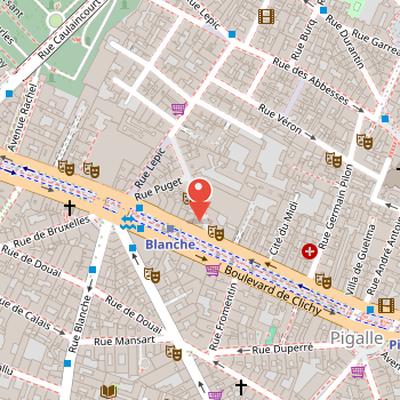
Nearby Objects
-
 Moulin Rouge 150 m away
 -
 Théâtre du Grand-Guignol 250 m away
 -
 Musée de la Vie romantique 300 m away
 -
 Place Pigalle 300 m away
 -
 Saint-Jean-de-Montmartre 300 m away
Cabaret Life at Le Chat Noir
Le Chat Noir was a cabaret in the Montmartre neighborhood of Paris, inaugurated on November 18, 1881 at Boulevard Rochechouart and closed in 1897. It featured performances by singer-songwriters such as Aristide Bruant and presented shadow theater shows created mainly by Rodolphe Salis and Henri Riviere. These performances were animated by Pere Romeu and accompanied by piano music. The cabaret also attracted many famous or notable artists as regular customers, which contributed to its cultural standing. Its influence extended beyond Paris, inspiring Els Quatre Gats in Barcelona and El Perro Descarriado in Saint Petersburg. The name Le Chat Noir continues to be used by multiple hospitality establishments worldwide.
Historical Context of Le Chat Noir
Le Chat Noir was founded in 1881, during the Third Republic in France. Its creation took place after a period marked by major political upheaval. Following the defeat of Napoleon III's Empire at the Battle of Sedan in 1871, a National Defense Government was formed in Paris to continue the war. Thiers was then appointed chief of executive power and negotiated peace with Bismarck in May 1871. The Paris Commune revolution began after that peace agreement and was later ended by strong repression.
In the early years of the Third Republic, the government was led by monarchy groups, but disagreements between legitimists and Orleanists complicated political life. In 1875, constitutional laws affirmed the republican regime, and by the late 1870s republicans had taken power, bringing greater stability and prosperity. During the foundation of Le Chat Noir, France was ruled by a republican government that promoted citizen freedoms such as divorce, press rights, and assembly rights. It also introduced educational reforms based on secular, free, and compulsory school attendance, and adopted representative measures such as the French anthem and National Day.
This period was considered favorable to the arts and was associated with the Belle Epoque. Stability was linked to support for technology, science, and art, and the years saw the creation of cafes, cabarets, concert halls, and art galleries in France and Europe. It was also a time of artistic splendor at the end of the 19th century, providing the broader cultural setting in which Le Chat Noir appeared.
The First Home of Le Chat Noir
Le Chat Noir began as a rental of a small two-room space at 84, Boulevard Rochechouart, a location now commemorated by a historical plaque. The cabaret gained success with the arrival of Les Hydropathes, a radical group of young writers and artists led by journalist Emile Goudeau. The club had previously met at Goudeau's house on the Rive Gauche, but after Salis convinced Goudeau to relocate, Le Chat Noir became its meeting place. Les Hydropathes took their name from their aversion to water and their preference for wine and beer. This association helped establish the cabaret as an important gathering place for literary and artistic circles.
A Cabaret for Artists and Urban Myth
Le Chat Noir was conceived in 1881 by Rodolphe Salis as a Louis XIII style cafe with Byzantine influences, intended for middle class men to drink. It opened in November 1881 as a small venue planned as a meeting place for painters and poets. Its early conditions were modest, with bad wine and inferior decoration, yet from the start it also had a distinctive identity: a Swiss guard at the door, decorated entirely with gold, who admitted painters and poets while restricting priests and military personnel. The cabaret took its name from a black cat Salis saw on the street during construction.
The clientele grew with the presence of artists such as painters Henri Pille and Nestor Outer, as well as cantautores Aristide Bruant and Jules Jouy, and poets Albert Samain and Maurice Rollins. As its popularity increased, the cabaret moved on June 10, 1885 to a larger venue at 12, Rue Victor Masse, the former private mansion of painter Alfred Stevens. Salis remodeled it into a fashionable establishment with architect Mauricio Isabey, and the interiors were decorated by Henri Riviere and Caran d Ache. The venue was described as having an eclectic and picturesque style.
The facade and interior were marked by a strong visual identity. On the first floor facade were two Eugene Grasset lamps in a neo medieval style. The second floor facade featured a central representation of a black cat by Alexandre Charpentier and a painted emblem by Adolphe Willette showing a black cat sitting on a silver crescent moon. Willette also created stained glass windows that illuminated the ground floor interior. Inside, drawings by Auriol, Riviere, Steinlen, Sommer, and Caran d Ache were displayed on the walls. Salis presented the cabaret as the most extraordinary cabaret in the world.
Le Chat Noir also became known for performance and innovation. It created a color shadow theater with music by Georges Fragerolle and debuted the Salon des Arts Incoherents, shadow artists, and comic monologues. Poets and singers performing there found it an excellent place to practice their craft in Paris. Salis served as host and master of ceremonies with ironic courtesy. The cabaret attracted foreigners from all over the world and some of the most powerful men of Paris. Later, it relocated to 68 boulevard de Clichy, where it reopened and remained until closure. Its last shadow play was presented in January 1897 before the company went on tour, and Salis died later that year while planning another move within Paris. The boulevard de Clichy location remained popular during the 1920s and is now a boutique hotel with references to its past. The cabaret's name also influenced many other cabarets worldwide, including Barcelona's Els quatre gats and Paris establishments Le Chien Noir and L Ane Rouge, and it inspired the annual Carnival opening dance in Dunkirk called the Bal du Chat noir.
Shadow Theatre at Le Chat Noir
Shadow theatre at Le Chat Noir emerged as a type of show within the cabaret and helped revive shadow theatre performances in France. It originated from a puppet theatre built by Henry Sommer and George Auriol in late 1885. The first presentation featured Henri Riviere moving cardboard silhouettes behind a white napkin screen, while Jules Jouy sang a song accompanied by cabaret piano. In 1887, the puppet theatre was replaced by a shadow theatre. The performances used a screen measuring 1.12 meters high and 1.40 meters wide, supported by a large frame. This format became one of the notable forms of entertainment associated with Le Chat Noir.
The Weekly Publication of Le Chat Noir
La revista Le Chat Noir was a weekly literary, promotional, and satirical publication named after the cabaret. Created by Rodolphe Salis and Emile Goudeau, it was designed to promote the cabaret and helped popularize cabaret and its shows through print. Published every Saturday, it consisted of four pages and appeared between 1882 and 1895, with 688 issues issued from January 14, 1882, to March 1895. A second series added 122 more issues, ending on September 30, 1897.
The publication combined contemporary literary works, cabaret stories, accounts of Montmartre activities, poems, drawings, political caricatures, and a section devoted to nightly shows at Le Chat Noir. Its listings included the famous Teatro de Sombras among the performances. The magazine also featured contributions from writers such as Guy de Maupassant, Victor Hugo, Edmond de Goncourt, Paul Verlaine, Jean Richepin, and Leon Bloy. Its musical section was led by Charles Gounod and Jules Massenet, while illustrations by Adolphe Willette and Caran d Ache were prominent, including satirical themes by Willette and military themes mainly by Caran d Ache. The publication also included early small articles by Jean Lorrain and collaborated with illustrators including Does, Fernand Fau, Nestor Outer, Godefroy, Uzes, Poirson, Gustave Verbeck, Marcel Capy, Lucien Pissarro, and Henri de Sta.
Esoteric Legend and Symbolism
A legend around Le Chat Noir emerged in the French esoteric world after the 1930 publication of Demeures philosphales by Fulcanelli. In this interpretation, Le Chat Noir served as an esoteric and political center until the death of Salis. The legend also held that the place contained a series of carefully disguised symbols, adding to its later cultural and interpretive significance.
Cultural References to Le Chat Noir
Le Chat Noir is mentioned in several later cultural contexts. Otros notes a poster of Le Chat Noir in photographs of the 2001 Kathleen Peterson murder crime scene. It is also identified as the nightclub where Frank Sinatra and Natalie Wood rekindled their relationship. The cabaret is further associated with a famous painting of a cat with blinking eyes on its entrance wall. In film, Le Chat Noir appears in several productions, including Messieurs les ronds-de-cuir by Henri Diamant-Berger, which is described as an adaptation of the Georges Courteline novel.