The Musée de la Franc-Maçonnerie is a Masonic museum associated with the Grand Orient de France in rue Cadet. Its origins lie in 19th-century efforts to preserve lodge cultural heritage, including a library created in 1838 and reorganized in 1874. The first museum collections were formed from items already owned by the Grand Orient de France, among them a medal collection noted since the 1840s, and lodges were invited to send historical objects and documents to rue Cadet. Over time, the holdings were expanded through donations and purchases.
The museum’s history includes interruption during the Second World War, when collections were pillaged and confiscated, and later returned to the Grand Orient de France after the Liberation. In the late 1960s and early 1970s, the headquarters was rebuilt and the museum opened to the public in 1973, at the time of the bicentennial of the Grand Orient de France formation. The museum received advice from the French Museums Directorate and René Guilly, and it later underwent renovation and reorganization in the early 1980s.
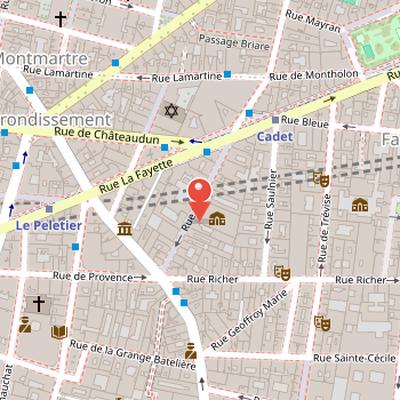
Nearby Objects
-
 Folies Bergère 160 m away
 -
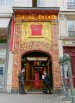 Musée Grévin 350 m away
 -
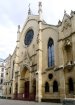 Église Saint-Eugène-Sainte-Cécile 350 m away
 -
 Salle Le Peletier 350 m away
 -
 Notre-Dame-de-Lorette 350 m away
The Origins of the Musee de la Franc-Maconnerie
The creation of the Musee de la Franc-Maconnerie was prompted by a circular asking the council of the order to organize a Freemasonic museum at the Grand Orient de France hotel. The project was intended to contribute to the centenary of the French Revolution and to celebrate Freemasonry's place in it. Its opening also reflected the growing interest in the cultural heritage of lodges during the 19th century.
The Grand Orient de France had already created a library in 1838 and reorganized it in 1874. The museum's first collections were made up of objects already owned by the Grand Orient de France, including a medal collection noted since the 1840s. Lodges were also asked to send historical objects and documents to rue Cadet. In late 19th-century imagery, the museum appeared as a cabinet of curiosities, and the Grand Orient de France headquarters was featured in an 1889 report in Le Monde illustre.
Collection History and Wartime Losses
The museum's collections were built up over many years through donations and purchases. Between the wars, they also benefited from Arthur Groussier's care and preservation efforts. In 1937 and 1938, some pieces were used for the Great Exhibition at the Petit Palais in Paris, while others were stored at square Rapp, the former Theosophical society headquarters. Because of limited resources, the collections were carefully packed in boxes. From 1940 to 1944, the collections were pillaged and confiscated by Nazis and Vichy secret societies. The remaining collections were returned to the Grand Orient de France at the Liberation.
From Headquarters to Public Museum
In the late 1960s, the Grand Orient de France rebuilt part of its rue Cadet headquarters, replacing the old small street building with a large metal facade building in the international style of the 1970s. This transformation marked the bicentennial of the Grand Orient de France formation in 1973, when a museum called the Grand Orient de France museum was opened to the public. The project benefited from advice and help from the French Museums Directorate and Rene Guilly, who also granted it the label of musee controle de deuxieme categorie. The museum received nearly ten thousand visitors each year.
During the early 1980s, the museum was renovated and reorganized under Paul Gourdot and Helene Camou. Its collections were later enriched by the Baylot sale in 1987. By the beginning of the 21st century, however, the 1973 museum no longer met public expectations. A new museum concept was then planned as part of the restructuring of the first two levels of hotel Cadet.
The new works exceeded technical requirements and, under grand master Alain Bauer, aimed to break with the fortress-like architecture designed by war-surviving Freemasons. The project opened the Grand Orient headquarters to the urban environment, created transparency with the city, replaced the image of closed and secretive Freemasonry with one of an open Masonry interacting with the world, and sought to unify an increasingly heterogeneous space through the new museum design.
Architectural Organization of the Museum
The architecture of the Musee de la Franc-Maconnerie was designed to transform existing disparities into a simple and coherent organization while supporting several uses. It emphasizes the complementarity of different elements through permeability and woven effects, with spaces interlocked by continuity in ceilings and floors, extensions of materials and colors, and numerous interior windows. The museum combines a permanent exhibition room with a temporary exhibition space, and the visitor route is organized on two levels in a clockwise loop linked to the double volume of the exhibition room.
The route is structured around a central open zone with increased height, where the fil du temps is presented through fluid and transparent furniture that guides visitors. Around it, a lowered peripheral zone contains the keys to reading, arranged as successive cabinets with varying degrees of openness toward the center. Visitors can move freely between the central and peripheral zones, allowing a personal pace of visit. An elevated gallery, resembling old libraries, cantilevers over the exhibition room and contains part of the reserves visible through translucent cladding, forming the mnemonotheque. This element is presented as a metaphor for the depth and rooting of the masonic fact in history.
Lighting and graphic design also play an important role. Chiaroscuro lighting balances the display of the museum space with the conservation of textiles and graphic documents, while luminous halos highlight the discourse and draw attention to objects such as the exceptional collection of faience with Masonic decoration. Graphic elements further assist visitor discovery.
Public Funding for the Museum
The Musee de la Franc-Maconnerie received public subsidies of three hundred thousand euros each from three institutions for museum financing: the mairie de Paris, the conseil regional d'Ile-de-France, and the ministere de la Culture. These allocations show that the museum was supported by both municipal and regional public bodies, as well as by the national cultural administration.
Museum Collections and Material Culture
The collections present the history of Freemasonry through paintings, prints, engravings, Masonic objects, furniture, ceramics, and paper archives. Among the notable items are the Chope Moderns porcelain from Meissen, Saxe, circa 1735, the Tablier de Chevalier d'Orient from France, the Epée de La Fayette from France, circa 1825, and the Plat de maitre irlandais faience from Marseille with a yellow background, dated 1760 and manufactured by Veuve Perrin.