Musée Grévin is a private wax museum in the 9th arrondissement of Paris, created by Arthur Meyer and owned by Grévin & Cie, a subsidiary of the Compagnie des Alpes. The museum contains wax reproductions of famous personalities and regularly adds new figures while removing older ones. Its collection includes at least two hundred wax figures, among them Albert Einstein, Mahatma Gandhi, Michael Jackson, and Alfred Hitchcock.
The museum also features recreated scenes from French history, such as Louis XVI's captivity and Joan of Arc's burning. Its visitor spaces include the Grévin theater, a performance hall, and the Palais des Mirages, an attraction based on the principle of optical illusion. The Coupole room and Colonnes room retain baroque-style decorations from 1882. The museum's historical context is linked to the wider development of wax display, which evolved from royal representations into a court art and later inspired several Parisian wax museums in the nineteenth century.
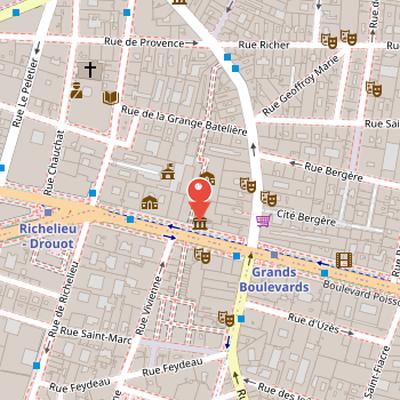
Nearby Objects
-
 Boulevard Montmartre 60 m away
 -
 Théâtre des Variétés 80 m away
 -
 Académie Julian 90 m away
 -
 Salle Le Peletier 250 m away
 -
 Musée de la Franc-Maçonnerie 350 m away
Architecture and Exhibition Spaces
Musee Grevin is a private wax museum created by Arthur Meyer and located in the 9th arrondissement of Paris. It is owned by Grevin and Cie, a subsidiary of the Compagnie des Alpes. The museum contains wax reproductions of famous personalities and includes at least two hundred wax figures, among them Albert Einstein, Mahatma Gandhi, Michael Jackson, and Alfred Hitchcock. Its displays also include recreated scenes from French history, such as the captivity of Louis XVI and the burning of Joan of Arc.
The museum also contains several notable spaces and attractions. The Grevin theater is a performance hall, while the Palais des Mirages uses the principle of optical illusion. The Coupole room and Colonnes room feature baroque style decorations from 1882. The museum regularly changes part of its collection by adding new personalities and removing older figures, which gives the exhibition a changing character over time.
From Court Art to Wax Museums
Displaying wax representations of royal figures after their death was a common practice until the seventeenth century. From that period onward, the making of wax figures developed into a full-fledged court art. Antoine Benoist made the wax funeral mask of King Louis XIV of France and helped popularize the wax cabinet by creating an exhibition of Queen Marie-Therese's immediate entourage. Around 1770, the Bernese Curtius was invited to Paris by the Prince of Conti to present the exhibition The royal family at the Grand couvert at Versailles at the Palais-Royal. He was assisted by a young girl he considered his niece, Marie Tussaud, who later molded the dead faces of Marat, Robespierre, and the royal couple during the French Revolution. After her uncle and master's death, she moved to London in 1795 and established the famous wax museum Madame Tussaud in 1835. In the nineteenth century, several Parisian wax museums tried unsuccessfully to rival Curtius and equal Madame Tussaud's museum.
From Early Wax Museums to the Gravin Museum
The history of the Musee Grevin is linked to a series of earlier museum projects in Paris. In 1865, the Hartkoff Museum opened in a room of the Passage de l'Opera. It was described as a geological, ethnological, and anatomical museum, and it included personality molds made by Professor Schwartz of Stockholm. Less than a year later, the Musee francais opened on the Boulevard des Capucines. That museum, created by modeler-anatomist Jules Talrich, presented wax statues of figures from literature, mythology, and history. It closed prematurely before the end of 1867.
A new phase began in 1881, when Arthur Meyer, director of the daily newspaper Le Gaulois, wanted readers to be able to see the faces of personalities mentioned in his journal. At a time when photography was not yet the standard in the press, he asked sculptor, caricaturist, and theatrical costume creator Alfred Grevin to make sculptures of current personalities. The Grevin museum opened and quickly achieved immediate success.
The museum's development was supported by Gabriel Thomas, who showed interest in the project in 1883. Thomas, already a major financier behind the Societe d'exploitation de la tour Eiffel and the theatre des Champs-Elysees, helped establish the financial structures that supported the museum until 1999. He also contributed significantly to the museum's framework and decorations. In 1999, Bernard Thomas, Gabriel Thomas's great-grandson, sold the museum to Groupe Parc Asterix after a friendly takeover bid.
The museum also developed a strong program of public entertainment. Emile Voisin was assigned to prepare magic shows for the future Cabinet Fantastique, and magician Dicksonn was accepted to help develop the magic programs. In 1889, management negotiated directly with Carmelli. The Cabinet Fantastique offered daily magic acts to visitors, and magicians such as Garcimore and Gerard Majax are noted as having debuted there. Around the turn of the century, the museum presented historical, current, and artistic scenes.
Further additions followed over time. The Palais des Mirages was installed in 1908. In 1984, a theater directed by Veronique Berecz began nightly programming, including one-man shows by various artists and classical concerts produced by Philippe Maillard featuring Jordi Savall and Philippe Jaroussky. Plays then followed one another until Grevin and group ended programming activities. The theater retains an original curtain painted by Jules Cheret, and the high-relief Les Nuées above the stage was created by sculptor Antoine Bourdelle. Les Nuées is also part of the museum visit route and includes representations of Charles Aznavour and Cecilia Bartoli. The theater can be rented occasionally for up to 250 people, while the entire museum can be reserved for evening events for up to 650 people.
Branches and Traveling Operations
From 1950 to 1958, Succursales operated a floating Grévin museum on a barge in Northern France, Belgium, and the Netherlands. The operation of this barge was entrusted to Georges Loyal, who worked there for several years with Paulette Loyal. Paulette Loyal later worked in the personnel department of the Grévin museum in Paris until her retirement in 1982.
From the 1970s to the 1990s, Succursales also opened a series of branches in France. These included the Lourdes museum, acquired in 1979 and sold in 1987; a branch in the royal castle of Tours, opened in 1984 and closed in 2005; La Rochelle, opened in 1989 and closed in 2002; Dijon, opened in 1990 and closed in 1995; Mont-Saint-Michel, opened in 1991; Salon-de-Provence, opened in 1992 and closed in 2015; and Saint-Jean-de-Luz, opened in 1993 and closed in 2007. In 1999, the Parc Astérix group acquired Succursales and renamed the group Grévin & Cie.
International Expansion and Later Closures
After gradually stopping the renewal of franchise licenses, Grévin and Cie left only the Lourdes and Mont-Saint-Michel museums in operation once the licenses expired. The group then continued to develop new sites under different forms. In 1981, Succursales opened an annex at Forum des Halles, with animated and sound-enabled displays devoted to Belle Epoque Paris. That site also presented exhibitions on the martyrs of Paris and rock music, but it closed in 1996 because it was not profitable.
The company later turned to international expansion. Compagnie des Alpes confirmed a project for Grévin Montreal and announced the creation of the museum, which opened at the fifth level of Centre Eaton. Its inauguration included attendees such as Bernard Pivot, Robert Charlebois, Veronic DiCaire, and Julie Payette. Grévin Montreal later closed permanently for financial reasons linked to a 50-week shutdown during the Covid-19 pandemic.
Compagnie des Alpes also announced a second foreign GrEvin museum, and Succursales opened a branch in Prague, Czech Republic. The group had planned to open one wax museum per year before changing its approach. Two additional sites were studied for 2015, including Seoul, and Compagnie des Alpes announced a GrEvin branch there for the first semester of 2015. The Seoul branch opened as a joint venture with Mast, a major player in Korean entertainment, and the museum was later sold. The deficit-making GrEvin Prague museum closed and later reopened under new owners as Chocotopia. In Switzerland, the group also opened a hybrid museum dedicated to Charlie Chaplin, combining scenography and wax statues.
Acade9mie Gre9vin
The Acade9mie Gre9vin was created in 2001 and is presided over by Ste9phane Bern. In 2022, its members included Daniela Lumbroso, Laurent Boyer, Ge9rard Holtz, William Leymergie, Christine Orban, Jacques Pessis, Henry-Jean Servat, c8ve Ruggieri, Nikos Aliagas, and Lionel Chouchan. The members meet twice a year to elect personalities for the museum.
How the Museum Creates Its Figures
The fabrication des personnages at Musee Grevin is carried out by several sculptors who work permanently for the museum. The process begins with an initial meeting with the personality, during which measurements, photos, videos, and 3D images are taken. After that, the face is modeled in clay or plastiline, while the body is also modeled in clay. Hands are molded from nature. The creation of each figure involves many specialists, including sculptors, molders, painters, implant technicians, costumers, dental prosthetists, ocular prosthetists, accessory makers, and decorative painters. Beeswax and paint are required for each character, and there is a minimum creation cost per figure. The tradition also includes the personality offering an outfit to improve the illusion. Among the first appointed museum sculptors were Leopold Bernstamm and Alexandre Barbiere, a student of sculptor Albert Chartier.
Wax Figures and Changing Displays
The personnage displays at the Musee Grevin have been made and exhibited in wax since 1882. Their presentation is not static: wax figures and decorations are regularly removed and replaced according to current events, giving the museum a changing historical route rather than a fixed arrangement. The oldest wax figures have been exhibited since 1889 as part of the Tableaux de la Revolution francaise, and some figures created in 1900 for the decor Une soiree a la Malmaison were also preserved within the collection. These wax figures were created under the direction of the historian Frederic Masson.
The historical route and the museum itself were entirely transformed and restored in 2001. The collection today includes about 300 wax figures. Among them are kings of France from the 2001 renovation, a cinema section from 1987 with Boris Karloff, Charlie Chaplin, and Alfred Hitchcock, and figures on the theme De Roland a Roncevaux a Napoleon III, started in 1939 and finished in 1960. New wax statues continue to be introduced, including Zlatan Ibrahimovic, with regular inaugurations such as in 2014.
At the same time, the museum also preserves traces of removals and replacements. About one thousand removed statues are stored in a warehouse in the Paris region, with heads carefully preserved in boxes. Some removed figures remain visible but downgraded near the museum exit, while removed busts are shown in the workshop display cases and removed statues are exhibited in the Grevin cafe. Several removals have become notable events, including the theft of the Georges Marchais statue, the removal of Valery Giscard d'Estaing by angry motorcyclists, and the removal of the Emmanuel Macron statue by Greenpeace militants in 2025. One statue, that of Edouard Herriot, was even melted urgently to form the successor president of the Council's head.
The museum has also presented newer figures in partnership with outside figures, such as the statues of Eric Judor and Ramzy Bedia, revealed by YouTuber Squeezie in a video in summer 2024.