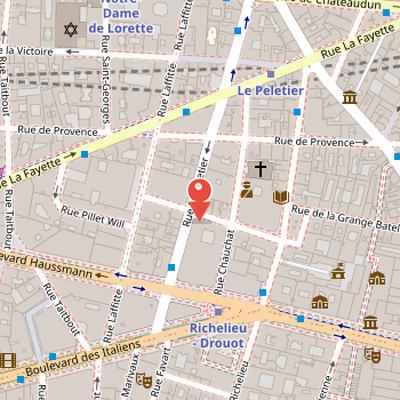
Salle Le Peletier was an opera house in Paris that served as the home of the Paris Opera from 1821 until its destruction by fire in 1873. Designed and constructed by the architect François Debret, it was built on the site of the garden of the Hôtel de Choiseul on rue Lepeletier. The theatre was inaugurated on 16 August 1821 with a mixed bill that included the anthem Vive Henry VIII, Catel’s opera Les bayadères, and Gardel’s ballet Le Retour de Zéphire. Built of wood and plaster, it was intended as a temporary structure and nevertheless remained in use for more than fifty years. Its area was 14,000 square metres, and it had a 104 ft. stage. During its years of use, the Salle Le Peletier was the first venue for several grand operas, including Rossini’s Guillaume Tell, Meyerbeer’s Robert le diable, Halévy’s La Juive, and Verdi’s Don Carlos. Over time, the building carried several official names, reflecting changes in political authority.
Nearby Objects
-
 Boulevard des Italiens 250 m away
 -
 Boulevard Montmartre 250 m away
 -
 Musée Grévin 250 m away
 -
 Académie Julian 300 m away
 -
 Théâtre des Variétés 300 m away
Salle Le Peletier as the Home of the Paris Opera
Salle Le Peletier was the home of the Paris Opera from 1821 until the building was destroyed by fire in 1873. It was designed and constructed by the architect Francois Debret on the site of the garden of the Hotel de Choiseul on the rue Lepeletier. Over the course of its history, the building carried several official names that reflected changing political periods: Theatre de l'Academie Royale de Musique from 1821 to 1848, Opera-Theatre de la Nation from 1848 to 1850, Theatre de l'Academie Nationale de Musique from 1850 to 1852, Theatre de l'Academie Imperiale de Musique from 1852 to 1854, Theatre Imperial de l'Opera from 1854 to 1870, and Theatre National de l'Opera from 1870 to 1873.
From the Rue de Richelieu to Rue Le Peletier
The Salle de la rue de Richelieu had served as the principal venue of the Paris Opera since 1794, but its history changed after Charles Ferdinand, duc de Berry, was fatally stabbed in front of the former theatre on 13 February 1820. Louis XVIII decided to demolish the theatre and replace it with a commemorative chapel, although this project was never carried out because of the 1830 revolution. The Fontaine Louvois in the Square Louvois now occupies the site where the chapel would have stood. Louis XVIII then commissioned architect Francois Debret to design a new theatre for the Opera on the Rue Le Peletier. The theatre was completed one year after the commission. During construction, the opera and ballet companies performed at the Theatre Favart and the Salle Louvois.
Salle Le Peletier: Temporary Stage for Opera and Ballet
The Salle Le Peletier was inaugurated on 16 August 1821 with a mixed-bill opening that included the anthem Vive Henry VIII, Catel's opera Les bayaderes, and Gardel's ballet Le Retour de Zephire. Built of wood and plaster, it was intended to be temporary, yet it served the Opera for more than fifty years. The theatre covered 14,000 square metres and had a 104 ft. stage. On 6 February 1822, gas was used there for the first time to light stage effects in Nicolas Isouard's opera Aladin ou La Lampe merveilleuse.
The Salle Le Peletier became an important venue for grand opera. Many major works were first presented on its stage, including Rossini's Guillaume Tell in 1829, Meyerbeer's Robert le Diable in 1831, Halevy's La Juive in 1835, and Verdi's Don Carlos in 1867. The building also had a flexible design: the stage and orchestra pit could be removed to transform the auditorium into a hall for balls and festivities.
It was also a major site in ballet history. The theatre hosted the romantic ballet heyday alongside the Ballet of Her Majesty's Theatre in London. Choreographers and ballet masters including Jules Perrot, Arthur Saint-Leon, Filippo Taglioni, Joseph Mazilier, Jean Coralli, and Paul Taglioni staged masterworks for the Paris Opera Ballet there. Works presented at the Salle Le Peletier included La Sylphide, Giselle, Paquita, Le corsaire, Le papillon, La source, and Coppelia. Among the great ballerinas associated with the Opra stage were Marie Taglioni, Carlotta Grisi, Carolina Rosati, Fanny Elssler, Lucile Grahn, and Fanny Cerrito. In 1831, the Opera also identified premiers sujets including Lise Noblet, Marie Taglioni, Mlle Julia de Varennes, Alexis Dupont, Amelie Legallois, and Pauline Montessu.
The theatre was the setting for the Opera Game of Chess in 1858, played in the Duke of Brunswick's private box during a performance of Bellini's Norma. The Salle Le Peletier was destroyed by fire on 29 October 1873 after burning for 27 hours, and the fire was believed to have been started by the theatre's gas lighting.
From Salle Le Peletier to the Palais Garnier
In 1858, Emperor Napoleon III hired Baron Haussmann to construct a second theatre for the Parisian Opera and Ballet. The new theatre was based on the design of architect Charles Garnier. This project resulted in the building now known as the Palais Garnier, which was inaugurated in 1875. The history of Salle Le Peletier is therefore closely tied to the planning of this later opera house and its role in the development of Parisian performance venues.
Ballet Premieres at Salle Le Peletier
Salle Le Peletier was the venue for a notable sequence of ballet premieres in the 19th century, making it an important site in the history of dance performance. Among the works first performed there were La fille mal gardee in 1828, with choreography by Jean-Pierre Aumer and music by Ferdinand Herold, and La Sylphide in 1832, choreographed by Filippo Taglioni with music by Jean Madeleine Schneitzhoeffer. Other premieres included La fille du Danube in 1836, Le diable amoureux in 1840, and Giselle in 1841, the latter with choreography by Jean Coralli and Jules Perrot and music by Adolphe Adam, with additional music by Friedrich Burgmuller. The theatre also hosted La Peri in 1843, Le diable a quatre in 1845, and Paquita in 1846.
Later premieres at the same venue included Le corsaire in 1856, Le marche des innocents in 1859, Le papillon in 1860, La source in 1866, and Coppelia in 1870. The repeated presentation of major ballets over several decades shows the theatre's continuing role as a central stage for new works and for choreographers and composers associated with the development of ballet.