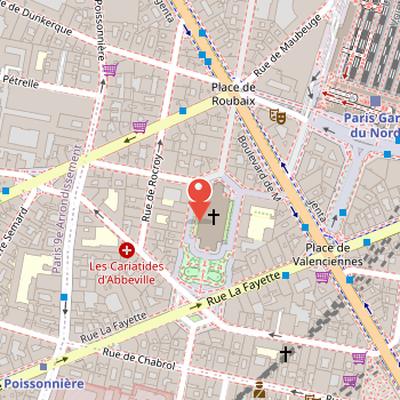
Saint-Vincent-de-Paul Church is a church building in Paris, located on Place Franz-Liszt. Dedicated to Saint Vincent de Paul, it dominates the neighborhood and stands on the site of the former Saint-Lazare enclosure, where the Saint-Lazare house once stood. Saint Vincent de Paul lived and worked there, and the site is closely linked to his memory.
The church was built in the 19th century after a parish of Saint-Vincent-de-Paul was created by decree in the year XII. A chapel at rue de Montholon had previously served the parish, but a new church was chosen for construction on a hill near clos Saint-Lazare. Initial plans were commissioned from architect Jean-Baptiste Lepère, and the first stone was laid on 2 November 1826. After delays caused by lack of funds and the revolution of 1830, Jacques Hittorff continued the work until the church opened for worship on 4 December 1844. Its basilical plan and more than one bell tower give the building its distinctive architectural presence. It was registered as a historic monument in 1936 and classified in 1991.
Nearby Objects
-
 Lariboisière Hospital 450 m away
 -
 Boulevard de Magenta 600 m away
 -
 Saint-Laurent 650 m away
 -
 Église Saint-Eugène-Sainte-Cécile 700 m away
 -
 Folies Bergère 700 m away
Location and Historical Background
Saint-Vincent-de-Paul church is located in Paris, on place Franz-Liszt, where it dominates the neighborhood. Dedicated to Saint Vincent de Paul, it was built in the 19th century on the site of the former Saint-Lazare enclosure, specifically where the Saint Lazare house once stood. This place is closely connected to Saint Vincent de Paul, who lived and worked there, and to the Congregation of the Mission, which occupied the house from 1632 to 1793. The church was registered as a historic monument on 29 February 1936 and classified as a historic monument on 21 May 1991.
Origins of the Parish and First Chapel
The parish of Saint-Vincent-de-Paul was created by a decree of Messidor in Year XII. Its territory extended over parts of the dependencies of the Maison de Saint-Lazare, and its name derives from Saint Vincent de Paul, who died on the territory. Before the present church, a chapel was built on rue de Montholon with barely 200 chairs. This chapel, named Saint Vincent de Paul-Montholon, was made of wood and plaster. It replaced the Sainte-Anne chapel on rue du Faubourg-Poissonniere, which had been destroyed in 1790. The Sainte-Anne chapel had served the Nouvelle France neighborhood without parish church status under the Ancien Regime. A new church was then chosen to be built on a hill near clos Saint-Lazare to replace the Montholon chapel.
Construction and Architectural Design
The church was commissioned with initial design and construction plans by architect Jean-Baptiste Lepere. The first stone was laid on November 2, 1826, in the presence of Prefect Gaspard de Chabrol and Archbishop de Quelen. Construction then progressed slowly, with interruptions caused by a lack of funds and the 1830 revolution. Work was continued by Jacques Hittorff from 1831 to 1844, and the church opened for worship on December 4, 1844.
Hittorff modified the original design to include more than one bell tower. He also arranged Place Franz-Liszt so that it opens onto the church, giving the square the character of a forecourt, and added a system of ramps, now converted into gardens, to facilitate carriage access. The building has a basilical plan that evokes major religious architectural works without copying any of them. Its facade includes a portico borrowed from Greek temples and a sculpted pediment by Charles-Francois Leboeuf-Nanteuil.
Architectural Decoration and Restoration
Saint-Vincent-de-Paul church is marked by an extensive program of sculpture, painting, and ornamental detail. On the pediment, Charles-Francois Leboeuf-Nanteuil sculpted L'Apotheose de saint Vincent-de-Paul, showing Saint Vincent-de-Paul glorified and surrounded by figures symbolizing his actions, including a missionary, a galley slave, and Daughters of Charity serving children or the sick. Inside the nave, Hippolyte Flandrin painted a frieze between 1848 and 1853 around the nave between two rows of columns; it represents 160 saints advancing toward the sanctuary. The nave ceiling sculpture was created by Luglien Francois Badou, while Francois Rude sculpted the calvary of the main altar. The axial chapel, the chapel of the Virgin, was enlarged by Edouard-Auguste Villain in 1869, and its decoration includes canvases by William Bouguereau from 1885 to 1889. Behind the altar stands a Virgin and Child sculpted by Albert-Ernest Carrier-Belleuse. The church also features ornamental cast iron designed by Hittorff and made by the Calla foundry, including gates, baptismal fonts, a holy water font, and a monumental door sculpted by Jean-Baptiste Farochon following Hittorff's instructions. Hittorff also chose to cover much of the facade behind the colonnade with enameled lava plaques painted by Pierre-Jules Jollivet. These plaques were removed in 1861 after scandal over the nudity of certain figures. One plaque was reinstalled in 1984, two were placed inside the church, and the seven plaques were restored and reinstalled on the facade and inaugurated on September 19, 2014, according to Hittorff's original design. The church also suffered damage during the Commune, when seven shells hit the bell turrets and more than twenty shells struck the steps from Pere-Lachaise.
The Church Organs
Saint-Vincent-de-Paul church has two organs: the grand organ and the accompanying organ. The organ ensemble was created in 1852 by Aristide Cavaille-Coll, the French organ builder, and was installed by him in 1858 with 22 stops. Its original configuration included 47 stops distributed across 3 keyboards and pipes. The instrument has 2 keyboards of 54 and 42 notes, a pedalboard of 30 notes, and mechanical transmissions. In 1970, the firm Danion-Gonzalez restored and enlarged the organs, and the present instrument includes features from that restoration.
Screen Appearances
Saint-Vincent-de-Paul church has appeared repeatedly in French cinema and television, often as a recognizable Parisian setting. It is visible several times in Zazie dans le metro, directed by Louis Malle in 1960, where the protagonists pass in front of it while confusing it with the Pantheon, the church of La Madeleine, Reuilly barracks, and other Parisian monuments. The church also appears in Un drole de paroissien by Jean-Pierre Mocky in 1963, featuring Bourvil and family, and it serves as the setting for one of the last scenes of Hibernatus in 1969, when the hibernated character gets married. In 1978, it is used as the decor of the courthouse in L'argent des autres, and it appears again in Papy fait de la resistance in 1983 during a costume exchange between Christian Clavier and Julien Guiomar. Later, it serves as the courthouse backdrop in the telefilm Marie Besnard, l'empoisonneuse in 2006. The church also appears briefly in Rire et Chatiment, directed by Isabelle Doval in 2003, with several scenes filmed in the adjacent square and Rue Bossuet.
Literary References
Saint-Vincent-de-Paul church appears in French literature through the nearby Square de l'eglise Saint Vincent de Paul, which is mentioned in Les Thibault by Roger Martin du Gard. Martin du Gard was a French novelist and Nobel Prize in Literature winner in 1937. In Les Thibault II, Folio, the square is the setting where Jenny and Jacques confess their love. Their relationship is presented as growing out of their respective troubled youth after years of separation.
Interior Views and Decorative Elements
The gallery presents several views of Saint-Vincent-de-Paul in Paris, including a rear three-quarter view from Montmartre hill, a front view during spring blossom, and general views of the nave. It also shows details of the nave and the grand organ, as well as a view of the nave ceiling. Among the interior elements highlighted are the pulpit, which is classified as a historic monument, and one of the angels of the main altar. The decorative program is further represented by the frieze painted by Hippolyte Flandrin and by several works by William-Adolphe Bouguereau: L Adoration des mages (1884), L Adoration des bergers (1884), La Visitation (1885), and La Fuite en Egypte (1885). The gallery also includes an enameled plaque originally intended for the facade and shown reinstalled above the portal in 2009.
Annexes and the Church of Saint-Vincent-de-Paul
The annexes associated with Saint-Vincent-de-Paul church are connected to a religious building in the 10th arrondissement of Paris. They are tied to the church designed by Jacques Ignace Hittorff and to the Congregation of the Mission. The annexes also appear in relation to a publication titled Description et histoire de l'eglise Saint Vincent de Paul, a Paris, written by a parishioner and printed in Paris by imprimerie H. Dumoulin in 1891. In terms of heritage status, the church is associated with a monument historique registered in 1944 and classified in 2017, reflecting its recognized place within the built heritage of the 10th arrondissement.