Place du Parlement-de-Bretagne is a square in Rennes created in the reconstruction that followed the fire of 23 December 1720, which devastated part of the city center. The rebuilding was first entrusted to the military engineer Robelin, before his project was abandoned in favor of the plan by Jacques Gabriel. The square and the adjoining buildings adopt the architectural style of the Parlement de Bretagne palace, with a granite ground floor and tuffeau upper floors. The facades around the square are protected as historical monuments, and the ground of the square is also listed as a historical monument. The name of the square comes from the Parlement de Bretagne palace on its north side, which hosted hearings of several chambers of the Parlement de Bretagne and was called the Palais de Justice until the 1970s. The square has also had earlier names, including place Louis-le-Grand and place de l’Égalité. It continues to serve as a gathering place for events and demonstrations in Rennes.
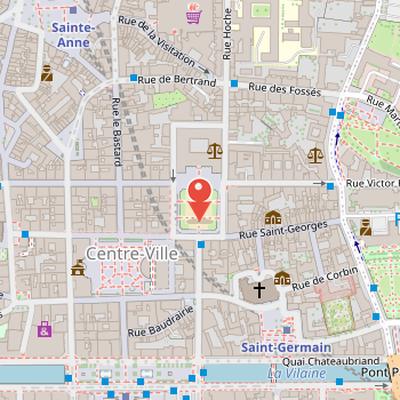
Nearby Objects
-
 Rennes Opera House 80 m away
 -
 Place de la Mairie 130 m away
 -
 Église Saint-Germain de Rennes 130 m away
 -
 Rennes City Hall 150 m away
 -
 Place Saint-Germain 200 m away
Name and historical designations
The name of place du Parlement-de-Bretagne comes from the Parlement de Bretagne palace on its north side. This palace hosted hearings of several chambers of the Parlement de Bretagne. Until the 1970s, the building was called Palais de Justice, and the square itself was known as place du Palais-de-Justice or place du Palais. The square also had earlier official names: it was called place Louis-le-Grand from 1726 to 1792, then renamed place de l'Egalite in 1792. A bilingual French-Breton plaque displays the odonym in Breton, although a synonym and a variant are sometimes used instead of the Breton form.
Architecture and historical development of the square
Place du Parlement-de-Bretagne was created after the fire of 23 December 1720, which devastated part of the heart of Rennes. The reconstruction of the city was first entrusted to Robelin, a military engineer, but his project was abandoned because of its high cost in favor of the project by Jacques Gabriel. The square and the buildings bordering it adopted the architectural style of the Brittany Parliament Palace, with a granite ground floor and tuffeau upper floors. This style was applied not only to the square itself but also to the reconstructed city around it. The facades of the square are entirely protected as historical monuments, and the ground of the square is also listed as a historical monument by order. The only building on the square constructed according to Robelin's plans is the Hotel de Muce at 4 Place du Parlement-de-Bretagne, which differs from the other buildings built by Gabriel.
In 1730, an equestrian statue of Louis XIV by Coysevox was placed at the center of the square, but it was melted down during the Revolution. The square was crossed by Tramway Line 3 until 1938, and rails from the tramway remain visible at the base of the Palace. Today, the square serves as a gathering place in Rennes for numerous events and demonstrations, including activities from Tombes de la nuit, Mythos, and a Christmas Market.