Lycée de Saint-Just is a public high school located in the Saint-Just district in Lyon, France. It overlooks the city from Fourvière hill, west of the Saône river. The site has a long layered history that includes a large Roman cistern under the lycée esplanade, known as Grotte Bérelle. The cistern has a main chamber measuring 16 by 15 meters and two concentric galleries, but its original function remains uncertain. Its walls bear charcoal signatures from visitors, with the oldest dated to 1550. The cistern is closed to the public for safety reasons.
The site also hosted an Ursulines convent and boarding school in 1633, which was sold during the Revolution in 1791. The current building dates from 1855 to 1861 and has a central body with two wings. It served as Saint-Irénée Seminary until 1908, later housed the Caisse des dépôts et consignations, and was used as a hospital during the First World War. In 1928 it became the Edgar Quinet lycée boarding school, and it became autonomous in 1946. The lycée was later modernized and became exclusively a lycée in 2011.
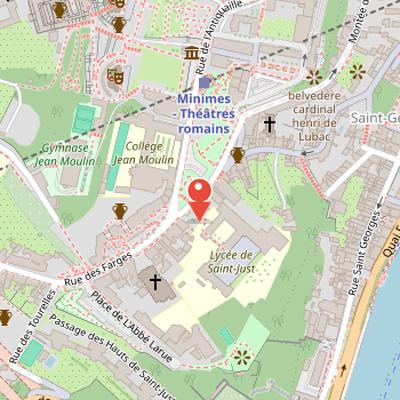
Nearby Objects
-
 Church of Saint-Just 120 m away
 -
 Jardin des Curiosités 200 m away
 -
 Montée du Chemin-Neuf 250 m away
 -
 Odeon of Lyon 250 m away
 -
 Antiquaille Hospital 300 m away
Location and Setting
The Lycee de Saint-Just is a public high school located in the Saint-Just district in Lyon, France. It overlooks the city to the west of the Saone river from Fourviere hill. Its setting gives the school a prominent position within the urban landscape of Lyon.
The Roman Cistern Beneath the Esplanade
Beneath the lycee esplanade at Saint-Just in Lugdunum, Lyon, there is a large Roman cistern known as Grotte Berelle. The cistern has a main chamber measuring 16 by 15 meters and includes two concentric galleries. Its original function is uncertain: it may have served as a water supply for the neighborhood or as a reservoir for the barracks of Lugdunum. The cistern walls also bear charcoal signatures left by visitors, with the oldest dated to 1550. For safety reasons, Grotte Berelle is closed to the public.
History and Uses of the Lycee de Saint-Just Site
The site of the Lycee de Saint-Just has a long institutional history. In 1633, it hosted an Ursulines convent and boarding school, and the convent was sold in 1791 during the Revolution. The current building dates from 1855 to 1861 and is composed of a central body with two wings. It then served as the Saint-Irene Seminary until 1908, when theology studies were offered there. After the separation of Church and State, the building housed the Caisse des depots et consignations in 1912, and during the First World War it was used as a hospital. In 1928, it became the boarding school of the Edgar Quinet lycee, and it became autonomous in 1946. Later modernization works added facilities such as a gymnasium and a cafeteria.
Beyond its educational role, the lycee had a notable place in the civic life of Lyon in the 1950s and 1960s, when it became an intellectual and militant center supporting Algerian independence. On November 15, 1962, eighteen female teachers and four staff members signed a letter in support of Algerian prisoners on hunger strike. Since 2011, the site has hosted only lycee students, after college students were transferred to the nearby Jean-Moulin school. The campus was illuminated by the city of Lyon in 2008 and 2009. At a later stage, a fire caused by an electrical problem damaged the kitchens and made the refectory unusable, although the other buildings were unaffected; renovation work began in spring 2014 and later reopened the refectory.
Teaching and Preparatory Programs
Lycée de Saint-Just hosts students preparing for the general baccalaureate as well as students in the technological STMG stream. It also offers a range of options, including theater and dramatic expression, cinema and audiovisual, art history, a European section, foreign languages, ancient languages, and music. In addition, the school provides three specialty courses: geography, modern languages such as Spanish, German, Italian, and Chinese, and Latin.
The lycée also hosts students in Classes Prepa ratoires aux Grandes Ecoles (CPGE) in two streams. Its ECG preparatory classes train students for business schools, management, ENSAE, and Institutes of Political Studies, and the ECG stream has two promotions per year. The B/L preparatory class opened in 2017 and offers a two-year multidisciplinary program in history, literature, social sciences, philosophy, English, and mathematics. From 2017 to 2024, its promotions were named Arthur Rimbaud, Albert Camus, Hannah Arendt, Emile Zola, Gisle Halimi, and Mary Jackson.
In 2025, the school ranked 43 out of 109 in departmental teaching quality and 1256 nationally in teaching quality. CPGE rankings are based on student admission rates to grandes ecoles.
Student-Led Film and Heritage Activities
At Lyccee de Saint-Just, cultural life includes a strong film program run by students. The Activites culturelles au sein du lycee relaunched the Cine Club in 2013 and manages it entirely through students. The club offers one film screening each month for high school students and staff, with the stated aim of providing a cinematographic culture linked to students studies.
This student involvement also extends to the Saint-Just Film Festival, created in 2015 by Activites culturelles au sein du lycee. The festival is organized every year so that students can present films publicly, and it is arranged entirely by Saint-Just students. Its direction is handled by a terminale student, assisted by one or two premiere vice-presidents. The festival includes a jury made up mostly of students and teachers, and it awards prizes to outstanding student films as well as a public prize. Financial support for posters and prizes is provided by parent associations, and the festival also partners with the Nuits de Fourviere festival. The founders of the student group also established the Uffle association, which brings together young film festival leaders. In the 2015-2016 school year, the school organized two high school film festivals.
The school also opens its doors to heritage-focused visits during annual Heritage Days. These visits are led by History of Arts students, who present the history and architecture of the school.