Musée Saint-Raymond, also called the musée d’Archéologie de Toulouse and formerly known as the musée des Antiques, is the archaeological museum of Toulouse. Opened in 1892, it is installed in the walls of the old Saint-Raymond university college near the basilique Saint-Sernin. The museum conserves and presents archaeological collections from protohistory to the Early Middle Ages, with holdings mainly covering the Celtic, Roman, and early Christian periods.
The building itself has a long history. It was originally on a Christian necropolis site near the tomb of Saturnin, beside the basilica Saint-Sernin. Founded between 1075 and 1080 as a hospital for the poor and pilgrims by Raymond Gayrard, with support from the counts of Toulouse, it was later adapted for the college. The present building was constructed in 1523 by mason Louis Privat. After the Revolution and the college’s closure, it was abandoned and later repurposed as a museum by the city. It is one of the few surviving examples of late medieval Toulouse university architecture.
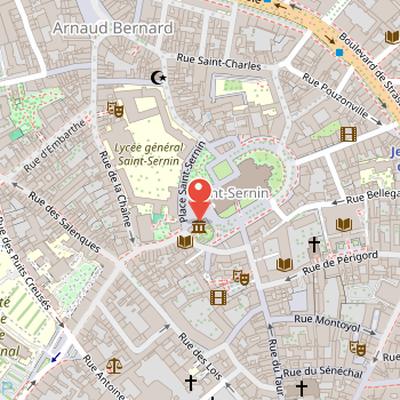
Nearby Objects
-
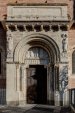 Porte Miègeville 70 m away
 -
 Basilica of St. Sernin 110 m away
 -
 École Supérieure d'Audiovisuel 120 m away
 -
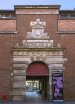 Cinémathèque de Toulouse 130 m away
 -
 Chapelle des Carmélites 200 m away
Musae Saint-Raymond and Its Archaeological Role
Musee Saint-Raymond, also known as Musee d'Archeologie de Toulouse and formerly called Musee des Antiques, is the archaeological museum of Toulouse. It opened in 1892 and is installed within the walls of the old Saint-Raymond university college, near the basilique Saint-Sernin. The museum conserves and presents archaeological collections spanning from protohistory to the Early Middle Ages. Its holdings mainly cover the Celtic, Roman, and early Christian periods, giving the institution a broad chronological role in the presentation of the region's past.
From Hospital to Museum
The building known as Musee Saint-Raymond stands on a Christian necropolis site near the tomb of Saturnin, beside basilica Saint-Sernin. It was originally founded between 1075 and 1080 by Raymond Gayrard as a hospital for the poor and pilgrims, financed with support from the counts of Toulouse. Around 1120, Raymond Gayrard was buried in the Saint-Jean chapel attached to the hospital, and in 1122 the chapel was renamed Saint-Raymond chapel.
The present building was constructed in 1523 by the mason Louis Privat, with partial financing from Martin de Saint-Andre and Pierre de Saint-Andre. Its ground floor housed the tinel, a large room with a fireplace used for receptions and dining, while the upper floor contained student rooms. After the college closed during the Revolution, the building was abandoned. The Revolution also led to the demolition of the chapel and the removal of its traces. In the aftermath, a fourth corner turret and two internal partition walls were added, and numerous crenellated fireplaces were built inside, reinforcing its medieval appearance. A neo-Gothic house was later built in the former courtyard, now a garden.
The building served as the presbytery of basilica Saint-Sernin until the 19th century. In that century, the city considered converting it into a labor exchange or a venue for scientific societies, but it was eventually repurposed as a museum. It is one of the few surviving examples of late medieval Toulouse university architecture, alongside the colleges of Foix and Perigord.
Adaptations and Reorganizations of the Museum
Musee Saint-Raymond was adapted for new functions by architect Arthur Romestin, who removed stairs, partitions, and cupboards to create larger exhibition spaces and added numerous windows to improve the lighting of the rooms. In the 1920s, Romestin also created three large windows for the exhibition room. These changes led to a downgrade by the commission of historic monuments in 1925 because of the window modifications. The building later regained its historic monument classification by decree, after a period of fifty years.
The museum was deeply reorganized in 1912 when Emile Cartailhac took direction of the institution. In 1939, the Society of Friends of Musee Saint-Raymond and ancient art was created in connection with the museum. Between 1946 and 1950, Robert Mesuret renovated the building, and in 1949 the museum became the Musee archeologique de Toulouse under his direction. At that time, it received the collections of Antiquity and Early Middle Ages of the city of Toulouse.
The museum continued to be reshaped in the late 20th century. In 1980, the city of Toulouse acquired the neighboring building at 11 rue des Trois-Renards to free space inside the museum, using it for offices, technical services, meeting rooms, documentation, and a conservation library. A new building was constructed between 1992 and 1994 in the Bourrassol district to hold the museum reserves. In 1992, architect Bernard Voinchet led a new redevelopment study, and in 1994 mayor Dominique Baudis decided on a complete redevelopment. Archaeological excavations carried out between 1994 and 1996 near the museum uncovered the Saint-Sernin necropolis, tombs, a lime kiln, and part of an old early Christian necropolis. After more than four years of renovation, the museum reopened to the public, and the building regained its original 1523 appearance.
The Collections of Musee Saint-Raymond
The collections of Musee Saint-Raymond originated from holdings assembled by the Academie royale des sciences, inscriptions et belles-lettres and the Academie royale de peinture, sculpture et architecture. They were seized during the Revolution and used to create the Museum provisoire de la Republique in 1793 in the couvent des Augustins. Over time, the collections were expanded through purchases, deposits, and excavations, and they later formed part of the musee des Antiques in the galleries of the cloitre du musee.
A major enlargement came from the sculptures discovered at the villa romaine de Chiragan during excavations led by Alexandre Du Mege between 1826 and 1830. Du Mege became conservator of the collections in 1832, and the displays along the galerie des Empereurs and the galerie de La Vener made a set that was said to be comparable only to the Louvre at the time.
The collections now bring together material from many Mediterranean civilizations. They include Cypriot and Etruscan items, Greek and Italiote vases, Hellenistic terracotta figurines, ceramics, terracotta sculptures, and coins produced between the 6th century BC and the 1st century AD. They also include sculptures mainly from Louvre deposits made in 1895 and 1969.
The holdings were further shaped by acquisitions from major private collections. They purchased the antiquities collection assembled in Naples and Pompeii by the architect Antoine Bibent in 1831, obtained the cabinet of antiquities from Count de Clarac through Alexandre Du Mege in 1843, and acquired eleven Etruscan vases from Lucien Bonaparte's antiquities collection through Edward Barry in 1848. The museum also received a part of Giovani Pietro Campana's collection deposited by the state in 1862, and it bought 47 vases from the same collection in 1861 on Napoleon III's order. Additional material came from Edward Barry's collection between 1874 and 1877 and from four Greek vases acquired from Theodre de Sevin's collection in a 1989 public sale.
Together, these acquisitions make the collections a representative set showing Greek ceramic evolution from Corinth, Attic, and Greater Greece production centers, while also reflecting the often uncertain archaeological contexts of many 19th century excavations in Etruria and Southern Italy.
Roman and Early Medieval Collections
Musee Saint-Raymond holds a substantial group of antiquities, with a particular strength in Roman and numismatic material. Its coin collections began with the 1847 deposit by the Toulouse Academy of Sciences of Charles Clement Martin de Saint-Amand's medal collection, which formed the basis of the museum's foundation holdings. The collections also received ancient weights from Edward Barry's collection in 1890, and they later expanded significantly under Ernest Roschach between 1892 and 1898 through local acquisitions, purchases, and donations. Greek numismatics, including a medallion of more than 5000 Gallic, Greek, Roman, Byzantine, and Early Middle Age coins, are among the notable holdings. After the 1950 reorganization of the city's museums, the museum retained only antique coins.
The Roman collection is especially important. It includes decorated oil lamps, fine ceramics from Montans and La Graufesenque, bronze keys and figurines, late Roman mosaics from Sigognac, Granejouls, Saint-Rustice, and Saint-Pierre-des-Cuisines, numerous lapidary inscriptions, and a group of votive altars. The museum also preserves a rich collection of Roman busts, partly found at the Chiragan villa ruins in Martres-Tolosane and partly at Beziers in 1844. This group ranks second after the Louvre in Roman busts and includes portraits of emperors, their families, magistrates, military figures, and unidentified men, women, and children. Related Chiragan villa finds include reliefs of Hercules' labors and statues and busts of Greco-Roman deities.
The early medieval holdings include paleochristian and Early Middle Ages objects such as sculptures, inscriptions, lamps, liturgical vases, ceramics, jewelry, fibulae, and Visigothic buckle-plates. The museum also preserves numerous paleochristian sarcophagi and the Tomb of Saint-Clair, intended for a child. These collections are further enriched by material from Lauragais and Ariiege, as well as by later additions such as two exceptional local monetary treasure sets acquired in 1976, including Merovingian thirds of sous from the Seviac villa in Gers and Gallic cross coins from Dunes in Tarn-et-Garonne.
Museum Layout and Museography
The museography of Musee Saint-Raymond was progressively reorganized to change both how the collections were presented and how the building was used. Under Robert Mesuret's direction, the museum modernized its museography and made reserves accessible to researchers. Starting in 1961, the first-floor rooms were emptied of Medieval and Renaissance collections. After the renovations of 1990, the museum was dedicated almost exclusively to Roman and paleochristian Toulouse.
The renovated museum distributed its exhibition spaces over four floors, including the basement and the second floor. The second floor was devoted to Tolosa in the pre-Roman period and in the Roman province of Narbonnaise. Roman sculpture from the Chiragan villa was presented on the first floor. Temporary exhibitions were shown on the ground floor in the former Tinel room, which also received a new temporary exhibition space. In the basement, the paleochristian necropolis brought together sarcophagi, funerary inscriptions, and a lime kiln. Earlier arrangements had distributed the collections into six rooms on two floors.