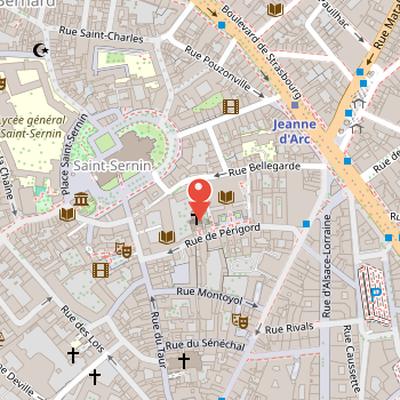
The Chapelle des Carmélites is an ancien édifice religieux catholique located on rue du Périgord in Toulouse, France. Erected in the 17th century as a place of prayer for the Carmelite convent, it is the only building of the convent that was not destroyed during the French Revolution. The chapel is classified as a historical monument by an official decree.
Its interior contains a notable collection of murals by Jean-Pierre Rivalz and paintings by Jean-Baptiste Despax. The Carmelite nuns of the branch reformed by Thérèse d’Ávila arrived in Toulouse in 1616 and settled in their convent in 1625. The new convent was directed by mother Élisabeth des Anges from Spain, who came after a request by Marie de Médicis to establish the Order in France. According to the historical account, King Louis XIII and Anne d’Autriche laid the first stone of the chapel in the year of the canonization of saint Thérèse d’Ávila. The painted decoration includes scenes related to the Carmelite Order, the Incarnation, and the Apotheosis of saint Thérèse.
Nearby Objects
-
 École Supérieure d'Audiovisuel 90 m away
 -
 Cinémathèque de Toulouse 110 m away
 -
 Porte Miègeville 140 m away
 -
 Basilica of St. Sernin 150 m away
 -
 Musée Saint-Raymond 200 m away
History and Artistic Interior
The Chapelle des Carmelites is an former Catholic religious building on rue du Périgord in Toulouse, France. It was erected in the 17th century as a place of prayer for the Carmelite convent. The chapel is notable for its collection of murals by Jean-Pierre Rivalz and paintings by Jean-Baptiste Despax. It is also the only building of the convent that was not destroyed during the French Revolution. Because of its historical and artistic importance, it has been classified as a historical monument by official decree.
Founding of the Chapel
The Carmelite nuns of the branch reformed by Therese d'Avila arrived in Toulouse in 1616 and settled in their convent in 1625. The first nuns to settle there came from the Carmelite convent of Bordeaux. The new convent was directed by mother Elisabeth des Anges from Spain, who came after a request by the queen mother, Marie de Medicis, to establish the Order in France. In the year of the canonization of saint Therese d'Avila, King Louis XIII and his wife Anne d'Autriche laid the first stone of the chapel.
The Painted Decoration of the Nave and Apse
The chapel's painted decoration was created within a program associated with the nun Sister Marie-Louise de la Misericorde. A major part of this ensemble was painted by Jean-Baptiste Despax between 1747 and 1751 and placed on the walls of the nave. These paintings present themes of the Carmelite Order. In the first two bays, four paintings recount the life of the founders and prayer life on Mount Carmel. Two narrow paintings are placed on the counter-facade, and above them is the Apotheosis of Saint Therese, in which she is shown being taken to heaven by angels before the Trinity. The composition also includes the Virgin, Saint Joseph, Archangel Saint Michael, Elijah, and Saint John the Baptist, while the lower level includes figures such as David and Saint Cecilia.
In the third bay, two chapels were removed and replaced by two large paintings by Felix Saurines, which are copies of Jean-Baptiste Despax's canvases copied from Restout in the Toulouse churches of Daurade and Saint-Nicolas. Two door overdoors were placed in the fourth bay. The apse contains three paintings representing the Incarnation. Despax also painted an oil on plaster half-dome with prophets and justs of the Old Testament, including Abraham, Samson, Noe, Adam and Eve, Daniel, Job, Cain and Abel, Salomon, Isaias, Josue, Moses, Jeremias and David. Theological and contemplative virtues were painted on each side of the high windows, as recommended by the Order. These virtue paintings partly derive from a drawing by Jean-Pierre Rivalz or his son, and the four nearest to the apse were created by Rivalz.
Decoration and Later Uses
The Chapelle des Carmelites underwent major decorative work in the mid-18th century. Its interior included a vault painted with a sky and trompe-l'oeil ornaments. Carmelite accounts record spending 60 livres for scaffolding in 1747, and decoration costs reached 14082 livres between 1749 and 1751. The chapel later replaced the lost Jean-Pierre Rivalz Annunciation painting with a 1769 Despax painting enlarged in height.
After the Revolution, the chapel was occupied by the departmental guard. Its paintings were deposited at the Muséum du Midi de la Republique, established in 1793 in the former Henri Augustin Hermits convent, and four of them were transferred to the cathedral after this deposit. Between 1807 and 1905, the building served as the chapel of the grand seminary, and current apse woodwork was made during this period. The vault paintings were restored by painter Roques in 1817, all paintings were returned to the chapel after restoration by painter Julia in 1837, and the paintings were restored again by painter Bernard Benezet in 1891.
After the law separating Churches and State, the chapel housed the University moulage museum. It was returned to the Ministry of Culture and opened to the public in 1975, then closed in 1982 because vandalism required significant restoration. The chapel reopened to visitors in 1993.