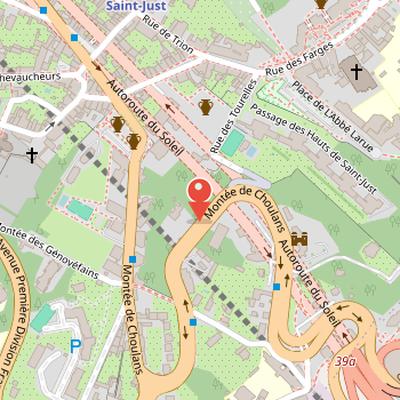
Montée de Choulans is a public traffic route in Lyon, France, and one of the main access routes to Fourvière hill from the Saône riverbank. It is a steep street with a slope of 5.4% and a marked difference in altitude between its starting and ending points. The street takes its name from a fountain located in the neighborhood, known from at least 1540, and referred to as “Au milieu du chemin montant à Saint-Irénée.”
The area around the street belonged to the quarter that was part of ancient Lugdunum. Its history includes the discovery of a mammoth skeleton in 1859, later exhibited at the Musée des Confluences. The site also yielded numerous mausoleums dating from the 1st to 3rd centuries AD along the Aquitaine road, some of which were exhumed during work on the Vaugneray railway line in 1885 and 1886. Five steles were installed on place Choulans, later renamed place Wernert, including those of Julia, Quintus Valerius, Julius Severianus, Satrius, and the tomb of Turpio, Seviri Augustales. A Greek-inscribed stele to Euteknios, a Syrian merchant who died in Lyon, was also dedicated here. In 1880, a very damaged mosaic with geometric motifs was discovered and removed immediately after. At the bottom of the street, near the quays, stood the Saint-Laurent de Choulans funerary basilica, whose ruins were found under a northern office building and the access ramp to the Fourvière tunnel. The street did not exist in the Middle Ages, when montée Saint-Barthélémy was the main access to the hill, later replaced in this role by montée du Chemin-Neuf after the Wars of Religion.
Nearby Objects
-
 Basilique Saint-Just de Lyon 150 m away
 -
 Church of Saint-Just 300 m away
 -
 Saint Irenaeus Church 300 m away
 -
 Jardin des Curiosités 400 m away
 -
 Lycée de Saint-Just 400 m away
Steep Access Route to Fourviere Hill
The montée de Choulans is a public traffic route in Lyon, France. It serves as the main access route to Fourviere hill from the Saone riverbank. The street is steep, with a slope of 5.4 percent. Its elevation changes from a starting altitude to an ending altitude, creating a noticeable difference in level along its course. As a result, it functions as an important uphill connection within the city, linking the riverbank to the hill above.
Origin of the Name
The name of the montée de Choulans was derived from a fountain located in the neighborhood, which is documented as early as 1540 at the latest. The designation refers to a fountain described as being 'Au milieu du chemin montant a Saint-Irenee', indicating a position in the middle of the road ascending to Saint-Irenee. This naming preserves a historical local reference tied to the area.
Archaeological Discoveries at Montmee de Choulans
Montee de Choulans belonged to the quarter that was part of antique Lugdunum, and it has been associated with several archaeological discoveries. In 1859, a mammoth skeleton was found there and later exhibited at the Musee des Confluences. The area also revealed many mausoleums dating from the first to the third century AD along the Aquitaine road. These mausoleums were exhumed during works on the Vaugneray railway line in 1885 and 1886, showing the extent of funerary activity in the sector.
Five steles were installed on Place Choulans, later renamed Place Wernert. Among them were the steles of Julia, Quintus Valerius, Julius Severianus, and Satrius, as well as the tomb of Turpio, Seviri Augustales, offered by five freedmen. A stele with a Greek inscription was also dedicated to Euteknios, a Syrian merchant who died in Lyon. In 1880, works uncovered a very damaged mosaic with a geometric motif, which was immediately removed after its discovery.
The Saint-Laurent de Choulans funerary basilica was located along the quays at the bottom of the street. Its ruins were found under a northern office building and the highway entrance ramp to the Fourviere tunnel, underlining the complex layering of later construction over the ancient remains.
Historical development of the route
Montee de Choulans is a later creation in the urban history of the area, since it did not exist in the Middle Ages. At that time, the main access to the hill was the Montee Saint-Barthelemy, while after the Wars of Religion the principal route became the Montee du Chemin-Neuf. Histoire also places the Montée des Genovefains and the Montee des Tourelles at the location of the present Montee de Choulans.
The area includes the Chateau de Choulans, which was built in the 14th century and belonged for a long time to the de Vauzelles family. It is still visible today and houses the restaurant club La cour des grands. Nearby, the Hopital de la Quarantaine stood on the Saone river side near Saint-Georges church from 1434 to 1856. It specialized in plague cases that required isolation outside the city, and was notably replaced by the Hopital de l'Antiquaille in 1856.
The serpentine part of Montee de Choulans was opened in 1858, and the route replaced the Montee du Petit Choulan.
Historic Buildings and Wartime Residents
The montée de Choulans is associated with several notable historical and architectural references. In 1881, Lucien Begule obtained his parents permission to create an atelier on the family property, after previously using an atelier at the montée du Chemin-Neuf. A later landmark on the street is Villa Albert Weitz, built in 1923 by the Lyon architect Michel Roux-Spitz; it now houses the Institut Cervantes de Lyon. The street also has wartime significance. During World War II, Francine Chollet lived at 118 montée de Choulans and Stanislas Fumet at 150 montée de Choulans. Both were resistance fighters, and a plaque was installed on Chollet's house.
Route Form and Traffic Layout
The lower part of the route is described as a 2x2 lane section with tight hairpin turns above the southeast entrance of the Fourviere tunnel and Kitchener bridge. Morphologie notes that this lower section is popular with roller users, who negotiate its eight hairpin turns. The A6 highway passes between the descending lane and the ascending lane, and one ramp provides access to the highway from the quays by running inside the structure of an office building. Another ramp allows exit from the A6 highway to reach the office building. The climb also encloses the four ventilation chimneys of the tunnel. Above the intersection with avenue Debrousse, the route becomes almost straight and crosses the Trion pass between the two highest points of Fourviere hill, la Sarra and Sainte-Foy.