Basilique Saint-Just de Lyon, also known as basilique Saint-Just des Macchabées, is an archaeological and church site with origins in Antiquity. The site formed part of the necropolis southwest of Lugdunum, where a funerary basilica was built in response to veneration of early Christian tombs. Three basilica buildings of different sizes successively occupied the site. The church was first dedicated to the Maccabean brothers and later to Saint-Just, a martyr of Lyon whose body, together with that of his disciple Viateur, was transferred inside the church walls in the 4th century. Historical sources mention its importance over many centuries, including a grand ceremony in 469 and later management by a community of canons. The church was rebuilt in the 13th century and was once Lyon’s second largest collegiate church after Saint-Jean cathedral. After its destruction during the Wars of Religion, it was rebuilt starting in 1565 inside the city walls under the name église Saint-Just.
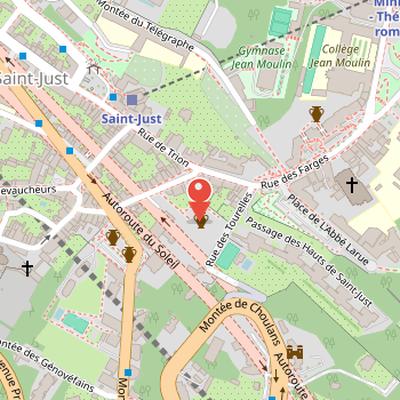
Nearby Objects
-
 Montée de Choulans 150 m away
 -
 Church of Saint-Just 200 m away
 -
 Saint Irenaeus Church 300 m away
 -
 Lycée de Saint-Just 300 m away
 -
 Jardin des Curiosités 350 m away
History of Basilique Saint-Just
Basilique Saint-Just, also known as basilique Saint-Just des Macchabees, was one of the oldest and most powerful churches in the city until it was destroyed during the Wars of Religion. Rebuilding began in 1565, when the church was restored inside the city walls under the name eglise Saint-Just. These changes mark an important phase in the building's history, linking its earlier religious prominence with its later reconstruction.
Historical Development of Saint-Just
The basilica of Saint-Just stands on a site that, in Antiquity, formed part of the necropolis southwest of Lugdunum. Histoire notes that a funerary basilica was established there because of the veneration of early Christian tombs, and that three basilica buildings of different sizes successively occupied the site. The nearby Saint-Irene church was built in the same era.
The church was first dedicated to the Maccabean brothers, Jewish heroes of the 2nd century BCE, before later being dedicated to Saint-Just, a martyr of Lyon who died as a hermit in Egypt. According to the facts provided, the bodies of Saint-Just and his disciple Viateur were transferred inside the church walls in the 4th century. A text by Bishop Adon of Vienne from the 9th century confirms this change of dedication, and Sidoine Apollinaire described a grand ceremony honoring Saint-Just in 469 in his Letters.
The building history continued in the early medieval period. Bishop Saint Patient of Lyon directed construction of the second church around 475, and during the Carolingian era the church was managed by a chapter of about twenty canons. It underwent significant restoration and repairs in the 9th century. In 868, Saint-Just and Saint-Irene were served by the same community of twenty canons, a shared arrangement that continued until the 11th century, likely until Archbishop Hugues de Die created a regular chapter at Saint-Irene.
The chapter rebuilt the church in the 13th century, when the collegiate church was Lyon's second largest after the primatial Saint-Jean cathedral. From that period onward, the head of the chapter was the abbot, although over time the obedienciarius became the true leader, assisted by a sacristan, choir master, and provost with judicial authority. From 1290, the Archbishop of Lyon always held the title of Abbot of Saint-Just. The church and the religious complex around Saint-Irene and Saint-Just are enclosed by a wall distinct from Lyon's city wall.
A Site of Papal and Royal Events
Saint-Just was closely linked to several major political and religious events. Pope Innocent IV lived in the cloister of Saint-Just for seven years, from 1244 to 1251. During his time in Lyon, he excommunicated the German emperor Frederick II at the first council of Lyon in 1245, received William of Holland as Frederick II's successor, and blessed Saint Louis and his brothers in 1248 before their seventh crusade. The site also hosted later papal ceremonial life, as Pope Clement V was crowned at Saint-Just after his election in Perugia in June. Beyond papal history, the church received visits from Louis XI in 1483, Marguerite of Austria, and Charles VIII and Anne of Brittany in 1497. Louise of Savoy stayed at Saint-Just for two years while her son Francis I was imprisoned. The suburb was later captured by the troops of Baron des Adrets on the night of May 28 to 29, and Saint-Just fell the following day.
Ruins and Archaeological Rediscovery
The basilica was destroyed by Protestants in 1562. Its stones were reused in other buildings, while ruins remained as a new church was built nearby. The remains were rediscovered during construction excavations in the 1970s at 13 rue des Macchabees. Archaeological work took place on the site between 1971 and 1974, and again between 1978 and 1980. After these excavations, only the bases of walls, no more than half a meter high, were left visible. Today, red and yellow signage presents the plan of the first two churches, based on the excavation results. The site was classified as a historic monument in 1984.
Origins and Early Development
The various buildings associated with the Basilique Saint-Just de Lyon originate from a Roman mausoleum linked to an important figure in the ancient Christian community of Lyon. Excavations uncovered a small mausoleum with an apse measuring 8 meters by 6 inside the walls of later churches. Numerous coins were found in the mausoleum, probably left as offerings. The structures are dated to the 4th century CE. A crypt was later built on the site of the Roman mausoleum, and only very few remains survive from the first church constructed shortly afterward.
Architectural Development of the Basilica
The site of Basilique Saint-Just de Lyon preserves the remains of several successive churches. The first church was probably a rectangular building with three naves. A second church was then built over it and enlarged the complex. This later phase added a transept, a new polygonal apse placed farther east, galleries along the nave, and various annexes. Beneath the high church, four rectangular vaulted crypts were constructed. Transformations to this second church probably took place in the 6th century.
In the 11th century, a third church was reconstructed in the Romanesque style. This version of the basilica appears on the 1550 scenographic plan of Lyon preserved in the Lyon municipal archives. It was a large building with two bell towers on the facade and a projecting transept. Excavations also showed that radiating chapels and an ambulatory had been planned, but these elements were never built.
After the excavations, the city of Lyon purchased the site and turned it into an archaeological garden. The place is open to the public and today contains low wall remnants, generally less than half a meter high. Changes in height between the street and the ruins illustrate the evolution of ground level from the 4th century to the present day. Red and yellow blocks indicate the positions of the first two churches, whose walls have disappeared. A fresco on a neighboring house wall shows the basilica as represented on the 1550 scenographic plan.
Excavations and Burial Remains on Rue des Macchabees
Several excavation campaigns along Rue des Macchabees uncovered burial remains linked to different periods. In 1903 and 1904, construction work at number 18 brought to light sarcophagi. Later, between 1950 and 1951, sewer installation in the center of Rue des Macchabees revealed a Merovingian necropolis. This site included four trapezoidal sarcophagi and two Christian epitaphs. Elements found further south suggested the presence of a High Middle Ages necropolis. Additional discoveries included two monolithic sarcophagi in front of numbers 62 and 64 Rue des Macchabees. At number 82, multiple sarcophagi and an amphora were associated with the Paleochristian necropolis of Saint-Irenee. Together, these finds indicate a long funerary use of the area.