The Church of Saint-Just is a religious building in Lyon, in the 5th arrondissement on the right bank of the Saône. It stands inside the city walls, about 200 meters from the original basilica Saint-Just, in an area associated with the Roman city and the Fourvière district. The building is near rue des Farges, Place des Minimes, the Jardin des Curiosités, the antique baths of Lyon, and the seminary of the Catholic University of Lyon. It is also part of the parish Saint-Irénée-Saint-Just, where masses are generally held in the church of Saint-Irénée.
The present church is a 19th-century reconstruction of the old basilica Saint-Just, which was destroyed during the Wars of Religion. The earlier basilica was originally dedicated to the Macchabées and later to Saint Just of Lyon, a 4th-century bishop of the city. The current building holds the status of a collégiale and reflects both dedications in its names. Construction began in 1565, with a first mass celebrated at Christmas that year, but progress slowed because of a lack of funds. The sanctuary was consecrated in 1591 and the work was completed in 1663. The façade was built in the 18th century in a neoclassical style by Ferdinand-Sigismond Delamonce. The church has been classified as a historical monument since 1977.
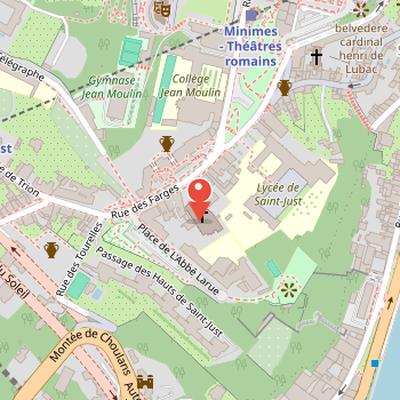
Nearby Objects
-
 Lycée de Saint-Just 120 m away
 -
 Jardin des Curiosités 160 m away
 -
 Basilique Saint-Just de Lyon 200 m away
 -
 Odeon of Lyon 300 m away
 -
 Montée de Choulans 300 m away
History and Status of the Church
The Church of Saint-Just is a religious building in Lyon, in the 5th arrondissement of the Rhone. It is a 19th-century construction that was created after the destruction of the basilica Saint-Just in Lyon. The new building was erected inside the city walls, approximately 200 meters from the original basilica site. The earlier basilica had first been dedicated to the Macchabees and later to Saint Just of Lyon, who was bishop of the city in the 4th century. The Church of Saint-Just holds the status of a collegiale and reflects both dedications in its names. It has been classified as a historical monument since 1977.
Location and Parish Context
The Church of Saint-Just is situated on the right bank of the Saone river in Lyon, within the area corresponding to the city of the Roman era, including the Fourviere district. It stands near 41 rue des Farges, on the south side of the street, about 600 meters below and south of the Basilica of Fourviere. The site is also close to Place des Minimes, Jardin des Curiosites, the antique baths of Lyon, and the university seminary. The antique baths are located on the north side of rue des Farges. The church belongs to the parish of Saint-Irenee-Saint-Just, where masses are generally held in the church of Saint-Irenee.
Reconstruction and Later History
The current Church of Saint-Just is the reconstruction of the old Saint-Just basilica, which was destroyed during the Wars of Religion. According to Histoire, the rebuilt church stands inside the city walls, about 200 meters from the original site, making it one of the few known examples of a church reconstructed at such a distance from its former location. The relocation was intended to protect the church behind the city walls, and it was also linked to a Lyon municipal project that planned to demolish the basilica for a fortress.
Construction began in 1565. Progress was initially rapid, and the canons of Saint-Just were able to celebrate mass at Christmas 1565. Work then slowed because of a lack of funds. The sanctuary was consecrated in 1591 by Archbishop Pierre IV d'Epinac, and construction was completed in 1663.
The facade was added in the 18th century in a neoclassical style by Ferdinand-Sigismond Delamonce, who later left the site for Sainte Camille church in Vaise. In recent years, the collegiate was entrusted by the Diocese of Lyon to the Fraternity of Saint-Pierre, which had previously been based in the Church of the Immaculate Heart of Mary in Villeurbanne before that church was demolished in 2016.
Facade and Setting
The Church of Saint-Just stands about fifteen meters back from the street, set between two buildings and forming a small square in front of it. A non-public passage lies to the left of the facade and leads to the university seminary. From the public space, the facade is the only visible part of the building and the only element with decorative interest. The walls are made of raw golden stone and have no sculpture or ornament. The facade was designed by Jean Delamonce in 1704, and construction was completed by Ferdinand Delamonce in 1711.
Interior Decoration and Artistic Program
Inside the Church of Saint-Just in Lyon, several decorative and artistic elements reflect its layered history. Jean-Francois Legendre-Heral remade statues that had been destroyed during the Revolution, completing this work in 1828. On the left side is a statue of Saint Just, with a bas-relief below showing the translation of his relics to Lyon. On the right side is a statue of Saint Irenee, with a bas-relief of his martyrdom below. In 1831, Pascal Gay built the triumphal arch and the main altar.
The church also preserves stalls and a pulpit from the 17th century, as well as portraits of bishops of Lyon buried in the former basilica Saint-Just. In the choir, there is a collection of 18th-century French paintings, including the Annonciation by Hyacinthe Collin de Vermont, the Nativite by Hughes Taraval, and the Adoration des mages by Bon Boullogne. The stained glass windows, dating from the 20th century, depict the life of Saint Just and early Christianity in Lyon.
The triumphal arch has medallions representing Christ and his witnesses, including Saint Just, Saint Luc, Saint Jean, Saint Matthieu, Saint Marc, and Saint Alexandre. These medallions were poorly restored in the 1960s.
Liturgical Practice and Music
The Church of Saint-Just in Lyon maintains a liturgical life centered on Latin offices and sacraments celebrated according to the Tridentine rite, also called the Extraordinary Form. Sunday masses and all Lyon solemnities are celebrated in the ancient Lyonnaise rite. At the grand mass, a choir performs Gregorian proper, polyphonic motets, and traditional hymns. The church also uses a grand organ located behind the main altar, built by Merklin and Kuhn in 1921. This organ is played at all masses.