Saint Irenaeus Church is located in the Saint-Irénée district on the heights of Lyon. Its lower part is considered one of the oldest in France, and its crypt dates from the Carolingian era. The building was rebuilt and completed in 1830, and it is one of the few monuments of the Upper Middle Ages partially preserved in elevation. The church was classified as a historic monument in 1862. In 2021, its calvary and Way of the Cross were also inscribed as historic monuments; they are installed on a terrace behind the church overlooking Lyon.
The site has a long archaeological history. It is built on a Roman necropolis west of the city of Lugdunum, active from the Roman High Empire to the Middle Ages. Excavations carried out in 2000 on Saint-Irénée square uncovered numerous Roman and paleochristian graves, complementing earlier digs from the 1970s and 1980s, as well as investigations in 1950–51 nearby. The church is also linked to the memory of ancient mausoleum remains and the development of local cults associated with martyrs Alexandre and Épipode.
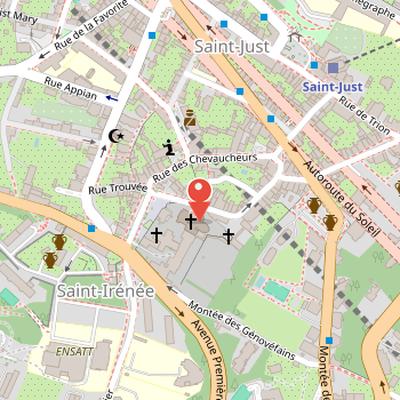
Nearby Objects
-
 ENSATT 250 m away
 -
 Basilique Saint-Just de Lyon 300 m away
 -
 Montée de Choulans 300 m away
 -
 Fourvière Hôtel 450 m away
 -
 Church of Saint-Just 500 m away
History and Heritage
Saint-Irenee Church is located in the Saint-Irenee district on the heights of Lyon. Its lower part is one of the oldest in France, and its crypt dates from the Carolingian era. The church was rebuilt and completed in 1830, and it is one of the few Upper Middle Ages monuments partially preserved in elevation. It was classified as a historic monument in 1862. In 2021, the calvary and Way of the Cross associated with the church were inscribed as historic monuments. These elements are installed on a terrace behind the church overlooking Lyon.
Roman and Early Christian Layers
Saint Irenaeus Church stands on a site with a long funerary and religious history. The area was part of a Roman necropolis west of the city of Lugdunum, active from the Roman High Empire through the Middle Ages. This necropolis extended across the present Trion district to the old basilica of Saint-Just. Archaeological work has confirmed this background: excavations in 2000 on Saint-Irenee square uncovered many Roman and paleochristian graves, adding to earlier digs carried out in the 1970s and 1980s south of basilica Saint-Just and in 1950-51 on Macchabees street, next to the church.
Several sarcophagi from this period remain visible outside the church, against the enclosure wall, and may have been brought there after being unearthed since the 19th century. The most important object found in the area is the Triumph of Bacchus sarcophagus, first discovered in 1824 by Ambroise Comarmond and exhumed again in 1845. It was soon transferred to the Lyon Museum of Fine Arts and is now displayed at the Lugdunum Museum. Other, less important 4th-century sarcophagi were left on the site.
The church is also linked to an ancient mausoleum that contained relics of unknown origin in the last third of the 4th century. These relics likely contributed to the emergence of the local martyrs Alexandre and Epipode. According to Histoire, the distribution of precious martyr dust described in homily 55 of Eusebius Gallicanus' collection was practiced here at the end of the 4th century. The building was constructed near or on the crypt of these two martyrs, and it may initially have been intended for private devotion to Alexandre and Epipode before the official public cult of Irenaeus began in the early 5th century.
The Mosaic of the Crypt
A mosaic was installed during the construction of the crypt between 450 and 490. It was destroyed in 1562 by the Protestants. The mosaic carried a text beginning with an unspecified phrase. Some believe this text predates the crypt and dates to the time of Sidonius Apollinaris around 450. Others believe it was written at the time of construction and do not confirm attribution to Bishop Patiens. It is probable that Bishop Patiens undertook the construction between 450 and 490.
Early History and Architectural Development
According to the history of the church, a building dedicated by Archbishop Avitus of Vienne under the patronage of Saint John the Baptist stood on the site in the early 6th century. That original structure had a large transept and a vast crypt, features described as characteristic of the Renaissance of the late 5th and early 6th centuries. It also showed similarities to the funerary basilica of Saint-Laurent de Choulans, suggesting a possible common architect. Today, only one arch remains from this first building.
Gregory of Tours, who lived in Lyon between 551 and 573, described the crypt as containing the relics of Saint Irenaeus, Alexander, and Epipodius. The crypt also had a lower altar that allowed eucharistic celebration on the martyrs' tombs, a practice later forbidden by the second Council of Braga, although it was supported by Saint Augustine and Isidore of Seville. In the first half of the 7th century, the building had an apse west of the crypt with a polygonal exterior and rectangular interior, and the restoration of the apse and the access to the crypt is attributed either to Bishop Arigius or to Ennemond.
Further medieval developments are recorded in the Histoire of the church. In the mid-9th century, Bishop Barthhelemy of Narbonne donated relics that were placed in the middle of the nave under the altar above the well of the martyrs. In 868, a community of canons common to Saint-Just and Saint-Irenee was established by Bishop Remigius. A later restoration campaign reduced the church to the choir of the old building, with an oblique-axis crypt having three vaulted naves, and a facade wall was built on the stair descent. The church later became the family necropolis of the first house of the counts of Forez after the donation of Count Artaud after 993.
Damage, Restoration, and Later Additions
Saint Irenaeus Church was severely damaged in 1562 during the Wars of Religion, when Protestant troops of baron des Adrets devastated the building, stole relics, and damaged the facade. The crypt was also nearly destroyed in the same year. Restoration began later, in 1584 for the church and in 1635 for the crypt. In 1687, a first calvary was erected behind the choir, but it was destroyed in 1793 during the French Revolution, when the church itself was converted into a hayloft and gradually abandoned. Interest in the site revived in the 19th century with the cult of saints, leading to the rebuilding of the church in 1824 in its current form and the renovation of the crypt in 1863. The calvary was rebuilt between 1814 and 1817 with Carrara marble statues and restored again by Joseph-Hugues Fabisch in 1868. A fourteen-panel stations of the cross was also added in the 19th century. The church and crypt were classified as historic monuments in 1862.
Architecture and Setting
Saint Irenaeus Church, also described as the Eglise et paroisse latine, stands at the corner of rue des Macchabees and place Saint-Irenee. Its upper church was built in the 19th century in a neoclassical style with Byzantine elements. The crypt is much older, dating from the 6th century, and was restored in the 20th century. It also contains elements from the 3rd century, including at least one arch. The church faces an inner courtyard rather than the street or square, and this courtyard contains Roman-era sarcophagi. The courtyard is enclosed by a wall opened in two places to the street and the square, and it surrounds the church, a calvary, and the parish house. The Catholic church also adjoins a Byzantine Rite Catholic Christian church.
Stained Glass, Organ, and Burial Spaces
The upper church of Saint-Irenaeus Church contains stained glass and statues produced between 1824 and the early 20th century, showing a long period of decorative development. In 1828, the parish commissioned Jean-Francois Legendre-Heral to sculpt Saint-Jean, Saint-Paul, Saint-Just, Saint-Irenee, and Le Martyre de Saint-Irenee. The nave stained glass presents the early Christian history of Lyon and portraits of the martyrs Saint Irenee, Sainte Blandine, Epipode, and Alexandre de Lyon. Later, in 1901, Lucien Begule was commissioned to create eight lateral nave stained glass windows devoted to the martyrs of Lyon, including Saint Pothin and Saint Irenee. Together, these works emphasize the church's connection to local martyr tradition and Christian memory.
The organ, built in 1855 by the Alsatian maker Claude-Ignace Callinet, has two 54-note keyboards, a 30-note pedalboard, and 17 stops. It was modified in 1885 by Carlen and Abbey of Brigue, Switzerland, and moved the same year from the tribune above the entrance door to its current place on the north side of the choir. The instrument received periodic maintenance, including work in 1987 by Jean Francois Dupont of Pont-l'Eveque, and it was restored in 2018 by the Lyonese maker Michel Jurine. Its titular organist in the early 1930s was Adrien Rougier.
The crypt and burial areas also form an important part of the site. The crypt walls date from the Carolingian period and were decorated during the 1863 restoration, while the corridors date from the Early Middle Ages. The church houses the tomb of Saint Irenee alongside Epipode and Alexandre de Lyon, and it contains an ossuary adjacent to the crypt holding collected bones. Two tunnels provide entry and exit to the crypt. The site also bears traces of disturbance: in 1562, during the Wars of Religion, the baron des Adrets desecrated the tombs and dispersed bones. Archaeological work has continued to reveal the depth of the site, including choir walls dated to around the 1st century, uncovered in 2022, and ongoing excavations under the altar as of 2024 in search of the remains of Saint Irenee.
The Calvary and Way of the Cross
The calvary of the Latin parish church dates from the 16th century and stands behind the choir on a hillside overlooking the Saone river. Its altar has three crosses representing the 10th station of the Way of the Cross, and it is surrounded by angels in adoration and cippi. Beneath the altar is an underground chapel, originally a chapel before its conversion into a funerary chamber. This lower space contains a funerary vault and a recumbent Jesus Christ representing the 11th station. The 16th century Way of the Cross comprises fourteen panels and surrounds the exterior choir of the church, with two panels placed in a stone shrine flanking the calvary. It also formed the end of an urban route that began at the former Sainte-Croix church of Lyon.
Byzantine Rite Use of the Former Chapel
Since 1991, the Paroisse byzantine Saint Irenee has used the former chapel of Refuge Saint Michel des Soeurs du Bon Pasteur. The parish celebrates liturgy according to the Byzantine rite in French and Slavonic. Its chapel was consecrated after two years of work, marking the completion of its adaptation for worship.