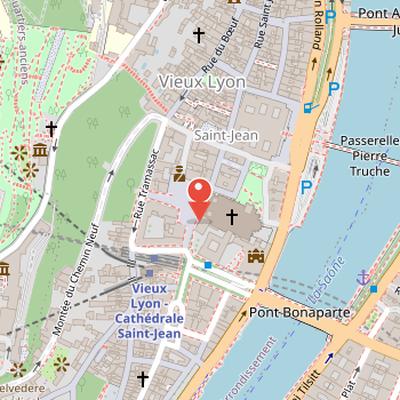
Manécanterie is a monument historique in Lyon, in the Saint-Jean district, attached to the south-southwest of Saint-Jean Cathedral. It belongs to the former cloister of the cathedral and was initially used by the canons of Saint-Jean before later becoming a manécanterie, a school for clergy singing. The building is considered the oldest in Lyon outside Roman buildings, although few texts give a precise date for its construction.
Historical sources mention a cloister for clerics in a letter from Archbishop Leidrade to Charlemagne around 810, while archaeomagnetic study has suggested that the bricks of the first construction date from around the year 800. Excavations also showed that the building rests on 1st-century constructions. The current structure is understood as the result of three construction campaigns. The oldest known part dates from the 13th century, and the south facade monumental arch is probably contemporary with Leidrade’s letter. The west facade is Romanesque, with sculptures from the early 13th century, and the building combines Gothic, Romanesque, and Byzantine influences.
Nearby Objects
-
 Lyon Cathedral 40 m away
 -
 Maison du Chamarier 120 m away
 -
 Musée Miniature et Cinéma 150 m away
 -
 Palais de justice historique de Lyon 200 m away
 -
 Montée Saint-Barthélemy 250 m away
Location and Historical Use
The Manecanterie is a monument historique located in Lyon, in the district of Saint-Jean. It is attached to the south south-west of the cathedral Saint-Jean and forms part of the former cloister of the cathedral. The building initially served the canons of Saint-Jean. It later became a manecanterie, meaning a school for clergy singing.
Origins and medieval development
La Manecanterie is located south of the cathedral Saint-Jean and is described by Histoire as the oldest building in Lyon outside Roman buildings. Its foundations have never been reached for archaeological analysis, and few texts specify its construction date. A letter from Archbishop Leidrade to Charlemagne, written around 810, mentions a cloister for clerics and suggests that no common house for canons existed before then. A 1995 archaeomagnetic study supports an early date by indicating that the bricks of the first construction were made around the year 800.
Histoire suggests that the present building resulted from three construction campaigns. Excavations revealed that it rests on 1st-century constructions, while the oldest known part of the building dates from the 13th century. This oldest part is associated with a larger building created when the Saone branch that formed Ile Saint-Jean was filled in. That earlier building was destroyed by fire in the 15th century. The south facade monumental arch is probably contemporary with Leidrade's letter and belonged to the common living building of the canons. Throughout the Romanesque period, this arch housed the canons' refectory. Histoire also notes that no texts record later modifications to the building.
Facade and Historical Changes
The Manecanterie presents a style that combines Gothic, Romanesque, and Byzantine influences. Its west facade is dated to the Romanesque style, while the sculptures belong to the early 13th century. The decor of the west facade door is compared with that of the apse of the basilica Saint-Martin d'Ainay. The facade includes statues of saints set in rectangular niches, representing the disciplines that were taught. The building underwent transformations throughout the late Middle Ages and the Modern Era, linked to the raising of the roadway of Saint-Jean square. Its sculpted figures were damaged in 1562, when troops of François de Beaumont vandalized the Manecanterie during the Protestant capture of Lyon.
Architectural Changes and Historical Uses
The history of the Manecanterie is recorded through early references and later architectural changes. The oldest representation of the building appears in the Histoire records, while the south building adjoining it is shown on the Anonyme Fabriczy document dated 1568-1572. In those records, this south building is identified as the domus puerorum, which was later destroyed in 1809. The Manecanterie itself underwent major modifications in the 17th century, including the opening of new windows, the addition of a floor, and the filling in of some arches.
The lower hall of the building is identified in the Histoire as the grande salle des clergeons, and cellars were located beneath it. By the 18th century, the building had become a manecanterie. The Histoire also notes that the south and east wings of the small cloister were destroyed in 1768 in order to build the Nouvelle Manecanterie, while the west wing was temporarily preserved after that demolition. Construction of the Nouvelle Manecanterie later stopped during the French Revolution. After this period, the Vieille Manecanterie became national property and was sold to private owners.
From Choirboys' Residence to Museum
According to Histoire, the parish purchased the building in 1806 to house choirboys. The south building was destroyed in 1809 to make way for a rental property, which itself was later destroyed in 1866. The building was classified as a historical monument by list in 1862. From 1930 onward, it housed the cathedral treasury museum of Saint-Jean, which contained liturgical objects collected during the 19th century by the cardinals Fesch and de Bonald.
The Cathedral Treasury
The Tresor de la cathedrale is managed by the Centre des monuments nationaux and the Conseil departemental du Rhone. It was formed by two archbishops of Lyon, Cardinal Fesch and Cardinal de Bonald. The treasury holds a collection of liturgical objects dating from the Byzantine era. Its exhibits include goldsmithery, ancient books and missals, Limousin enamels, clothing, and tapestries.