Salle Rameau is a municipal hall in Lyon, in the Terreaux quarter on rue de la Martinière. It was inaugurated in 1907 as a performance hall and was built in just over one year in the Art Nouveau style. The hall was conceived after the closure of the quai Saint-Antoine philharmonic hall, with the aim of hosting the Société musicale created by Georges Martin Witkowski. Lyon owned the plot and ceded land to a real estate company for construction while retaining ownership of the new building; the company received a 60-year management lease. The first stone was laid in spring 1907 by President Armand Fallières and Council President Georges Clemenceau. The hall was inaugurated by the Société des grands concerts de Lyon, whose orchestra numbered more than 200 musicians, with a program including works by Jean-Philippe Rameau and Ludwig van Beethoven. Salle Rameau was one of the first concert halls in France specifically intended for symphonic music. After serving as a performance hall, it became a brasserie and later a billiard hall. Closed and requiring major renovation, it was entrusted in the 2020s to a firm for renovation and reuse as a performance hall.
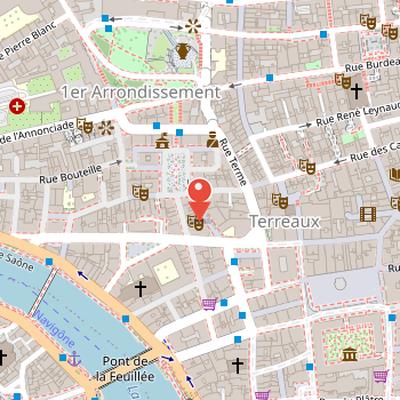
Nearby Objects
-
 Place Sathonay 90 m away
 -
 Rue Sainte-Catherine 200 m away
 -
 Rue des Capucins 200 m away
 -
 Rue Lanterne 200 m away
 -
 Fontaine Bartholdi 200 m away
From Performance Hall to Reuse
Salle Rameau is a municipal hall in Lyon, in the quartier des Terreaux on rue de la Martiniere. It was inaugurated in 1907 as a performance hall. After this first use, it became a brasserie and later a billiard hall. The hall had no stable occupation in the second half of the 19th century. In the 2020s, it was entrusted to a firm for renovation and reuse as a performance hall.
Construction and early history
Salle Rameau was created after the closure of the quai Saint-Antoine philharmonic hall for security reasons, when Historique sought a new concert hall for the city of Lyon. The project was also intended to host the Societe musicale created by Georges Martin Witkowski. Lyon owned the plot between rue Hippolyte-Flandrin and rue Louis-Vitet, at the location pierced by rue des Auges, and the Municipal Council approved an agreement between the city and the real estate company. The city ceded the land for construction but kept ownership of the new building, while the company received a 60-year management lease to help cover construction and installation costs.
The first stone was laid in spring 1907 by President Armand Fallieres and Council President Georges Clemenceau. The real estate company was directed by Lyon architect Francois Clermont, and the architects Francois Clermont and Eugene Ribout built 25 buildings on rues de la Martiniere, Thimonnier, and Louis Vitet. The concert hall itself was completed in just over one year in the Art Nouveau style. At the time of construction, it had a seating capacity of an unspecified number. The sculpted decorations on rue de la Martiniere were assigned to Maurice Penelle, and the interior decorations were assigned to the decorator Flachat.
History and Renovation of Salle Rameau
Salle Rameau was inaugurated by the Societe des grands concerts de Lyon orchestra, which brought together more than 200 musicians. Its first program included l air des Fetes d Hebe by Jean-Philippe Rameau and the Ninth Symphony by Ludwig van Beethoven. The hall was one of the first concert halls in France created specifically for symphonic music, which gives it a notable place in the history of concert venues. After a period of closure, the building required major renovation before it could reopen. In 2019, Compagnie de Phalsbourg signed a 60-year emphyteutic lease with the city of Lyon to renovate and operate the site. The reopening, originally planned for 2021, was postponed to 2024 because of the covid-19 crisis. The renovated building is scheduled to include a performance hall for 900 people, a solidarity canteen, and a stage for local bands.
Faacade and Decorative Program
The architecture of Salle Rameau was delegated to Eugene Riboud, with work shared among multiple artists and artisans. The sculpted decoration of the galleries was assigned to Flachat, while Penelle was responsible for the pediments. The facade on rue de la Martiniere was decorated with two mosaics by Mangier and Guillermin, including representations of Polymnie and Euterpe. It also features two sculpted heads surrounded by flowers, one dedicated to eloquence and the other to music, along with four composite order columns. Above the windows, the facade is enriched with numerous sculptures of castles, towers, and cornucopias. The curved part of the facade displays the Lyon coat of arms and the poem by Clement Marot, which reads: "suis le lion qui ne mord point, sinon quand l'ennemi me poingt". Furniture was sourced from the grands magasins des Cordeliers.