The Basilica of Saint-Martin d'Ainay is an ancient Romanesque former abbey church located in the Ainay district on the Lyon peninsula. It is classified as a historical monument by the 1840 list and was elevated to the rank of basilica in 1905. The church is one of the few preserved Romanesque churches in Lyon. Its central apse and apsidiole were worked on by Hippolyte Flandrin in 1855.
According to Histoire, the origins of Ainay Abbey were presented through several traditions, including a foundation connected to the discovery of the remains of the martyrs of Lyon and another legend attributing the abbey to a hermit named Badulphe. Histoire also notes that no attested trace of the abbey exists before the 9th century. The monastic establishment later became an abbey, and major construction began at the end of the 11th century under Abbot Josserand de Foudras. The abbey church was dedicated on October 8, 1107, under the patronage of Saint Martin by Pope Paschal II.
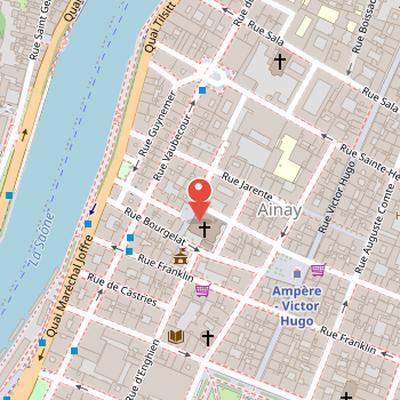
Nearby Objects
-
 Saint-Marc Lycée 200 m away
 -
 Rue Victor-Hugo 200 m away
 -
 Les Rails de la Mémoire 300 m away
 -
 Place Carnot 300 m away
 -
 Lycée Juliette Récamier 350 m away
Historic Status and Later Decoration
The Basilica of Saint-Martin d'Ainay is an ancient Romanesque former abbey church located in the Ainay district on the Lyon peninsula. It was classified as a historical monument in the 1840 list, reflecting its recognized heritage value. In 1905, it was elevated to the rank of basilica. Later work also affected its interior, as Hippolyte Flandrin worked on the central apse and apsidiole in 1855.
Origins, Growth, and Medieval Importance
Histoire presents the basilica as an institution with both legendary and documented origins. According to the monks of Ainay Abbey, it was founded on the basis of Gregory of Tours' writing in the 2nd century, at the site where the remains of the martyrs of Lyon were discovered. The tradition included a bag of ashes and a stone on which Pothin of Lyon allegedly placed his head. However, recent historical works treat this origin with skepticism because of the imprecision of Gregory's text and the difficulty of identifying Ad Athanacum. Another tradition places the discovery of the martyrs' remains at Saint-Nizier, while a further legend says Ainay Abbey was founded by a hermit named Badulphe and dedicated to Saint Martin of Tours. In any case, Histoire notes that no attested trace of the abbey exists before the 9th century.
A text from 859 mentions Charles of Provence approving the foundation of a monastery at Cessieu by Aurelian, abbot of the royal Ainay monastery, and the monastery was described as abandoned that same year. Histoire also records the foundation of a Benedictine priory on the Lyon peninsula in 859. The abbey played a central role in the celebration of the Fete des Merveilles attributed to Saint Badulphe, and it celebrated Saint Pothin and the martyrs on January 2, a day counted among the greatest solemnities of the monastery.
At the end of the 11th century, the establishment was elevated to abbey status and major construction began under Abbot Josserand de Foudras. The abbey church was dedicated on October 8, 1107, under the patronage of Saint Martin by Pope Paschal II, and on the same day an altar was consecrated to the Conception of Notre-Dame. Histoire identifies this church as one of the few preserved Romanesque churches in Lyon.
In the 13th century, at the First Council of Lyon under Saint Louis and Pope Innocent IV, the abbey was recognized as preeminent over 71 churches, abbeys, and priories from Burgundy to Provence. Its influence extended through affiliated houses such as the priory of Saint-Jean de Geneve, which collected tithes, owned lands, and held authority over parishes between Pays de Gex, Genevois, and Faucigny. Histoire describes Ainay Abbey as one of the most powerful abbeys in the Kingdom of France, and notes that Abbot Jean II de la Palud built a palace within the monastery between 1313 and 1324.
From Abbey to Parish Church
During the Renaissance, the site possessed a port, an abbot's palace, and important buildings with a cloister, garden, and vineyard. Its monastic life weakened after the king began appointing commendatory abbots in 1504, and land was sold as new neighborhoods developed on parts of the property. The buildings suffered severe damage in 1562, when troops of Baron des Adrets partly destroyed them during the religious wars; the cloister was razed, the church devastated, and the archives burned.
The site nevertheless continued to host notable visitors. King Henri IV stayed there in 1600 during his marriage with Marie de Medici in Lyon Cathedral. Louis XIII also stayed at the site with Minister Richelieu, and Louis XIV lodged there four times. In the later 17th century, the monastery had disappeared. Camille de Neufville de Villeroy, appointed commendatory abbot at the age of five and later consecrated archbishop of Lyon in 1653, obtained the secularization of the site in 1685. That same year, the remaining church and buildings were entrusted to a secular chapter.
The church was later adapted to changing urban and religious conditions. Between 1723 and 1769, the chapter decided to subdivide the perimeter of the property in order to value the land. On August 21, 1764, the church became parochial and lost the title of abbatial church. During the Revolution, the monastery was confiscated and the abbot's palace was razed, while the church was converted into a grain store, which prevented its destruction. It was reopened to the faithful in 1802. The church was classified as a historical monument in 1844 and restored in the 19th century in a neo-Romanesque style by Pollet and Benoit, who worked in a purely Romanesque spirit, destroyed the last traces of the cloister, and added collateral chapels. A mosaic found near the main altar in 1851, showing a cleric presenting a church model, is described as the only medieval mosaic discovered in Lyon in the 19th century. The former abbey church, later the parish church Saint-Martin d'Ainay, was elevated to a minor basilica by Pope Saint Pius X on January 27, 1905.
Architectural Layers of the Basilica
The Basilica of Saint-Martin d'Ainay presents several architectural periods while preserving a unity of style. Its main structure is Romanesque, with additions in the Neo-Romanesque style that restored and expanded the building. The basilica also includes pre-Romanesque and Gothic elements, notably in its chapels.
The tower in the facade is a clocher-porche fifty meters high. Its base was built with stones taken from antique monuments and dates to the 11th century. The door and ogival vault date from the late 12th century, and the tympan was made by Joseph-Hugues Fabisch in 1860. On the parvis, to the left of the door, there is a 12th-century bas relief that is a reproduction of the original, which is inside the basilica.
At the rear, two different chevets can be seen: the chapelle Sainte-Blandine and the chapelle Saint-Martin. The chapelle Sainte-Blandine is the oldest chapel and one of the last vestiges of the basilica in its ancient form. It has traces of an older chapel, but the current structure dates from the 11th century. It was vaulted and remodeled in the 12th century. The chapel consists of a chapel and a crypt and is built on a simple plan with a rectangular nave and a square choir covered by a half-dome. Its chevet is square-shaped and belongs to the early Middle Ages.
The chapelle Saint-Martin has a circular chevet built in the 12th century. The chapelle Saint-Michel, located on the site of the old Romanesque chapelle de la Conception Notre-Dame, was reconstructed just before 1485 and is in the Gothic Flamboyant style. It adopted the name Saint-Michel in 1690. Jacobe Razuret painted the chapel in 1899, Lucien Begule created three stained glass windows there in the late 19th century, and Joseph-Hugues Fabisch made carved panels on mosaic backgrounds for it from the Saint-Martin church pulpit.
Crypt, Columns, and 19th-Century Chandelier
The Basilica of Saint-Martin d'Ainay includes a crypt beneath the half-dome covering the choir. The crypt is decorated with a floor mosaic that includes the names of the Lyon martyrs, and it also contains two niches for relics and a small altar. The building measures 37 meters in length, and the nave is 17 meters wide. At the transept crossing, four monolithic columns support the structure. These columns are made of gray granite, or syenite, possibly from Egypt. Lyon archaeology attributes them to the imperial altar columns in the federal sanctuary of the Three Gauls, and the column shafts were cut in two and reused in the basilica, with the northeast pillar connecting above the southwest pillar and the southeast pillar placed on the northwest pillar. The capitals of these columns are inspired by Antiquity, but are not antique.
The dome contains a chandelier dating from the 19th century. It is presented as a tribute to the Barberousse chandelier, which was commissioned and offered to Mary by Holy Roman Emperor Frederick Barbarossa in the 12th century and installed in Aachen Cathedral. The Lyon chandelier is made of gilded copper, enameled, and represents city walls and towers. The Ministry of Culture states that it was made around 1860 and given to the basilica by Ire9ne9e Chalandon in 1861.
The Organ Installations at the Basilica
The Basilica of Saint-Martin d'Ainay contains a history of organ building and later replacement that reflects several phases of installation. The Grand Orgue was made by Beaucourt and Voegeli between 1847 and 1850, then sold secondhand to the grande synagogue de Lyon in 1864. A choir organ was ordered from the Cavaillé-Coll manufactory in 1866 for 17,500 Francs and installed at the entrance of the chapelle Saint-Michel in 1867. This choir organ has two keyboards, 12 stops, and a 16-foot bourdon, and its case is made of Nordmann fir with linden wood sculptures. In 1890, a large organ by Joseph Merklin with three keyboards and 36 stops was installed in the nave. The gallery organ case dates from the old Cavaillé-Coll organ of 1867, while the nave organ case dates from the Merklin organ of 1890. Restorations were carried out by Michel, Merklin, and Kuhn in 1921 and 1938.