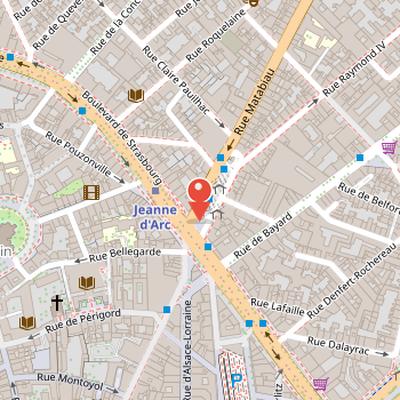
Place Jeanne d'Arc is a square in Toulouse, the capital of the Occitanie region in southern France. It lies south of the Matabiau and Les Chalets neighborhoods and marks the boundary between the Arnaud-Bernard and Capitole neighborhoods. The square is crossed by several streets, including Boulevard de Strasbourg, Petite-rue Saint-Lazare, Rue Matabiau, Rue Raymond-IV, and Rue des Moutons. It has one one-way automotive traffic lane running from rue Léon-Gambetta toward place de la Bourse and is located in a zone 30 with a speed limit of 30 km/h.
Since the 1970 creation of the bus station in its central space, the square has served as a major urban transport interchange for Tisséo. It is the terminus for several bus lines and is also served by the Jeanne d'Arc metro station on line B, in service since 2007. Nearby VélôToulouse stations are located at 32 boulevard de Strasbourg, 15 rue Joseph-Bosc, and 1 rue Raymond-IV.
Historically, the site was occupied by fields in the Middle Ages. A borough developed around the Saint-Sernin abbey in the 12th century, enclosed by ramparts with several gates. The Matabiau gate stood near the present boulevard de Strasbourg and gave rise to the first faubourg Matabiau. The square began to take shape in the early 19th century, after the city sought the demolition of the ramparts and architect Jacques-Pascal Virebent planned a boulevard with four rows of trees in 1815.
Nearby Objects
-
 Chapelle des Carmélites 250 m away
 -
 Basilica of St. Sernin 300 m away
 -
 École Supérieure d'Audiovisuel 350 m away
 -
 Porte Miègeville 350 m away
 -
 Cinémathèque de Toulouse 350 m away
Location and Context
Place Jeanne d'Arc is a street in Toulouse, the capital of the Occitanie region in southern France. Its identification as a street places it within the urban fabric of the city, linking it to the wider public space of Toulouse. The available information emphasizes its geographic setting rather than any architectural or historical details, situating it in one of the main cities of southern France.
Location and transport access
Place Jeanne d'Arc is a public street in Toulouse located south of the Matabiau and Les Chalets neighborhoods, at the boundary of the Arnaud-Bernard and Capitole neighborhoods. It functions as a major urban transport interchange for Tisseo, with a bus station occupying its central space since 1970. The site serves as the terminus for several bus lines, and it is also served by Linio and other buses stopping on or near Boulevard de Strasbourg. Since 2007, it has been served by the Jeanne d'Arc metro station on line B.
The street has one one-way automotive traffic lane running from rue Leon-Gambetta toward place de la Bourse and is located in a zone 30 with a speed limit of 30 km/h. It intersects with Boulevard de Strasbourg, Petite-rue Saint-Lazare, Rue Matabiau, Rue Raymond-IV, and Rue des Moutons. Nearby bicycle access is provided by several VeloToulouse free-service stations at 32 boulevard de Strasbourg, 15 rue Joseph-Bosc, and 1 rue Raymond-IV.
Early History of Place Jeanne d'Arc
The current location of Place Jeanne d'Arc was occupied by fields in the Middle Ages, outside the city. In the 12th century, a borough developed around the Saint-Sernin abbey and was surrounded by ramparts pierced by several gates. One of the most important of these was the Matabiau gate, located at the site in front of the present boulevard de Strasbourg. Several houses then appeared facing the gate, forming the first faubourg Matabiau. The name Matabiau may come from cattle slaughterhouses that existed in the northern countryside of Toulouse in the 13th century.
Formation of Place Jeanne d'Arc
The current square began to take shape in the early 19th century, within a broader urban project linked to the transformation of the faubourgs as population growth and industrialization accelerated. In 1806, the Toulouse municipality asked Emperor Napoleon I to declassify the city ramparts and authorize their demolition. An imperial decree of October 22, 1810, then ceded the ownership of the ramparts and moat materials to the city. In 1815, architect Jacques-Pascal Virebent planned a boulevard with four rows of trees forming a wide promenade, extending the Saint-Etienne alley, now the allées Forain-Francois-Verdier, to the Lascrosses gate in the north.
The site gained a more defined square in 1825, when the development of boulevard Matabiau, now boulevard de Strasbourg, cleared a small square facing the grande-rue Matabiau, now rue Charles-de-Remusat. At that time, the square was bounded to the east by rue des Moutons, which extended to rue du Faubourg-Matabiau, now rue Matabiau. A watering trough stood at the center of the square in 1825, and a weighbridge was built there in 1833. The growth of the faubourg Matabiau later followed railway construction and the opening of Matabiau station near the Canal du Midi.
By 1897, the municipality was concerned with enlarging place Matabiau by demolishing houses on rue des Moutons. In 1898, a decision was taken to erect a monument to the poet Peire Godolin and to demolish the watering trough and weighbridge, although the Godolin monument was eventually installed at place Lafayette, now place Wilson, instead of place Matabiau. The area also included the Modern Hotel and cafes such as cafe Matabiau where current structures now stand. On July 4, 1912, a monument to Jeanne d'Arc, by sculptor Antonin Mercie and cast by Barbedienne, was inaugurated beside the boulevard at market du Cristal, with thousands in attendance. In the 1970s, the square later became the site of a bus terminus.
The Monument to Jeanne d'Arc
The monument to Jeanne d'Arc was initiated in 1913 through a subscription organized by the Catholic newspaper L'Express du Midi. The statue was entrusted to the Toulouse sculptor Antonin Mercie. Its development was suspended during the First World War, then resumed in 1921 with the support of a private committee led by Samuel de Palaminy and Victor Lespine. The statue was cast in bronze by the foundry of Ferdinand Barbedienne.
The sculpted group rests on a high gray Vosges granite pedestal sculpted by Georges Mercie, the son of Antonin Mercie. Jeanne d'Arc is shown mounted on a horse and wearing knight's armor, standing on the stirrups. She holds the reins with her left hand and a banner with her right hand. Her face is turned toward the sky and she wears a laurel crown. The caparisoned horse is shown advancing in a parade attitude.